Advertisements
Advertisements
प्रश्न
Briefly comment on:
The author’s meeting with Norbu.
Advertisements
उत्तर
The author had almost lost hope and felt absolutely helpless as the town seemed so mundane with no pilgrims or visitors, despite it was the season of Kora. Only the locals were busy carrying their daily activities of playing pool or ladies washing their head in the icy water. It was all very disappointing for the author. Besides, now that Tsetan had also left, he wondered how will he be able to communicate with anyone in English. He was not prepared to complete the Kora on his own. He did not even know if the snow is cleared and had no body to answer him this simple question. The author was sitting in the café when a man walks up to him. Recognising the language in the book he is reading, he asks the author if he was English. The author reckoned that the man was not from the region as he wore a windcheater and metal-rimmed spectacles of a western style. The man told his name was Norbu and he worked in Beijing at the Chinese Academy of Social Sciences, in the Institute of Ethnic Literature. He as well had come to do the Kora. He had been writing academic papers about the Kailash Kora and its importance in various works of Buddhist literature for many years. They both were equally ill-equipped and were ideal companions for the expedition.
APPEARS IN
संबंधित प्रश्न
Answer any four of the following question in 30 – 40 words each:
(a) ''What a thunderclap these words were to me!'' (Franz). What were those words and what was their effect of Franz?
(b) Why did Douglas fail to come to the surface of the pool as he hoped to?
(c) What was Kamala Das's childhood fear?
(d) How is the Earth a source of life when all seems dead on it? Keeping Quiet)
(e) How does Mr. Lamb react when Derry enters his garden?
(f) Which problem did the Maharaja face when he had killed seventy tigers? How did he solve it?
On the basis of your understanding of the above passage, make notes on it using headings and subheadings. Use recognizable abbreviations (wherever necessary – minimum four) and a format you consider suitable. Also supply an appropriate title to it.
A1 Web :
Complete the following web with the help of the passage :
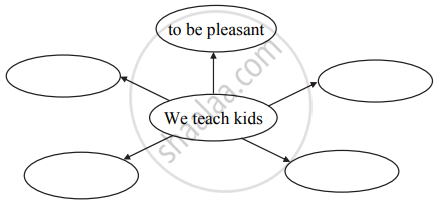
My dictionary tells me that personality is the “Personal or individual quality that makes one person be different and act differently from another.” Personality is, “the total physical, intellectual and emotional structure of an individual, including abilities, interests, and attitudes.”
There are many benefits to having a pleasant personality. There is only one opportunity to make a first impression, and all of us instinctively make decisions or judgments about an individual within the first few seconds of crossing paths. With that in mind, I believe when we teach our kids to smile, to be pleasant and cheerful, to be courteous and respectful of others, to pleasantly respond to requests or questions, we are helping them develop a personality that will open many doors for them. Once the doors are opened, the character will keep them open; but personality, not character, is on display in the first few seconds. Therefore, it’s important to develop a pleasant personality and use it for life.
A2 Personality :
Personality of an individual is recognized by :
(i) _______ (ii) _______
(iii) _______ (iv) _______
A3 Vocabulary :
Find out words for the following from the passage and write:
(i) polite =
(ii) relating to feelings =
(iii) to do anything naturally without thinking =
(iv) a chance to do something =
A4 Complete the following table :
| Noun | Adjective | Adverb |
| – | different | differently |
| Instinct | – | instinctively |
Select any word from the table and use it meaningfully in a sentence of your own.
A5 Personal Response :
Why do you thing, personality development is necessary?
What distinguishes the tribal imagination from the secular imagination?
What facet of political life does the behaviour of Ajamil illustrate?
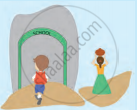
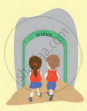
Which pictures reflect gender equality? Write their numbers.
Study the pictures below and note down the differences.
Doctors who do special advanced study of specific parts of the body have special terms.
In your group try to match the specialist doctors with who / what they treat.
| Specialists | Who/What they treat | ||
| 1. | Dentist | a. | bone |
| 2. | Cardiologist | b. | brain/with spine |
| 3. | Ophthalmologist | c. | small kids |
| 4. | Orthopedic | d. | teeth |
| 5. | Pediatrician | e. | animals/birds |
| 6. | Neurologist | f. | eye |
| 7. | Veterinarian | g. | heart |
Discuss with your partner the different ideas connoted by the word 'season'.
- _______________________
- _______________________
- _______________________
Refer to a good dictionary that carries phonetic transcriptions printed next to words. The word below is familiar to you. Copy the phonetic transcription from the dictionary and say it aloud as you write.
work ........
Use the following word/phrase to make a sentence of your own.
enthusiasm
Say WHY. . . . . .
Hardy invited Littlewood for a discussion.
Answer the following question in short.
What do you learn about Pundits of Vijaynagar?
Choose the odd one out :
Flute, Snug, Quince, Cobweb.
Explain the following statement with reference to the context.
Because your father can't do without my help.
Have you seen non-commercial advertisements - those that are not ‘selling’ anything but are only giving people useful information?
Answer the following question in one sentence.
What should human beings do in order to make progress?
‘Smart Answers’: Form a large group. Each person asks the next one a question to get him to say ‘yes’ or ‘no’. He/She can use appropriate statements, requests, or even other questions as a response. But if he/she says ‘yes’ or ‘no’, he/she is out. Otherwise, he/she continues the game. Questions cannot be repeated.
Write a few lines about each character.
Name the white and bright things mentioned in the poem.
Find out the following with the help of your teacher and the internet.
Seasonal Rains (monsoon) in India and other countries.
This story takes an unexpected turn when the lion decides to spare the camel’s life. Choose any fable, a story that you like, and rewrite it giving it an unexpected turn.
From the poem, find three lines that use comparisons.
• ______ • ______ • ______
Write the symbol that is used in the poem to represent the following idea.
Some other time.
There are many popular lines like:-
- ‘Life is a game - play it well’.
- ‘Life is a journey - keep going ahead’.
Discuss and write down a few such metaphorical lines about ‘life’. You can make them up yourselves.
- ____________________________
- ____________________________
- ____________________________
- ____________________________
- ____________________________
Present Mr. Wilson’s story as it would be shown in a comic strip. Write what picture you will show in each frame along with the dialogues. Write the dialogue with the help of the story. Examples:
 |
 |
 |
Who said the following, to whom, and when?
“He dwells within a cave of Himalaya.”
Who said the following, to whom, and when?
"Ah no, to thee I sing: he sings to God.”
The poem has rhyming words at the end of the lines. Find and write the pairs of rhyming words in each stanza.
Discuss the following in group.
Do’s and Don’ts for young children.
List the characters in the story and write a few lines about each of them.
Write in short how the travellers crossed the first ditch.
What did the Judge tell Ahmad?
What are search engines?
How is Karagattam performed?
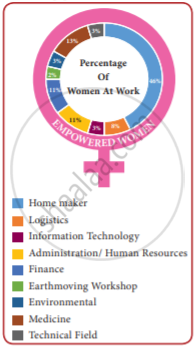
Read the data below and answer the following question.
Choose the correct answer.
Percentage of women working in finance is the same as ______.
What scared Usha during the dark rainy night?
We should develop the ability to learn from______
- self
- others
- books
Role play
Put students in pairs to role-play a conversation between:
- Alice and her sister.
- Alice and White Rabbit.
Can a courageous man be defeated? Why?
Vasantha could not see the rescue operation because ______
Why do we need trees? List four reasons that Grandfather gives.
What does the peepul do?
The farmer was thankful at the sight of the verdant bowl because______.
In Mars ______ Earth days make a year.
Why did the trees become a green blur?
Read scene I of the play carefully and answer the question below.
Who is about to go on a hunt? Do the wolves panic on his arrival? Explain.
Write the correct form for the present perfect tense.
They ______ (start) playing.
Did she give up the fight?
______is good at cooking.
Did they find a new country?
Bala and Janani acted like the______.
Find and write the clues.
Clue for the load on the camel ______
Read the advertisement and answer the question given below.

What is the advertisement about?
Amir realised his mistakes.
What was the truth finally learned by Chris?
Write the correct word.
| rooster, king, hen, tiger, queen, tigress. |
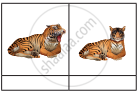
Did the girl buy a picture book?
What did the boy wonder about?
Find words from the passage which mean the same as the following.
- a malevolent desire for revenge (para 1)
- tactful (para 2)
- despise (para 3)
