Advertisements
Advertisements
प्रश्न
What distinguishes the tribal imagination from the secular imagination?
Advertisements
उत्तर
The tribal imagination is, according to the author, dreamlike and hallucinatory. It admits fusion between various planes of existence and levels of time in a natural way. These characteristics distinguish the tribal imagination from the secular imagination. In tribal stories, oceans fly in the sky as birds, mountains swim in the water as fish, animals speak as humans and stars grow like plants. In tribal imagination, stars, seas, mountains, trees, men and animals, can be angry, sad or happy.
APPEARS IN
संबंधित प्रश्न
Attempt a character sketch of Mr Gilman as a teacher.
How did a story book, 'Little Lord Fauntleroy' open a window of knowledge to Helen and help to shape her career?
Dolly Winthrop has a very noble nature. Comment.
What is the meaning of the line “Both wry with the laboured ease of loss”.
Discuss the following in pairs
Empathy and understanding are going out of modern society. The individual experiences intense alienation from the society around him or her.
Explain the contradiction in the similies, ‘Like a child from the womb, like a ghost from the tomb’.
Try rewriting the lecture as a formal essay and examine Forster’s statement: 'since the novel is itself often colloquial, it may possibly withhold some of its secrets from the graver and grander streams of criticism’.
'Whose roots lay deeper than our lives' – what aspect of human behaviour does this line reflect?
Read the extract 'Being Neighborly' and complete the following statement:
To Jo, the fine house seemed like ______.
Paraphrase the poem in your own simple language. Write it down in your notebook.
Discuss the activities carried out by a farmer.

The poem is a Petrarchan Sonnet. The poem is divided into two parts -
- An Octave
The first part comprising eight lines. - A sestet
The second part comprising six lines.
Read the first four lines of the poem. The rhyme scheme is a b b a. Read the rhyme scheme for the next four lines. It is a b b a. Now read the first three lines of the sestet and note the rhyme scheme. It is c d c. The rhyme scheme of the last three lines is d c d. This is the common design of a Petrarchan Sonnet.
This is a Petrarchan Sonnet. Complete the given table by giving examples from the poem.
| Features | Examples / Lines |
| Objects used | |
| Praise/blames | |
| Metaphor | |
| Simile | |
| Personification | |
| Number of lines | |
| Rhyme scheme |
Fill in the gap, choosing a word from the bracket to make an appropriate comparison.
(tall / quiet / humble / merry / busy / slippery / fast / sly / slow / big)
as ______ as a lark
The drone is given a death sentence because he ______.
Answer the following question in short.
Explain the significance of the title.
Write a short monologue using one of the following ideas. Write down the monologue and present it in the class.
Yonamine’s father worrying about getting her married.
Find out the following with the help of your teacher and the internet.
Seasonal Rains (monsoon) in India and other countries.
Prepare similar word chains using the following ideas.
size - big _______________.
Sayali’s mother did not want her to go on the trip.
There were no human settlements on the moon.
Gather more information about the following from your Science textbook, the internet, and other sources.
Gravitational force
What changes do we see in the life of human beings when the season changes? Write with reference to their clothes.
Answer the following question and write in short, why the parody sounds funny.
What does the crocodile stand for?
Read the ode ‘To Autumn’ by the famous poet John Keats. ‘Season of mists and mellow fruitfulness...’
Choose the appropriate phrase to insert in the gap, to make the sentence meaningful. Use the appropriate form of the verb.
After I took the medicine, I ______ ______ the pain.
Prepare a table to show 'Caesar’s Pranks' at home and outside.
Write the symbol that is used in the poem to represent the following idea.
It was tempting and needed to be tried.
Rohan desperately wished for ______.
Write in your own words.
How does the poet describe his home in the second stanza?
Find out when and where we get strawberries in Maharashtra.
Find the meaning of the following word.
starlets
Find the meaning of the following word.
delicious
Find out how the following game is played.
Badminton
Write other meaningful words that begin/end with springtime.
Rewrite the following line in your own words.
.......... ‘till off they flash
Singing sweetly their delight.’
Why had Prospero raised a violent storm in the sea?
Title summarises the story. Each paragraph is a part of the story. Look at the following expressions and find out the paragraphs that best suit these expressions.
- Oh, No! But it happens!
- Don’t let out your travelling dates
- Anyway, people will be people
- Search begins
- Things are not that easy
- Hurry invites worry
Who was the first person to withdraw cash from the ATM?
Why did the governments of India, America and Pakistan – honour Neerja?
According to the author the tendril was moving towards grandfather because it______.
Complete the mind map given below

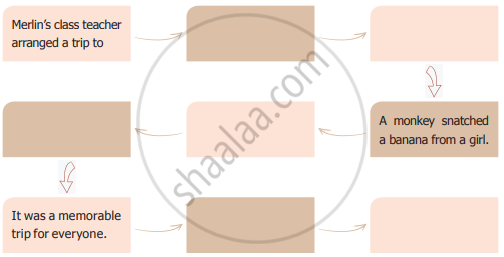
Recall Merlin’s memories and complete the story map.
Gulliver took the small creatures in his hand and crushed them.
The wild boar got up from its daybed because it was disturbed by another boar.
The boy and the girl were taken by the cavalry to explain their action.
The aliens gave a new shuttle to them.
Brain of a robot is the______.
Match their hobbies.
 |
swimming |
 |
cycling |
 |
gardening |
They would rest on the tree.
Some words sound the same but their spelling and meaning are different. Such words are called homophones. There are many homophones.
Why did the audience cheer?
Will you solve a mystery with friends? Why?
Circle and write the adverbs.
Suddenly the old man fainted. ______
Fill in the blank
When does the world become green?
Kamali gave her savings to______.
______ is a great risk to the environment.
Describe in your own words the garden that Alice saw.
Why did the animals think that the jackal was a king?
