Advertisements
Advertisements
प्रश्न
Identify the common characteristics shared by tribal communities all over the world.
Advertisements
उत्तर
The essayist identifies some common characteristics shared by tribal communities all over the world. The tribals live in groups that are cohesive and organically unified. They show very little interest in accumulating wealth or in using labour as a device to gather interest and capital. The tribals accept a world view in which nature, human beings and God are intimately linked and they believe in the human ability to spell and interpret truth. They live more by intuition than reason, they consider the space around them more sacred than secular, and their sense of time is personal rather than objective.
APPEARS IN
संबंधित प्रश्न
How important was the presence of Miss Anne Sullivan in Helen’s life?
In ‘The Diary of a Young Girl’ how did the Franks and others celebrate two festivals, Hanukkah and St. Nicholas Day in the Annexe ?
Orangutans use big leaves during a downpour because
Read the extract and do the following activities :
B1 Likes and dislikes :
(i) The child likes eating _______
(ii) The child dislikes eating _______
They won’t eat peas, don’t like your bread -
For something in it crunches;
They gag on fat, the gravy’s gross,
They won’t eat grapes in bunches.
Tomatoes, onions, peppers, fish
Garlic nor cottage cheese;
Oh, it’s a dish uncommon rare
That truly seems to please.
No red sauce may the ice cream have,
“It’s bleeding,” they will say;
And gravely hand it to their mum
To take it to clean away
But let us speak of chocolate cake,
It must be frosted o’er;
They’ll devour three full slabs,
And calmly ask for more.
Oh, I do so always love to eat
With picky little pests,
Whose parents joy to make them
The most undesirable guests!
B2 What message does the poem convey for children?
B3 Pick out two pairs of rhyming words from the poem.
Answer the following question in 200-250 words:
Helen had a great love for animals and birds. Write about this aspect of her character.
In which language do you think Gangadharpant and Khan Sahib talked to each other? Which language did Gangadharpant use to talk to the English receptionist?
There is mention of three communities in the story: the Marathas, the Mughals, the Anglo-Indians. Which language do you think they used within their communities and while speaking to the other groups?
Tick the item that is closest in meaning to the following phrase.
to meet one's match
How do you distinguish between information gathering and insight formation?
Discuss the following in pairs
Behind the public face of the people in various occupations is a whole saga of personal suffering and joy which they wish to share with others.
Why has he compared the three passions to great winds?
Explain the phrase.
his bending sickle's compass
Write words from the poem that describe the following.
- sky ____________
- heart ____________
- hand ____________
- beginning ____________
- surprises ____________
Answer in your own words.
Why did she decide to keep her new knowledge ‘a secret’?
Using a good dictionary, find the shade of difference in the following:
‘Profession’ refers to ____________
Find from the lesson word/phrase that mean the following.
colours .............
Using a dictionary/internet note down the main difference between farm and granary.
Find proof from the poem for the following.
The colour imagery in the poem.
Compare and contrast the two opposing human feelings as expressed by the poet.
Behrman was a hard-hearted person.
Correct the following statement.
Sue and Johnsy were good neighbours.
Out of all names of birds and animals given in the poem, pick out 4 names that are similar in English as well as in Hindi/Marathi or your Mother's tongue.
Fill in the gap, choosing a word from the bracket to make an appropriate comparison.
(tall / quiet / humble / merry / busy / slippery / fast / sly / slow / big)
as ______ as a fox
Explain the use of the following property in the development of the play.
Stick
Enact the ad by playing the roles of Didi and her relatives. One more child acts as the salesman of ‘Hemagauri’ and presents the text given in white letters in pink bubbles.
What were the three things that Sushruta discovered?
Have you seen a newborn young one of an animal?
Find four words ending with ‘-ous’ from the story.
Can you add three more words ending with ‘-ous’ to this list?
Visit a library:
Read stories about Gautama Buddha. Relate one story in the class.
Listen and complete:
Close your books. The teacher will dictate some lines from the poem. She will say the first half and you have to write the entire line/verse.
- I know a funny ____________ As quiet as a ____________ Who does the mischief that is done ____________.
- There’s no one ever sees his face, And yet we all ____________ That every plate we break was ____________ By ____________.
Read the passage and answer the following:
Which book is introduced in the passage?
Think and answer:
Are the boys and girls happy that it is raining?
Sayali did not understand the mistake she had made.
Prepare a ‘PowerPoint’ presentation, using one slide for each of the above points. Present your review in a PPT format in the classroom.
Pick out from the poem, two lines each that reflect an optimistic (positive) attitude and pessimistic (negative) attitude.
Optimism :
- ______
- ______
Pessimism :
- ______
- ______
Who said the following, to whom, and when?
“Mighty thy Teacher must be and divine.”
Do you agree with the poet’s thoughts? Why?
What is a website?
__________________was the chief of all spirits
The second human being that Miranda saw on the island was __________________.
Why did Mrs. Jhunjhunwalla buy the painting?
Read the data below and answer the following question.
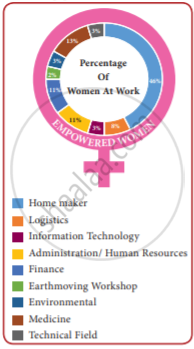
Choose the correct answer.
What is the difference between the percentage of women working in logistics and Medicine?
What does the poet mean by ‘Festival of flowers’?
Write down the word that alliterate in the poetic line below
That spreads treasures on a tree.
Read the line and answer the question.
And the wheel’s kick and the winds song and the white sail’s shaking
What according to the poet are the pleasures of sailing?
Vasantha could not see the rescue operation because ______
A turtle’s flippers help it to ______.
Read the lines and answer the questions given below.
Autumn is English
in red, yellow and brown
Autumn is Indian
Whenever leaves fell down
- How is autumn in India?
- Compare the English autumn with the Indian autumn.
In the Earth, we get water from ______.
He offered _______ to his daughters.
Write the rhyming word.
culture - ______.
Take out the correct rhyming pair from the poem and match with the given word.
| 1. | tall | |
| 2. | light | |
| 3. | might |
Choose the correct answer.

Choose and write the adverbs to complete the sentence.

My dog barks ______.
Fill in the blank with rhyming word.
larder- ______
Although Helen could not hear or see, what kind of girl was she?
Now, read the following passage on “Laughter Therapy” and answer the questions that follow.

- Laughing is an excellent way to reduce stress in our lives; it can help you to cope with and survive a stressful life. Laughter provides full-scale support for your muscles and unleashes a rush of stress-busting endorphins. Since our bodies cannot distinguish between real and fake laughter, anything that makes you giggle will have a positive impact.
- Laughter Therapy aims to get people laughing, in groups and individual sessions and can help reduce stress, make people and employees happier and more committed, as well as improve their interpersonal skills. This laughter comes from the body and not the mind.
- Laughter Yoga (Hasya yoga) is a practice involving prolonged voluntary laughter. It aims to get people laughing in groups. It is practiced in the early mornings in open-parks. It has been made popular as an exercise routine developed by Indian physician Madan Kataria, who writes about the practice in his 2002 book ‘Laugh for no reason'. Laughter Yoga is based on the belief that voluntary laughter provides the same physiological as well as psychological benefits as spontaneous laughter.
- Laughter yoga session may start with gentle warm-up techniques which include stretching, chanting, clapping, eye contact and body movements to help break down inhibitions and encourage a sense of playfulness. Moreover, laughter is the best medicine. Breathing exercises are used to prepare the lungs for laughter followed by a series of laughter exercises that combine a method of acting and visualization techniques. Twenty minutes of laughter is sufficient to augment physiological development.
- A handful of small-scale scientific studies have indicated that laughter yoga has some medically beneficial effects, including cardiovascular health and mood. This therapy has proved to be good for depressed patients. This laughter therapy also plays a crucial role in social bonding.
Answer the following.
a. How does laughter help one to cope with stress?
b. Which word in the text (para 2) means the same as ‘dedicated'?
c. Why do you think voluntary laughter provides the same physiological as well as psychological benefits as spontaneous laughter?
d. ‘Laughter is the best medicine’. Explain.
e. Given below is a set of activities. Which of these are followed in the ‘Laughter Yoga’ technique?
- sitting on the ground with legs crossed
- body movements
- clapping
- closed eyes
- breathing exercises
- chanting
- stretching of arms and legs
- bending backwards
- running/jogging
- eye contact
f. ‘Laughter therapy also plays a crucial role in social bonding’. How?
Read the following information given in the table below and answer the questions.
| A nice choice from Chennai to the National capital | |||
| RAJADHANI EXPRESS TIMETABLE | |||
| Shortest Route between Chennai and Hazrat Nizamuddin 8 Halts & 324 intermediate stations in between | |||
| Station Name | Departs | Day | Speed |
| Chennai Central | 06.05 | 1 | 75 |
| Vijayawada | 11.55 | 1 | 76 |
| Warangal | 14.40 | 1 | 77 |
| Balharshah | 18.00 | 1 | 78 |
| Nagpur | 20.45 | 1 | 74 |
| Bhopal | 02.10 | 2 | 89 |
| Jhansi | 05.31 | 2 | 99 |
| Gwalior | 06.32 | 2 | 85 |
| Agra Cantt | 07.57 | 2 | 76 |
| Hazrat Nizamudin | 10.25 | 2 | - |
a) The number of stations between Chennai Central and Hazrat Nizamudin is______.
- five
- ten
- eight
- eleven
b) The train is expected to reach ______ around 8.45 PM
- Warangal
- Vijayawada
- Bhopal
- Nagpur
c) Between ______ the train runs at its maximum speed.
- Bhopal and Gwalior
- Bhopal and Jhansi
- Bhopal and Hazarat Nizamudin
- Bhopal and Agra
d) Almost ______ the train reaches Vijayawada.
- the day after
- around early morning
- late night
- around noon
e) People prefer the Rajadhani Express to travel from Chennai to reach the capital because ______.
- it reaches the destination on the same day
- the charge is reasonable.
- the train halts at ten stations.
- it is the shortest route from Chennai to New Delhi.
f) The destination of Rajadhani express is______.
- Hazarat Nizamudin.
- New Delhi junction.
- Old Delhi.
- Rajkot.
Write compound word using the pictures.
 |
+ |  |
| ____________ | ||
