Advertisements
Advertisements
प्रश्न
How did Kumudini react to her mother's death?
Advertisements
उत्तर
The news of the death of Kumudini's mother was not directly given to her by the Principal of the school where she was studying at that time. She was told that she had to go home as her mother was sick. When Kumudini reached home she saw her mother dead. She felt helpless in this world . She was only 14 years old at that time. Her hands hung loose from her body. She also felt hungry but couldnot express it to anybody. She was afraid of appearing greedy.
APPEARS IN
संबंधित प्रश्न
How did the air raids disrupt the Dutch public life?
Read the passage given below and answer the questions that follow:
The term dietary fibres refers collectively to indigestible carbohydrates present in plant foods. The importance of these dietary fibres came into the picture when it was observed that the people having diet rich in these fibres, had low incidence of coronary heart disease, irritable bowel syndrome, dental caries and gall stones.
The foodstuffs rich in these dietary fibres are cereals and grains, legumes, fruits with seeds, citrus fruits, carrots, cabbage, green leafy vegetables, apples, melons, peaches, pears etc.
These dietary fibres are not digested by the enzymes of the stomach and the small intestine whereas most of other carbohydrates like starch and sugar are digested and absorbed. The dietary fibres have the property of holding water and because of it, these get swollen and behave like a sponge as these pass through the gastrointestinal tract. The fibres add bulk to the diet and increase transit time in the gut. Some of these fibres may undergo fermentation in the colon.
In recent years, it has been considered essential to have some amount of fibres in the diet. Their beneficial effects lie in preventing coronary heart disease, and decreasing cholesterol level. The fibres like gums and pectin are reported to decrease postprandial (after meals) glucose level in blood. These types of dietary fibres are recommended for the management of certain types of diabetes. Recent studies have shown that the fenugreek (Methi) seeds, which contain 40 per cent gum, are effective in decreasing blood glucose and cholesterol levels as compared to other gum containing vegetables.
Some dietary fibres increase transit time and decrease the time of release of ingested food in colon. The diet having less fibres is associated with colon cancer and the dietary fibres may play a role in decreasing the risk of it.
The dietary fibres hold water so that stools are soft, bulky and readily eliminated. Therefore high fibre intake prevents or relieves constipation.
The fibres increase motility of the small intestine and the colon and by decreasing the transit time there is less time for exposure of the mucosa to harmful toxic substances. Therefore, there is a less desire to eat and the energy intake can be maintained within the range of requirement. This phenomenon helps in keeping a check on obesity. Another reason in helping to decrease obesity is that the high-fibre diets have somewhat lower coefficients of digestibility.
The dietary fibres may have some adverse effects on nutrition by binding some trace metals like calcium, magnesium, phosphorus, zinc and others and therefore preventing their proper absorption. This may pose a possibility of nutritional deficiency especially when diets contain marginal levels of mineral elements. This may become important constraints on increasing dietary fibres. It is suggested that an intake of 40 grams dietary fibres per day is desirable.
(Extracted from ‘The Tribune’)
(a) On the basis of your reading of the above passage make notes on it in points only, using recognizable abbreviations wherever necessary. Also suggest a suitable title. (5)
(b) Write a summary of the above in about 80 words. (3)
Answer any four of the following in 30−40 words each:
(a) What did garbage mean to the children of Seemapuri and to their parents?
(b) How did Rajkumar Shukla establish that he was resolute?
(c) 'Life is what it is all about;...' How is keeping quiet related to life?
(d) Mention any four things of beauty that add joy to our life.
(e) The manner of his (the Tiger King's) death is a matter of extraordinary interest. Comment.
(f) In what condition did Dr. Sadao find the American soldier at the seashore?
Chimps making their own fishing rods is an indication that
When and how did the people of Iping grow suspicious of the invisible man ?
Answer the following question in 200-250 words:
How did Kitty help Anne overcome her loneliness?
Guess the meaning of the following word:
Kora
In which language are these word found?
Comment on the graphic detail with which the various passengers who took Iona's cab are described.
How does Shelley's attitude to science differ from that of Wordsworth and Keats?
The Cloud ‘fuses together a creative myth, a scientific monograph, and a gay picaresque tale of cloud adventure': explain.
List the distinctive features of the tribal arts.
'New Literature' is a misnomer for the wealth of the Indian Literary tradition. How does G. N. Devy explain this?
Discuss in pairs or in small groups
The description of novels as organisms.
What are the unpleasant aspects of the human condition that the poet wants to escape from?
Read the extract 'Being Neighborly' and complete the following statement:
In order to tidy the room, Jo __________________.
An acrostic is a poem or a write· up in which the first letter of each line forms a word. when it is read vertically.
For example,
Faithful
Reliable
Inspiring
Encouraging
Noble
Dedicated
With your benchmate / group, complete the acrostic of BELIEVE and FAITH.
(Please note that the words / phrases should be more or less related to the topic. You can use a thesaurus.)
Be certain of
E ......................
L ......................
I ......................
E ......................
V ......................
E ......................
F ......................
A ......................
I ......................
T ......................
H ......................
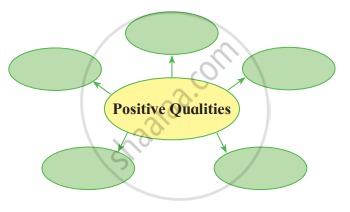
Find from the poem, positive qualities to fill up the web.
Correct the following statement.
Sue and Johnsy were good neighbours.
Discuss in groups and share with one another.
Do you spend time admiring and thinking over the beauties of nature? Elaborate on your response.
Discuss in your class.
How can we take help of robots in our daily life?
The term 'Anaesthesia' in the poem means - 'The planner gives beautiful pictures of the new modern city'. Now find out what is Amnesia and Hypnosis in the given context.
Read the passage and answer the following question:
What makes Indra’s vajra or weapon invincible?
The description of the character is given below. Identify the character from the play. Find some sentences which support your choice.
He is the centre of the play.
Form a pair. Write at least one short dialogue for the following expression.
I agree.
The merchant ships brought spices and other treasures from India and other countries to Italy.
Write a few lines about each character.
What themes did the committee identify?
To whom is the poem addressed?
Draw word webs for the following.
Begin with the given word and go on writing as many other words associated with it, as you can.
Use these words to write other related words to form a word web.

Complete the following sentence with reference to the passage.
Nobody knows for certain who ___________________.
Find the words that mean the following from the first stanza.
- Gold hammered into a flat, thin shape: ______
- show off proudly: ______
- tilt, move at an angle: ______
- across, especially in a slanting direction: ______
Write the symbol that is used in the poem to represent the following idea.
Some other time.
Find from the Internet and write down.
In which century did William Shakespeare write his famous plays?
Correct the following sentence and rewrite it.
Papa Panov saw the sweeper, the young mother, and the beggars he had helped only once in the morning.
Correct the following sentence and rewrite it.
Jesus had actually visited Papa Panov only once on Christmas Eve.
Fill in the blank choosing the appropriate word/idiom from the lesson.
The sight of a snake ______.
Find the meaning of the following word.
delicious
Guess the meaning of the following word.
pounced
How was Gulliver taken to the city?
What different names is ‘Rangoli’ known by in different regions?
Guess the meaning of the following word.
fragrant
Read the following line from the poem and answer the question that follow.
My heart will keep the courage of the quest And hope the road's last turn will be the best.
|
My heart will keep the courage of the quest, And hope the road's last turn will be the best. |
- What kind of quest does the poet seek here?
- What is the poet’s hope?
Answer the question in a paragraph of about 100 – 150 word.
Narrate how Prospero made his enemies repent to restore his dukedom.
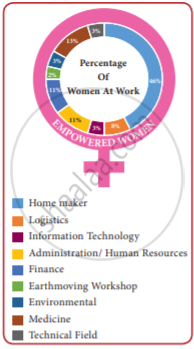
Read the data below and answer the following question.
Choose the correct answer.
Identify the three jobs where the same percentage of women work.
Find out the rhyme scheme employed in the fourth stanza.
Write the story in your own words
The war between the two kingdoms ended in peace.
Read the lines and answer the questions given below.
Summer comes
in a blaze of heat with
sunny smiles
and dusty feet
- Does the poet welcome the summer? How do you know?
- Which line tells you that there is no rain in summer?
How is water produced in Mars?
How did the aliens know the boys' language?
Did Santhosh enjoy his morning walk? How do you know?
Arrange the pictures by using numbers.

What was the dish served to the old man?
Why did the old man need someone?
Match the rhyming words.
| mars | crime |
| bed | cars |
| time | head |
Answer the following yes or no question.
Did Bujju realise his mistake?
Three waves hit the village.
Tenzin’s family first lived in ______.
One day Chris tried to draw a ______.
Why does the poet feel that the nose is a funny thing?
