Advertisements
Advertisements
प्रश्न
You know what ‘hide-and-seek’ is. What would ‘hide-and-speak’ mean?
Advertisements
उत्तर
The expression 'hide-and-speak' here expresses the taboo of the dark-skinned people being inferior to those who claim themselves to be 'fair-skinned' and thus, more learned, sophisticated, civilised, and superior.
APPEARS IN
संबंधित प्रश्न
Read the passage given below and answer the questions that follow:
1. Air pollution is an issue which concerns us all alike. One can willingly choose or reject a food, a drink or a life comfort, but unfortunately there is little choice for the air we breathe. All, what is there in the air is inhaled by one and all living in those surroundings.
2. Air pollutant is defined as a substance which is present while normally it is not there or present in an amount exceeding the normal concentrations. It could either be gaseous or a particulate matter. The important and harmful polluting gases are carbon monoxide, carbon dioxide, ozone and oxides of sulphur and nitrogen. The common particulate pollutants are the dusts of various inorganic or organic origins. Although we often talk of the outdoor air pollutions caused by industrial and vehicular exhausts, the indoor pollution may prove to be as or a more important cause of health problems.
3. Recognition of air pollution is relatively recent. It is not uncommon to experience a feeling of 'suffocation' in a closed environment. It is often ascribed to the lack of oxygen. Fortunately, however, the composition of air is remarkably constant all over the world. There is about 79 per cent nitrogen and 21 per cent oxygen in the air − the other gases forming a very small fraction. It is true that carbon dioxide exhaled out of lungs may accumulate in a closed and over-crowded place. But such an increase is usually small and temporary unless the room is really air-tight. Exposure to poisonous gases such as carbon monoxide may occur in a closed room, heated by burning coal inside. This may also prove to be fatal.
4. What is more common in a poorly ventilated home is a vague constellation of symptoms described as the sick-building syndrome. It is characterized by a general feeling of malaise, head-ache, dizziness and irritation of mucous membranes. It may also be accompanied by nausea, itching, aches, pains and depression. Sick building syndrome is getting commoner in big cities with the small houses, which are generally over-furnished. Some of the important pollutants whose indoor concentrations exceed those of the outdoors include gases such as carbon monoxide, carbon dioxide, oxides of nitrogen and organic substances like spores, formaldehydes, hydrocarbon aerosols and allergens. The sources are attributed to a variety of construction materials, insulations, furnishings, adhesives, cosmetics, house dusts, fungi and other indoor products.
5. By-products of fuel combustion are important in houses with indoor kitchens. It is not only the brining of dried dung and fuelwood which is responsible, but also kerosene and liquid petroleum gas. Oxides of both nitrogen and sulphur are released from their combustion.
6. Smoking of tobacco in the closed environment is an important source of indoor pollution. It may not be high quantitatively, but significantly hazardous for health. It is because of the fact that there are over 3000 chemical constituents in tobacco smoke, which have been identified. These are harmful for human health.
7. Micro-organisms and allergens are of special significance in the causation and spread of diseases. Most of the infective illnesses may involve more persons of a family living in common indoor environment. These include viral and bacterial diseases like tuberculosis.
8. Besides infections, allergic and hypersensitivity disorders are spreading fast. Although asthma is the most common form of respiratory allergic disorders, pneumonias are not uncommon, but more persistent and serious. These are attributed to exposures to allergens from various fungi, molds, hay and other organic materials. Indoor air ventilation systems, coolers, air-conditioners, dampness, decay, pet animals, production or handling of the causative items are responsible for these hypersensitivity − diseases.
9. Obviously, the spectrum of pollution is very wide and our options are limited. Indoor pollution may be handled relatively easily by an individual. Moreover, the good work must start from one’s own house
(Extracted from the Tribune)
(a) (i) What is an air pollutant? (1)
(ii) In what forms are the air pollutants present? (2)
(iii) Why do we feel suffocated in a closed environment? (1)
(iv) What is sick building syndrome? How is it increasing? (2)
(v) How is indoor smoking very hazardous? (1)
(vi) How can one overcome the dangers of indoor air pollution? (2)
(b) Find the words from the above passage which mean the same as the following: (3)
(i) giddiness (para 4)
(ii) constant (para 8)
(iii) humidity (para 8)
Anne's father was close to her. What did she like about him? Why?
You are Smitha/Sunil, Secretary AVM Housing Society. You are going to organize a yoga camp. Write a notice in not more than 50 words, urging the members of your society to come in large numbers to attend the camp. Invent all the necessary details.
(i) The interest of Maharashtra and that of India should be one for the progress of Maharashtra state, because ................
Notice these expression in the text. Infer their meaning from the context.
swathe
Indian society has moved a long way from the way the marriage is arranged in the story. Discuss.
Tick the item that is closest in meaning to the following phrase.
to give vent to
While tribal communities may not seem to possess the scientific temper,there are many ideas from tribal conventions that could enrich modern societies.
What does the bird in the poem announce? How is this related to the title, ‘Coming’?
Discuss in pairs or in small groups
'Our daily life reflects a double allegiance to 'the life in time' and 'the life by values'.
Fill in the blank.
The author wanted to grow ______________.
Read the story and complete the following.
Revathi won the prize for the ‘Best plant’ because, ____________.
Pick out words that refer to ‘means of living’ and fill them in the Web.
(profession/recreation/occupation/job/ pastime/employment/hobby/career/entertainment/mission/trade/buisness/sports/retirement/placement)
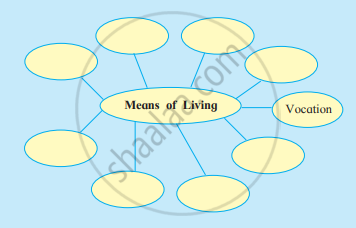
Find proof from the poem for the following.
The struggle of the cherry tree for survival.
You might have visited a bridge. Complete the web describing the sights you could see from the bridge.

You have heard the proverb ‘Plan your work, work your plan’. It means - ________________.
Read the lesson and name the following.
The First surgeon to perform operations ______
Write a short autobiography of any bird or animal of your choice.
Read the description of the Kabaddi match and do the following:
Describe, in your own words, the important events in the first half.
Look at the following words carefully for one minute. Now close your book and try to write down as many of the words as you can remember.
| crust, tremendous, lava, crater, volcanic, tsunami, island, extinct, disaster, dormant, eruption, plume, inland, molten, active, coast |
Discuss the following question after you have seen a presentation of the ‘ad’.
What would happen if you ate proper meals like rice and dal or dal-roti?
How long a period did Shalihotra allow to find the missing things?
Imagine you are visiting the Science Fair. What other stalls (apart from the ones mentioned here) are you likely to find there? Try to list at least five more stalls.
Recite the poem with proper rhythm and intonation.
Read the passage and name the following.
He persuaded Helen to elope with him.
What is direct and indirect.
Rohan had finished ______ rounds of the tree before Mrs. Groover discovered him.
Guess the meaning of the following word.
barefoot
Guess the meaning of weary.
Read the following lines from the poem and answer the question that follow.
Let me but live my life from year to year,
With forward face and unreluctant soul;
- Whom does the word ‘me’ refer to?
- What kind of life does the poet want to lead?
Identify the character or speaker.
He was the chief of all spirits.
Read the incident again and answer the following question.
Why were the other passengers in the flight gazing at the writer?
The weather is always too hot or cold; Summer and winter alike they scold. Nothing goes right with the folks you meet Down on that gloomy Complaining Street.
Pick out the rhyming words and identify the rhyme scheme of the above lines.
What did Aravind confess?
Complete the following table with information from the anecdote about Mr. Scotti’s short trip.
| Name | Nicholas Scotti |
| Occupation | |
| Reason for his trip | |
| Means of transport | |
| Destination |
Who baked the homemade cookies?
Which of these statements do you find in the speech?
- Inclusion is essential for us to do well in life.
- We should neglect others.
- Communicate politely with the less privileged.
- Teachers teach us to communicate well.
- Effective Communication is inessential to excel in life.
What is the ‘breath of life’?
The author did not want to plant saplings in the forest because______.
Read the story on your own. Discuss in a group and complete the story map below.
| A story map is the main events of the story given in a flow chart. |
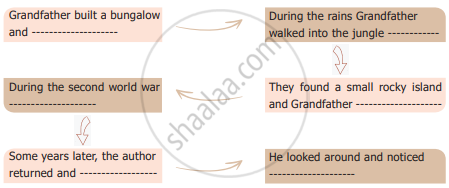
Why did the girl scream?
Write the story in your own words
There is a connection between the rhyming words and rhythms of the train. Present your views about it.
How should one react to adversity?
The land was wet and green.
The little bird broadened the hole with her______.
Find example of alliteration and write them in the blank.
Spring Is pretty
but short and sweet
The girl was badly hurt.
What did the father give to all the daughters?
Match the following.
| treat everyone | love each of her child |
| nation | no inner boundaries |
| kind | not divided as people |
| country | alike |
How can we make our nation proud?
Choose the correct option from the given homophones.
What did you ______ at the store?
Choose and write the adverbs to complete the sentence.

She coloured the picture ____.
Circle and write the adverbs.
I'm waiting here. ______
Moles trap worms and store them.
Join the word with the correct prefix.
| paid | un |
| send | dis |
| able | re |
| continue | pre |
Match the rhyming words.
| Say | grow |
| All | time |
| Go | day |
| Rhyme | fall |
Match the words with similar meaning.
| truck | subway |
| underground | lorry |
| tap | wallet |
| purse | faucet |
Here is an amazing news item on how the qualities of duty and devotion is not restricted to humans alone but shared by animals. Read the passage and answer the questions that follow.
Caesar, the Hero of Mumbai on 26/11
- Mumbai: Caesar, the last surviving hero of his kind, died of a heart attack on Thursday. Caesar, a Labrador Retriever, was covered with tri-color and given an emotional farewell from the city Police Force. The Mumbai Police Commissioner too marked the passing of the hero with a tweet.
- Caesar, who was 11 years old was the sole survivor among the dogs of Mumbai Police who took part in bomb detection operations during the terrorist attack on Mumbai that began on November 26, 2008. He died of a heart attack at a farm in Virar where he and his three canine buddies had been sent after retirement. During the terror attack in Mumbai, Caesar saved several lives when he sniffed out the hand grenades left by the terrorists at the busy CST railway station.
- Caesar was also a part of the search team at Nariman House, where terrorists were holed up for three days. Earlier he was also pressed into service for bomb search operation after the 2006 serial train blasts and July 2017 blast in Mumbai. The Mumbai police officials also tweeted their grief saying, “Services of retired members of Dog Squad during 26/11 will be unforgettable. We will remember our heroes forever.”
Answer the following questions.
- The Labrador Retriever was covered with tri-color. What does this signify?
- How did Caesar save several lives at the CST railway station?
- Which word in the third paragraph of the passage means the same as ‘forced’?
- “Services of retired members of Dog Squad during 26/11 will be unforgettable”. Mention three services rendered by Caesar.
- Caesar is a Labrador breed of dogs. Name a few other native breeds that are used by the Police Force.
- Try to rewrite the news item in your mother tongue without losing the spirit and flavour of the text. Give a suitable title to the translated version.
