Advertisements
Advertisements
प्रश्न
Here is an amazing news item on how the qualities of duty and devotion is not restricted to humans alone but shared by animals. Read the passage and answer the questions that follow.
Caesar, the Hero of Mumbai on 26/11
- Mumbai: Caesar, the last surviving hero of his kind, died of a heart attack on Thursday. Caesar, a Labrador Retriever, was covered with tri-color and given an emotional farewell from the city Police Force. The Mumbai Police Commissioner too marked the passing of the hero with a tweet.
- Caesar, who was 11 years old was the sole survivor among the dogs of Mumbai Police who took part in bomb detection operations during the terrorist attack on Mumbai that began on November 26, 2008. He died of a heart attack at a farm in Virar where he and his three canine buddies had been sent after retirement. During the terror attack in Mumbai, Caesar saved several lives when he sniffed out the hand grenades left by the terrorists at the busy CST railway station.
- Caesar was also a part of the search team at Nariman House, where terrorists were holed up for three days. Earlier he was also pressed into service for bomb search operation after the 2006 serial train blasts and July 2017 blast in Mumbai. The Mumbai police officials also tweeted their grief saying, “Services of retired members of Dog Squad during 26/11 will be unforgettable. We will remember our heroes forever.”
Answer the following questions.
- The Labrador Retriever was covered with tri-color. What does this signify?
- How did Caesar save several lives at the CST railway station?
- Which word in the third paragraph of the passage means the same as ‘forced’?
- “Services of retired members of Dog Squad during 26/11 will be unforgettable”. Mention three services rendered by Caesar.
- Caesar is a Labrador breed of dogs. Name a few other native breeds that are used by the Police Force.
- Try to rewrite the news item in your mother tongue without losing the spirit and flavour of the text. Give a suitable title to the translated version.
Advertisements
उत्तर
- The use of tricolor flag on the body of the Labrador retriever signifies that it has served the nation as a soldier and deserves our homage.
- During the terror attack in Mumbai, Caesar saved several lives when he sniffed out the hand grenades left by the terrorists at the busy CST railway station.
- Pressed into means “forced”.
- Caesar had taken part in the bomb detection operations during the terrorist attack on Mumbai that began on November 26, 2008. Caeser saved several lives when he sniffed out the hand grenades left by the terrorists at the busy CST railway station. Caesar was also a part of the bomb search operation after the 2006 serial train blasts and the July 2017 blast in Mumbai.
- The Bloodhound, The German short-haired pointer, The Boxer, The Doberman, The Dutch German Shepherd, and The Giant Schnauzer are some of the famous breeds used by the police force.
- German Shepherd, Belgian Malinois, Boxers, Doberman Pinscher, Bloodhound, and Giant Schnauzer.
APPEARS IN
संबंधित प्रश्न
B1. Find reasons
(i) The effect of receding forest …………………………………. .
(ii) The number of animals is reduced because ………………………. .
(iii) Elephants entered the city because…………………… .
(iv) Elephants lived a wary life …………………….. .
On the left bank of the Ganga, where it emerges from the Himalayan foothills, there is a long stretch of heavy forest. There are villages on the fringe of the forest, inhabited by bamboo cutters and farmers, but there are few signs of commerce or pilgrimage. Hunters, however, have found the area an ideal hunting ground during the last seventy years, and as a result, the animals are not as numerous as they used to be. The trees, too, have been disappearing slowly; and, as the forest recedes, the animals lose their food and shelter and move further on into the foothills. Slowly, they are being denied the right to live
Only the elephants can cross the river. And two years ago, when a large area of the forest was cleared to make way for a refugee resettlement camp, a herd of elephants - finding their favourite food, the green shoots of the bamboo, in short supply - waded across the river. They crashed through the suburbs of Haridwar, knocked down a factory wall, pulled down several tin roofs, held up a train, and left a trail of devastation in their wake until they found a new home in a new forest which was still untouched. Here, they settled down to a new life but an unsettled, wary life. They did not know when men would appear again, with tractors,bulldozers and dynamite.
B2. Find out
Mention four things the elephants did when they found shortage of food:
(i)………………
(ii)………
(iii) …………
(iv) ………….
B3.Phrases
Make meaningful sentences by selecting any two of the following phrases:
(i) to make way for
(ii) in short
(iii) on the fringe of.
B4. Language study
Select the proper alternative to make the correct voice:
(i) Hunters have found an ideal hunting ground.
-An ideal hunting ground ........found by hunters. (had been, has been, was)
(ii) They are being denied the right to live.
- The people ........them the right to live. (are denying, were denying, denying)
B5.Personal response
What would be your contribution to protect the natural habitat of animals?
How did a story book, 'Little Lord Fauntleroy' open a window of knowledge to Helen and help to shape her career?
Notice these expression in the text. Infer their meaning from the context.
salt flats
Considering that this is an excerpt from a lecture, how does the commentary provided by the speaker string the arguments together?
Comment on the lines that make you visualise the colourful image of the peacock.
Discuss in pairs
Ruskin's insistence on looking intensely at words, and assuring oneself of meaning, syllable by syllable – nay, letter by letter.
Discuss in pairs or in small groups
'Our daily life reflects a double allegiance to 'the life in time' and 'the life by values'.
Who gives medicine/treatment to sick animals and birds?
Discuss in your class.
Are robots truly useful to human beings? Why? Why not?
With the help of the internet and other sources, obtain more information about the critically endangered birds and animals in India. Find the names of their sanctuaries.
List five of your favourite Hindi or Marathi poems or songs. Try to translate any one of them into English.
List the various people and places mentioned in the passage. The places Milo visits and the people he meets have unusual names. Write the meanings of those names.
Prepare charts for each one of the asanas described in the passage. Use the following points:
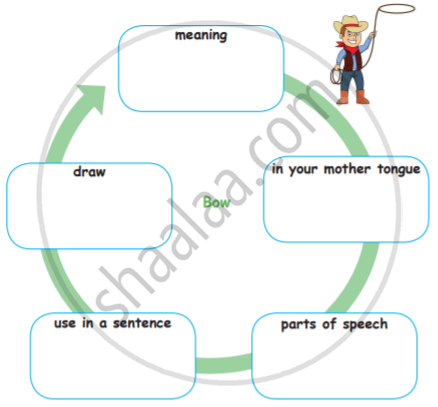
- Name (in English, in your mother tongue)
- Meaning in English
- General information
- Steps and pictures
- Benefits
Choose the appropriate phrase to insert in the gap, to make the sentence meaningful. Use the appropriate form of the verb.
The minister ______ his personal body-guards.
How does the following character in the story live up to their name? Provide points from the story.
Taffimai Metallumai
Say whether you agree or disagree.
The youngest child was most irritating.
Write a short note on ‘money’.
Read the following lines from the poem and answer the question that follow.
Let me but live my life from year to year,
With forward face and unreluctant soul;
- Whom does the word ‘me’ refer to?
- What kind of life does the poet want to lead?
Read the following line from the poem and answer the question that follow.
My heart will keep the courage of the quest And hope the road's last turn will be the best.
|
My heart will keep the courage of the quest, And hope the road's last turn will be the best. |
- What kind of quest does the poet seek here?
- What is the poet’s hope?
The author did not want to plant saplings in the forest because______.
Where did Raj’s mother send him?
Where did the boys and girls go?
A tiny bird looked for a place to lay her eggs.
The rich man ______ at the beggar.
Kaliyan worked in a ______.
What was the dish served to the old man?
Try your own.
Choose the correct answer.
Amir realised his mistakes.
Being a bachelor, the stranger had no patience with children.
