Advertisements
Advertisements
प्रश्न
What has not changed over the years? Does this suggest something to you?
Advertisements
उत्तर
The lines, ‘And the sea, which appears to have changed less’ depict that the sea has stayed the same over the years. It has not changed at all.
These lines suggest a sharp contrast to the mortal human life. Human life is transitory and temporary whereas the sea symbolizes permanence, immortality, and eternity. The poet makes use of the phrase ‘terribly transient feet’ to highlight the ephemeral nature of human life.
APPEARS IN
संबंधित प्रश्न
There were many reasons for Helen Keller's embittered childhood. What were they and how were they overcome?
Anne's relationship with her mother was never simple. What created the tension and discord? Why
Attempt in 120‒150 words a character sketch of Miss Sullivan.
Describe the role of Mr. Keith in the life of Helen in ‘The Story of My Life’.
Guess the meaning of the following word:
Kora
In which language are these word found?
Read the text below and summarise it.
The Great Desert Where Hippos Once Wallowed
The Sahara sets a standard for dry land. It’s the world’s largest desert. Relative humidity can drop into the low single digits. There are places where it rains only about once a century. There are people who reach the end of their lives without ever seeing water come from the sky.
Yet beneath the Sahara are vast aquifers of fresh water, enough liquid to fill a small sea. It is fossil water, a treasure laid down in prehistoric times, some of it possibly a million years old. Just 6,000 years ago, the Sahara was a much different place.
It was green. Prehistoric rock art in the Sahara shows something surprising: hippopotamuses, which need year-round water.
“We don’t have much evidence of a tropical paradise out there, but we had something perfectly liveable,” says Jennifer Smith, a geologist at Washington University in St Louis.
The green Sahara was the product of the migration of the paleo-monsoon. In the same way that ice ages come and go, so too do monsoons migrate north and south. The dynamics of earth’s motion are responsible. The tilt of the earth’s axis varies in a regular cycle — sometimes the planet is more tilted towards the sun, sometimes less so. The axis also wobbles like a spinning top. The date of the earth’s perihelion — its closest approach to the sun — varies in cycle as well.
At times when the Northern Hemisphere tilts sharply towards the sun and the planet makes its closest approach, the increased blast of sunlight during the north’s summer months can cause the African monsoon (which currently occurs between the Equator and roughly 17°N latitude) to shift to the north as it did 10,000 years ago, inundating North Africa.
Around 5,000 years ago the monsoon shifted dramatically southward again. The prehistoric inhabitants of the Sahara discovered that their relatively green surroundings were undergoing something worse than a drought (and perhaps they migrated towards the Nile Valley, where Egyptian culture began to flourish at around the same time).
“We’re learning, and only in recent years, that some climate changes in the past have been as rapid as anything underway today,” says Robert Giegengack, a University of Pennsylvania geologist.
As the land dried out and vegetation decreased, the soil lost its ability to hold water when it did rain. Fewer clouds formed from evaporation. When it rained, the water washed away and evaporated quickly. There was a kind of runaway drying effect. By 4,000 years ago the Sahara had become what it is today.
No one knows how human-driven climate change may alter the Sahara in the future. It’s something scientists can ponder while sipping bottled fossil water pumped from underground.
“It’s the best water in Egypt,” Giegengack said — clean, refreshing mineral water. If you want to drink something good, try the ancient buried treasure of the Sahara.
Staff Writer, Washington Post
We 'draw up a deed'. Complete the following phrase with an appropriate word.
________a deaf ear to
Examine the communication channels in the story between Basset and Paul's uncle.
Explain the line:
'I seemed to detect in myself a sort of sneaking fellow-feeling for the mummy in the museum, and a desire to swap news with him.
What is the central argument of the speaker?
Discuss the following in pairs or in groups of four:
'It is time to realise that unless we modify the established notion of literature as something written, we will silently witness the decline of various Indian oral traditions'
Write words from the poem that describe the following.
- sky ____________
- heart ____________
- hand ____________
- beginning ____________
- surprises ____________
Read the story and complete the following.
When Revathi played her favourite raga, the plants began to move because, ____________.
Make a list of the preparations made for an assault on Tiger Hill.
Throughout the last week of June 1999, 18 Grenadiers ____________.
Correct the following statement.
The last leaf was a real leaf that survived.
Read the descriptions of the following from the story and describe any one of them using your own words.
- The ivy vine
- Behrman
- The last leaf that Johnsy saw
Discuss in your class.
Are robots truly useful to human beings? Why? Why not?
Discuss in your class.
Name some gadgets and appliances that we use in day-to-day life?
Say WHY. . . . . .
Ramanujan found the number 1729 very interesting.
'It all builds on the charm of the 1967 film, which by itself is a must-watch for any child.'
Explain this sentence in the context of the movie, focusing on the two given phrases- 'Charm of the 1967 film' and 'must-watch'.
Go through the following web that highlights the essential qualities of a compere. Discuss with your partner the essential qualities and also the precautions that a compere should take while compering a program.

Precautions to be taken :
- __________________________
- __________________________
- __________________________
- __________________________
Choose the odd one out :
Bottom, Moth, Mustardseed, Cobweb.
Discuss the following question after you have seen a presentation of the ‘ad’.
Think of the people you like. Do you like them because they have a fair (white) skin or because of some other qualities? List those qualities.
Apart from the stone, how many things go into the soup?
Form a pair. Write at least one short dialogue for the following expression.
I agree.
Explain the meaning of the following phrase:
An eagle’s eye
Write a conversation between a donkey and a dog.
Antonio’s ships were lost at sea.
Read the passage and answer the following:
Who is the main character in the story?
What do the following events/actions tell us about the characters? Discuss.
Sir Ector asked Sir Kay to show him whether he could draw the sword out of the stone.
Discuss:
Is it necessary to develop a good accent? Why? What efforts can you take to improve your pronunciation? With your teacher’s help, find out how to use online dictionaries for the purpose.
Read the poem: ‘Home they brought her warrior dead’ by Alfred Lord Tennyson.
Write about the sights you may see from a bus or an airplane. You may write it in the form of a short poem.
The Emperor says he had realised earlier that Abdul has great talent. Does this tally with his actions? Give your opinion.
Find the words that mean the following from the first stanza.
- Gold hammered into a flat, thin shape: ______
- show off proudly: ______
- tilt, move at an angle: ______
- across, especially in a slanting direction: ______
These two passages are examples of a short introduction to works of art - a short review. They cover the following points:
- The creator
- The theme or subject matter
- Type of art
- Individual style
- Presentation techniques
- Its effect on viewers
- Message or interpretation
Compare the points with those you used for a book review and the review of a play. Present the comparison in the form of a chart.
| Book Review | Review of a play | Review of a painting |
Fill in the blank choosing the appropriate word/idiom from the lesson.
The sight of a snake ______.
Discuss how you will measure the worth of a book.
List the characters in the play.
Birds and animals
Identify the character or speaker.
He was the chief of all spirits.
Identify the character or speaker
I must finish my task before I take my rest.”
What do you understand by the mother’s act of throwing the shoe?
Why do you think Mrs. Bodwell wanted to sell the house?
Identify the speaker/character.
‘Even though I clearly said no!’
Identify the speaker/character.
‘ Remember the tiny penknife he gave me last year’.
Hamid’s friends are ______
Which of these statements do you find in the speech?
- Inclusion is essential for us to do well in life.
- We should neglect others.
- Communicate politely with the less privileged.
- Teachers teach us to communicate well.
- Effective Communication is inessential to excel in life.
Write the names of the characters in this story.
1. ______ 2. ______ 3. ______
Complete the sentence given below with word/phrase.
The rains came and poured______.
Why did Santhosh forget to watch television or play video games?
What did Anandhan want to become?
Where is Jaswantgarh located?
Why did she pick up her pace?
Choose and write the adverbs to complete the sentence.

She won the game _____
The sparrow solved the problem with her _____.
What would you have done if your grandmother would have slipped?

What did the books in the library look like ?
What did he call his puppet?
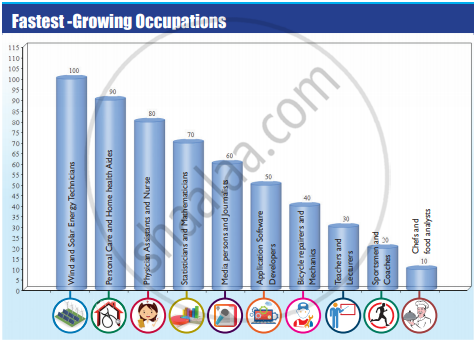
Look at the following non-verbal representation. Based on your understanding and inference, write a paragraph on career trends in the next decade.
Read the following information given in the table below and answer the questions.
| A nice choice from Chennai to the National capital | |||
| RAJADHANI EXPRESS TIMETABLE | |||
| Shortest Route between Chennai and Hazrat Nizamuddin 8 Halts & 324 intermediate stations in between | |||
| Station Name | Departs | Day | Speed |
| Chennai Central | 06.05 | 1 | 75 |
| Vijayawada | 11.55 | 1 | 76 |
| Warangal | 14.40 | 1 | 77 |
| Balharshah | 18.00 | 1 | 78 |
| Nagpur | 20.45 | 1 | 74 |
| Bhopal | 02.10 | 2 | 89 |
| Jhansi | 05.31 | 2 | 99 |
| Gwalior | 06.32 | 2 | 85 |
| Agra Cantt | 07.57 | 2 | 76 |
| Hazrat Nizamudin | 10.25 | 2 | - |
a) The number of stations between Chennai Central and Hazrat Nizamudin is______.
- five
- ten
- eight
- eleven
b) The train is expected to reach ______ around 8.45 PM
- Warangal
- Vijayawada
- Bhopal
- Nagpur
c) Between ______ the train runs at its maximum speed.
- Bhopal and Gwalior
- Bhopal and Jhansi
- Bhopal and Hazarat Nizamudin
- Bhopal and Agra
d) Almost ______ the train reaches Vijayawada.
- the day after
- around early morning
- late night
- around noon
e) People prefer the Rajadhani Express to travel from Chennai to reach the capital because ______.
- it reaches the destination on the same day
- the charge is reasonable.
- the train halts at ten stations.
- it is the shortest route from Chennai to New Delhi.
f) The destination of Rajadhani express is______.
- Hazarat Nizamudin.
- New Delhi junction.
- Old Delhi.
- Rajkot.
