Advertisements
Advertisements
Question
Who gives medicine/treatment to sick animals and birds?
Advertisements
Solution
The doctor who treats animals is called a veterinarian.
APPEARS IN
RELATED QUESTIONS
Read the passage carefully.
1. I remember my childhood as being generally happy and can recall experiencing some of the most carefree times of my life. But I can also remember, even more vividly, moments of being deeply frightened. As a child, I was truly terrified of the dark and getting lost. These fears were very real and caused me some extremely uncomfortable moments.
2. Maybe it was the strange way things looked and sounded in my familiar room at night that scared me so much. There was never total darkness, but a street light or passing car lights made clothes hung over a chair take on the shape of an unknown beast. Out of the corner of my eye, I saw curtains move when there was no breeze. A tiny creak in the floor would sound a hundred times louder than in the daylight and my imagination would take over, creating burglars and monsters. Darkness always made me feel helpless. My heart would pound and I would lie very still so that 'the enemy' wouldn't discover me.
3. Another childhood fear of mine was that I would get lost, especially on the way home from school. Every morning, I got on the school bus right near my home ‒ that was no problem. After school, though, when all the buses were lined up along the curve, I was terrified that I would get on the wrong one and be taken to some unfamiliar neighbourhood. I would scan the bus for the faces of my friends, make sure that the bus driver was the same one that had been there in the morning, and even then ask the others over and over again to be sure I was in the right bus. On school or family trips to an amusement park or a museum, I wouldn't let the leaders out of my sight. And of course, I was never very adventurous when it came to taking walks or hikes because I would go only where I was sure I would never get lost.
4. Perhaps, one of the worst fears I had as a child was that of not being liked or accepted by others. First of all, I was quite shy. Secondly, I worried constantly about my looks, thinking people wouldn't like me because I was too fat or wore braces. I tried to wear 'the right clothes' and had intense arguments with my mother over the importance of wearing flats instead of saddled shoes to school. Being popular was very important to me then and the fear of not being liked was a powerful one.
5. One of the processes of evolving from a child to an adult is being able to recognise and overcome our fears. I have learnt that darkness does not have to take on a life of its own, that others can help me when I am lost and that friendliness and sincerity will encourage people to like me. Understanding the things that scared us as children helps to cope with our lives as adults.
(a) On the basis of your reading of the above passage, make notes using headings and subheadings. Use recognizable abbreviations wherever necessary.
(b) Make a summary of the passage in not more than 80 words using the notes made and also suggest a suitable title.
Answer any four of the following questions in 30-40 words each:
(a) What did Franz wonder about when he entered the class that day?
(b) What shocking experience did Douglas have at YMCA pool?
(c) Why does Kamala Das compare her mother to 'a pale winter's moon'?
(d) What rich bountry has the heaven given us? (A Thing of Beauty)
(e) Why did the Maharaja have to pay a bill of three lakh rupees to the British jewellers?
(f) What problem did Roger Skunk face when he went to play with his friends. How did he solve it?
Read the following passage carefully and complete the activities given below :
A.1) Complete the web :
Write the words from the passage on the web. 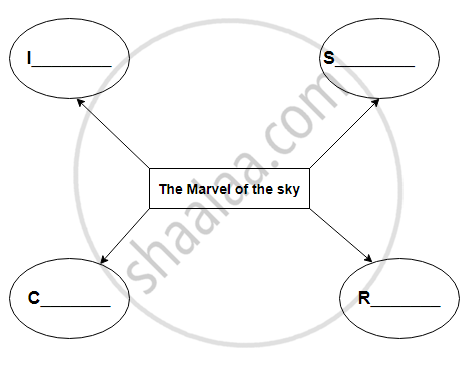
We saw small bits of grass peeping through the small cracks in concrete pavement. It left us thinking: however impossible things may look, there is always an opening…………
We saw a tree bare of all leaves in the cold winter months. We thought its chapter was over. But three months passed, spring set in and the tree was back to its green majesty once again, full of leaves, flowers, birds, and life. What if we too had the conviction that, however difficult things are right now, it will not remain so forever. Remember, this too shall pass.
We saw an army of ants lugging a fly which was at least ten times the ant’s size. The ants organized themselves around the fly, lifted it on frail feelers and carried it to quite a distance. Their teamwork and perseverance were impressive. What if we too are consistent, organized, focused ……… Spider webs are delicate, yet very strong. A rainbow colors the entire sky. Oysters take in a grain of sand they open up with a pearl. Innumerable stars shine across the infinite sky. Clouds take new shapes with every passing moment. The wind makes trees dance with unhindered passion. Water, without a hint of ego, changes its form according to the dictates of the sun and the wind. When we see a caterpillar turn into a butterfly, a flower turns into a fruit, we experience the alchemy of nature ………. We touch it and become gold ourselves.
A.2) Finding meanings :
Write what you mean by :
(i) _______ there is always an opening.
(ii) _______ its chapter was over.
(iii) _______ the tree was back to its green majesty.
(iv) _______ this too shall pass.
A.3) Matching :
Match the words in Column ‘A’ with their synonyms in Column ‘B’:
| Column 'A' | Column'B" | ||
| (i) | conviction | (a) | strong feeling |
| (ii) | alchemy | (b) | delicate |
| (iii) | frail | (c) | mysterious/magical power |
| (iv) | passion | (d) | strong belief |
A.4) Language study :
Rewrite the sentence using the correct question tag given in the brackets :
(i) Water changes its form. (does it?, do it?, do they?, doesn’t it)
(ii) However impossible things may look, there is always an opening. (Rewrite using ‘but’)
A.5) Personal Response :
Nature is the best teacher. Explain.
Tick the statement that is true.
The story tries to relate history to Science.
Discuss the following statement in groups of two pairs, each pair in a group taking opposite points of view.
The methods of inquiry of history, science, and philosophy are similar.
Do you think that the ruled always adopts the language of the ruler?
Is drama a good medium for conveying a social message? Discuss.
Divide the story into parts. Make 4 groups in your class. Each group should take one of the 4 parts to convert the story into a play and enact your part.
Make pair of sentences to show the difference between the meaning of the following Homograph from the story.
interest
State whether the following statement is true or false. Correct the false statement.
The Ear was appointed as a judge.
Match the terms in ‘A’ with their explanation in ‘B’.
| 'A' | 'B' | ||
| (1) | tooth- extraction | (a) | a cut made for surgery |
| (2) | cardiac | (b) | having length, breadth, and depth |
| (3) | sedative | (c) | plastic surgery |
| (4) | tumor | (d) | related to the heart |
| (5) | incision | (e) | a control unit for a robotic surgery |
| (6) | a console | (f) | removing a decayed tooth |
| (7) | 3-D | (g) | a substance that makes a person sleep |
| (8) | Cushing clip | (h) | an extra growth in the body |
| (i) | a device to stop blood loss in neurosurgery |
Answer the following question in short.
Explain the significance of the title.
Write about how your family supports you to go to school.
Write in short about what your parents/guardians feel when they send you to school.
Read each invitation carefully, keeping in mind the list of eight questions given below. Note the answers in your notebook. Verify that the formal invitation ‘A’ covers all the eight points. Now see which of these eight points are covered in the other invitations ‘B’, ‘C’ and ‘D’. Put tickmarks against the points that are covered.
- A formal invitation
- An oral invitation
- A notice
- Another oral invitation
- Who is sending/giving the information?
- What is the programme?
- What is the name of the project?
- Who will inaugurate it?
- Who will preside over the function?
- What time will the function start?
- Where will it take place?
- How many names get mentioned in the invitation?
| Points | A | B | C | D |
| (1) | ✓ | |||
| (2) | ✓ | |||
| (3) | ✓ | |||
| (4) | ✓ | |||
| (5) | ✓ | |||
| (6) | ✓ | |||
| (7) | ✓ | |||
| (8) | 6 |
Gather more information about the following from your Science textbook, the internet, and other sources.
Gravitational force
Read the ode ‘To Autumn’ by the famous poet John Keats. ‘Season of mists and mellow fruitfulness...’
Pick out from the poem, two lines each that reflect an optimistic (positive) attitude and pessimistic (negative) attitude.
Optimism :
- ______
- ______
Pessimism :
- ______
- ______
List and say whether the following statement agrees with the passage or not.
When you want to make a speech, there’s no need to think about it in advance.
What do the people do when the festival of Music is celebrated?
How is water produced in Mars?
Choose the odd one out.
______helped Bujju to reach his family.
Why do we ask questions?
Read the advertisement and answer the question given below.

What is free, for LED TV?
Where do ants pile their food?
Jana and her family moved to the village _______ ago.
Before going to bed that night, Chris gave his new teacher a ______.
Recite the poem Never give up with correct intonation.
Where did the rabbit go?
