Advertisements
Advertisements
प्रश्न
What, according to Ruskin, are the limitations of the good book of the hour?
Advertisements
उत्तर
According to Ruskin, the limitations of the good book of the hour are that these are not true books but merely letters or newspapers in good print. The good books of the hour are simply some useful or pleasant talk of some person whom one cannot otherwise converse with. These good books are written merely for the purpose of communication to a wider audience. According to the essayist, these good books are rather books of talk which are printed only because their authors cannot speak to thousands of people at once. These are mere conveyance of voice through printed words.
APPEARS IN
संबंधित प्रश्न
Answer any four of the following in 30 − 40 words each:
(a) "It is his karam, his destiny." What is Mukesh's family's attitude towards their situation?
(b) What were the terms of the indigo contract between the British landlords and the Indian peasants?
(c) How will 'keeping quiet' protect our environment?
(d) Which objects of nature does Keats mention as sources of joy in his poem, 'A Thing of Beauty'?
(e) Why did the Tiger King decide to get married?
(f) What was Sadao's father's dream for him? How did Sadao realise it?
Complete the call-outs:
A.1)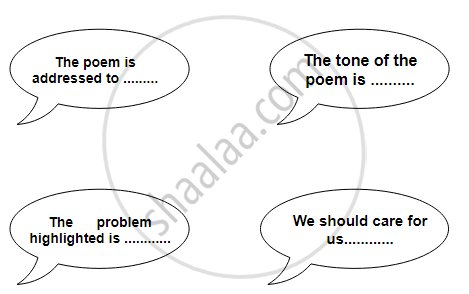
Our world is an institution
Of environmental pollution
We choose not to care
For our future generations
And I for one am guilty
For buying the hundreds of electronic gadgets
That attracts the industries to produce like maggots
environmental pollution is at the heart of our planet
The forests are dying
Wildlife is crying
Millions of fish are dying
Mother earth is sighing
Tell me is it right
That we sleep well at night
Replenishing ourselves
For tomorrow’s greedy fight
Overcrowded trains
Overloaded brains
Where is the light? What is our plight?
While the river break their banks
And greedy industries play their polluted pranks.
A.2) Find the examples that show that we do not care for our future generation
A.3) Match:
Match the lines in Column ‘A’ with the figures of speech in Column ‘B’:
| Column ‘A’ | Column ‘B’ | ||
| (i) | Our world is an institution | (a) | Personification |
| (ii) | Mother earth is sighing | (b) | Simile |
| (c) | Metaphor |
Give reasons for the following statement.
The author’s experience at Hor was in stark contrast to earlier accounts of the place.
Discuss in groups of four.
The sensitive behaviour of hill-folk.
Briefly comment on:
Tsetan’s support to the author during the journey.
Notice the italicized sentence placed at the top of the article which tells us at a glance what the article is about.
Astrologers' perceptions are based more on hearsay and conjecture than what they learn from the study of the stars. Comment with reference to the story.
Discuss the following in pairs or in small groups.
Exceptionally talented people are born so; talent cannot be cultivated
Read the following statement and mark those that apply to you.
I have a small group of close friends and have no wish to interact with anyone else.
Name the world-famous personality who reached great heights despite of humble circumstances.
Find from the story one word for the following.
any animal that catches mice ______
Make sentence of your own using the following expression.
overcome:
Read the story and complete the following.
Revathi was confident of proving her ownership of her pot of plants because, ____________.
The word 'report' means -
(a) Give a spoken or written account of something.
(b) Cover an event or subject as a journalist or reporter.
Everyone admired the statue of the Happy Prince.
Building a bridge needs careful planning. Think about what goes on before the actual construction begins.
- Proper planning
- ________________
- ________________
- ________________
- ________________
Doctors who do special advanced study of specific parts of the body have special terms.
In your group try to match the specialist doctors with who / what they treat.
| Specialists | Who/What they treat | ||
| 1. | Dentist | a. | bone |
| 2. | Cardiologist | b. | brain/with spine |
| 3. | Ophthalmologist | c. | small kids |
| 4. | Orthopedic | d. | teeth |
| 5. | Pediatrician | e. | animals/birds |
| 6. | Neurologist | f. | eye |
| 7. | Veterinarian | g. | heart |
Read the lesson and name the following.
A sack around the heart ______
Say WHY. . . . . .
Ramanujan had to be hospitalized.
Write a sentence each about three of your friends. Each time you should say what your friend cannot do, and yet, pay a compliment to your friend.
Suggest what you would do in the following situation:
One particular friend of yours is always late for college, social functions, movies, etc. and delays everyone.
Have you seen a newborn young one of an animal?
Visit a library:
Find and read stories and poems written by Edith Nesbit.
Read the following and observe the use of tenses.
‘Last week I witnessed a strange accident. Let me tell you about it. The signal flashes green. Vehicles start in the opposite direction. They move fast. Suddenly a speeding motorcyclist tries to cut across, from the wrong side. He is about to collide with a loaded truck. He applies the brakes. He falls and slides out with his bike from under the truck. He comes out unscathed on the other side.’
- When an event, which has occurred in the past, is narrated in the Present Tense to create a dramatic effect its Tense is called the ‘Dramatic Present Tense’.
- Now try to relate Jayant’s sci-fi story, in brief, in the dramatic past tense.
Choose the appropriate phrase to insert in the gap, to make the sentence meaningful. Use the appropriate form of the verb.
After I took the medicine, I ______ ______ the pain.
Find from the Internet and write down.
From which play is this song extracted?
Pick out three examples of interrogation (rhetorical questions) from the poem.
Explain in your own words the point that each one makes.
| Interrogation | Explanation |
| (1) | |
| (2) | |
| (3) |
Form groups of five. Discuss how you can complete the rest of the story without referring to Part II of the story.
Describe the following with the help of the (The Twelve Months) story.
Summer
Name the following.
Not comfortable with the wet ground.
Find out how the following game is played.
Football
Prospero ordered Ariel to bring ____________ to his place.
What do you understand by the mother’s act of throwing the shoe?
What do the people do when the festival of Music is celebrated?
Neerja leapt into action when she______.
How does the coconut tree grow?
Who is Muthu?
Write a paragraph about 50 words describing the scenes that the poet passed by.
They all stood around the little jewel of blue means______.
Jaswantgarh is named after the Indian soldier ______.
Look at the picture and tick Choose the correct word.

The old man is _____.
Did they find a new country?
Will you solve a mystery with friends? Why?
Why do we ask questions?
Choose and write the adverbs to complete the sentence.

My dog barks ______.
How did they go to school?
Teddy took his pillow as a sign of ______ them.
Who were the guest to Kani’s home?
Whose word are these? Name the character.
“Utensils made of brass and tin for sale!”
Read the passage carefully and answer the following question.
What did the farmer find in the field?
How did Bala help Amma and sisters?
Name the pictures and match it with the rhyming words.
 |
dancer | |
 |
floor | |
 |
will | |
 |
rush |
What subject did he like the most?
How did Alice reach Wonderland?
How was the stump of the tree useful?
Say Aloud
| dash | bash | splash | cash | trash |
| steer | tear | clear | deer | dear |
| shower | power | tower | flower | mower |
| poked | croaked | soaked | stroked | joked |
| wept | kept | crept | leapt | slept |
What are the details not to be revealed in public domain?
What should parents do to ensure the safety of children in cyber space?
Why is it not advisable to play online games?
