Advertisements
Advertisements
प्रश्न
How does the ‘assortment of remarks’ compiled by the author give us an understanding of the ways of science and poetry?
Advertisements
उत्तर
The assortment of remarks compiled by the author helps in providing an answer to the question ‘Why is there a difference in the patterns of creativity among the practitioners in the arts and the practitioners in the sciences?’ It shows how different poets view science and how they use their work to condemn or appreciate the work of the scientists. It even provides a glimpse of how scientists appreciate those poets who acknowledge the importance of science. The remarks also include a narrative of Charles Darwin, a scientist, who was also highly interested in literature during his young years, and of Faraday who introduced some remarkable inventions. An extract from Shelly’s A Defense of Poetry, talks highly about the work of the poets and the importance that poetry holds.
APPEARS IN
संबंधित प्रश्न
What were Helen’s memories of Radcliffe?
Read the passage and complete the activities given below
B1 Complete the table :
A few facts about the Mehendi rituals during marriage ceremonies are given below :
Write them into appropriate columns :
(i) A simple family affair.
(ii) Song and dance performances accompanied by lavish food and entertainment.
(iii) Creative family members, apply Mehendi to the bride.
(iv) Beauticians are appointed to apply Mehendi to the bride.
Fill in the table as :
| Yesteryears | Present times |
| (i) | (i) |
| (ii) | (ii) |
Mehendi enjoys special attention during the wedding. In India, the day before the wedding is devoted exclusively to the elaborate ritual of applying Mehendi on the hands and feet of the bride. This practice is followed in Arab countries as well, except that it is held a few days prior to the wedding day. Songs are woven around the healing properties and lucky omens associated with mehndi are sung by the bride’s family and friends. An age-old belief handed down to generations lays great emphasis on the color of the bride’s Mehendi – a darker color suggests bountiful love and affection from the future in-laws and husband, and for this reason, brides take the pain to ensure that only the best quality henna is used for her wedding day.
The ritual of adorning the bride with henna is a sacred one and in some communities requires the initiation by the mother-in-law. A popular game during marriage function is the search for their names, by the bride and groom hidden within the elaborate pattern on the bride’s hands.
In certain parts of India, the bridegroom has his hands decorated with henna. The Mehendi function during marriages has evolved from simple family affairs of yesteryears to elaborate events of today. A lavish spread of food and entertainment in the form of song and dance performances have transformed it from a small function to a gala prelude. In earlier days, the task of applying Mehendi on the bride was the sole prerogative of creative family members. The demand for intricate and different style now, sees this job outsourced to beauticians skilled in this art. Beauty salons charge according to the style and complexity of pattern desired by the clients.
B2 What is the age-old belief related to the bride’s Mehendi color and its significance?
B3 Find the words :
Find the words from the passage :
| Noun | Verd | Adjectives |
| (i) attention | attend | _______________ |
| (ii) creation | _________________ | creative |
A lot of money is spent nowadays on marriage ceremonies. What is your opinion about it?
Read the following passage and do the activities:
A1 True or False:
Rewrite the following statements and state whether they are ‘true’ or ‘false’.
(i) Mashelkar’s mother did menial work to bring him up.
(ii) Mashelkar’s father died when he was twelve.
(iii) Mashelkar was born in a very rich family.
(iv) Tatas added much value to Mashelkar’s life.
I start with my greatest guru-my mother. I was born in a very poor family and my father died when I was six. We moved to Mumbai and my mother did menial work to bring me up. Two meals a day was a tough challenge. I studied under street lights and I walked barefoot until, I think, I was twelve. I remember when I passed the seventh standard and I wanted to go into the eighth standard, our poverty was such that even to secure 21 rupees for secondary school admission became a big challenge. We had to borrow from a lady, who was a housemaid in Chaupati in Mumbai. That was the tough life I had.
In fact, I remember, my passing the SSC Examination-i.e. 11th standard. Those days it used to be not 10th standard or 12th standard but 11th standard. I stood 11th among 1,35,000 but I was about to leave higher education and find a job. What helped me was the scholarship by Sir Dorab Tata Trust. It was just 60 rupees per month and would you believe that 60 rupees per month from Tatas added so much value to my life that I have been able to stand here today before you to speak to you.
I am on the Board of Tatas now and it is very interesting that the same Bombay House where I used to go to collect that 60 rupees per month now one goes and sits there like a Director on the Board of Tata Motors. The turn that these 40 years have taken is very interesting. It has all been possible because of the chance I got to do higher studies at the insistence of my mother. She gave me the values of my life. She was one of the noblest parents I have met in my life.
So, my greatest guru was my mother. My second guru was Principal Bhave, about whom I made a mention earlier. He taught us Physics. Because it was a poor school, I remember, it had to innovate to convey to the young students the message of Science.
A2 Complete:
Complete the following sentences and write:
(i) Mashelkar was inspired by his greatest guru _______
(ii) Mashelkar studied under _______
(iii) Principal Bhave taught _______
(iv) The scholarship by _______ Trust helped him in higher education.
A3 Find the meaning:
Choose the appropriate meaning of the underlined words from the given alternatives:
(i) We moved to Mumbai and my mother did menial work.
(a) skilled
(b) hard
(c) unskilled
(d) of low status
(ii) Because it was a poor school, it had to innovate to convey to the young students the message of science.
(a) do a cheap experiment
(b) introduce new things
(c) avoid
(d) try hard
(iii) I got to do higher studies at the insistence of my mother.
(a) firm saying
(b) being inspired
(c) being inspected
(d) being instigated
(iv) That was the tough life I had.
(a) difficult
(b) soft
(c) cheap
(d) simple
A4 Match:
Match the following sentences with their tags:
| 'A' | 'B' | ||
| (i) | I stood 11th among 1,35,000 |
(a) | aren’t I? |
| (ii) | I am on the Board of Tatas | (b) | didn’t we? |
| (iii) | It was a poor school | (c) | didn’t I? |
| (iv) | We moved to Mumbai | (d) | wasn’t it? |
A5 Personal Response:
“Mother is the greatest Guru.” Discuss.
Tick the statement that is true.
The places mentioned in the story are all imaginary.
Briefly explain the following statement from the text.
“You neither travelled to the past nor the future. You were in the present experiencing a different world.”
Comment on the way in which the theme of the story has been introduced.
'New Literature' is a misnomer for the wealth of the Indian Literary tradition. How does G. N. Devy explain this?
Adi Song for the Recovery of Lost Health' is in Miri Agom while Adi Agom is the Adi community's language for routine conversation. How does this reflect upon the high level of language sensitivity of the Adi? Can you think of other parallels in modern languages between the literary variety and the colloquial variety?
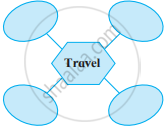
Pick out words from the poem to fill in the web diagram. They should be related to the theme in the web.
A small thought, put in action, led to a great achievement. Pick out the lines from the beginning and end of the poem and explain their significance.
Stories can be told even in the form of poetry. Such poems are called Narrative poems. Narrative poems do not always follow rhythmic patterns of a fixed rhyme scheme. Such poems are written in a style called ‘Free Verse.’
Recall and name some narrative poems you have done/read earlier.
Go through the poem and state whether the following statement is true or false.
Planners plan to construct buildings wherever they find a place.
Discuss with your partner the different ideas connoted by the word 'season'.
- _______________________
- _______________________
- _______________________
Write a short autobiography of any bird or animal of your choice.
Suggest what you would do in the following situation:
Your very close friend has been using a fake social media account to play pranks on others and is not ready to stop in spite of several attempts by you.
Find out the different processes by which fabrics are made. Find illustrations and write a few lines on each process.
State whether the following statement is True or False:
Titania falls in love with an ass.
Explain the following statement with reference to the context.
Because your father can't do without my help.
Does the traveller really have a magic stone?
An activity:
Speak fast, think faster! Form groups of 4-6. Discuss each of the following topics. Then each person in the group should choose a topic and speak about it for one minute. Try to say as many sentences as you can in that time
What is not likely to happen or will never happen...
‘It won’t rain in the classroom... I won’t ever see a live dinosaur... The sun will never set in the east...’ etc.
Write a short note on the following:
Sujata’s offering
Prepare a short note on sea turtles with the help of the information given in the passage.
Prepare similar word chains using the following ideas.
wind - breeze __________________.
Read the passage and name the following.
He persuaded Helen to elope with him.
The Emperor says he had realised earlier that Abdul has great talent. Does this tally with his actions? Give your opinion.
Pick out the line that means:
Sing in such a manner:
Make adjectives from the following.
- harm
- continue
- believe
- fear
- thought
- wish
- question
- courage
Read the following pieces from the story and suggest a title for each as shown in the 1st one.
| From | Up to | Title | |
| 1. | It was a hot afternoon ______ | ______ said the aunt weakly. | ‘Children Pester their Aunt’ |
| 2. | The smaller girl created a diversion ______ | ______ likely to lose his bet. | ______ |
| 3. | In a low confidential voice ______ | ______ it was so stupid,” said Cyril. | ______ |
| 4. | She (Bertha) did all that she was told ______ | ______ must be an extra good child. | ______ |
| 5. | The storyteller paused to let ______ | ______ popular tunes of the day. | ______ |
| 6. | Bertha was trembling very much ______ | ______ the three medals for goodness ______ | ______ |
Write in your own words.
What does the poet miss?
Write out a few things that you would really miss about your home if you were to stay away from it for long.
Now try to add a contradictory word to the following:
- What a ______ mess you’ve got us into!
- It’s a ______ imitation of a diamond necklace.
- My trip to Matheran was a ______ holiday.
- With such heavy makeup, she looks ______ ugly.
- A ______ crowd gathered to see the magic show.
Note: Contrasting words that go together are examples of the language device called Oxymoron.
Fill in the blank choosing the appropriate word/idiom from the lesson.
In the examination, I did not know the answer, so I ______.
Find two examples of the following from the lesson.
A Statement
What is the ‘Internet’?
Identify the character or speaker.
He was the chief of all spirits.
The author left the ties in the taxi.
Find out the rhyme scheme employed in the fourth stanza.
Can a courageous man be defeated? Why?
Olive Ridleys are the only sea turtles seen on Indian shores.
Read the poem aloud in pairs.
Grandfather felt planting trees would help the forest because______.
Identify the sports and the sports personalities from the lesson and fill in the table.
| Sports | Name of the player & Field of sports | Awards |
 |
||
 |
||
 |
Identify the speaker/character.
"Don't let us down now, Gulliver; we need your help."
In the Earth, we get water from ______.
Which planet has rings around it?
Jaswant decided to stay in his post.
Try your own.
| Our national emblem is taken from Ashoka’s pillar at Sarnath. It is found on all government documents, coins, currency notes, postcards, and envelopes. It consists of four lions standing back to back but, we can see only three lions at a time. There is a Dharma chakra in the centre of the base plate, with the figure of a bull in the right and that of a horse in the left. The entire structure is sitting on a lotus. The words ‘Sathyameva Jayate’ is written under it in Devanagari script. These words mean, ‘Truth alone Triumphs’. |
- Where is our national emblem taken from?
- Where is our national emblem found?
- What does ‘Sathyameva Jayate’ mean?
- What are the animals found in the emblem?
Write the rhyming word.
Nature - ______.
Write the rhyming word.
face - ______.
Anbu was talented in catching______.
Read the advertisement and answer the question given below.

What is the name of the dealer?
Kani took Teddy out for a ____.
Fill in the blank with rhyming word.
tunnels- ______
Nithin had many ______toys.
He got an admission to study at Stanford University ______.
What did the library door say?
Where did they go to buy books?
Say Aloud
| dash | bash | splash | cash | trash |
| steer | tear | clear | deer | dear |
| shower | power | tower | flower | mower |
| poked | croaked | soaked | stroked | joked |
| wept | kept | crept | leapt | slept |
Read the following passage carefully and answer the following questions.
Pollution is the introduction of contaminants into the environment that cause harm to the ecosystem. The different kinds of pollution are air pollution, water pollution and land pollution. The release of various gases, finely divided solid particles, or liquid droplets that escape into the atmosphere to disperse and dilute in the environment is called air pollution. Modern society is also concerned about specific types of pollutants, such as noise pollution, light pollution, and plastic pollution.
Particulate Matter (PM), also known as particle pollution, is a complex mixture of extremely small particles and liquid droplets that get into the air. These particles if inhaled can affect health. The impact of PM 2.5 is particularly high in South Asia. Outdoor pollution is caused by a variety of pollutants like public and private vehicles, waste burning in the open, power production industries and construction and even cigarette smoking in public places.
Presently, air pollution is a major and growing risk factor for ill health in India. Delhi is one of the most air polluted cities in India. The air in the city as well as areas surrounding it has worsened to extremely hazardous levels in the recent years. This year’s pollution level is the worst in four years. Several studies have shown that poor air quality is a cause for many health issues among people with lower respiratory disorders with symptoms like dry cough, breathlessness, wheezing, chest discomfort, serious lung infections and cardio vascular diseases. Some studies throw light on the fact that about 16 per cent of the deaths worldwide in 2015 were due to pollution.
Air Masks are an option to protect oneself outdoor. Air masks can be used while commuting or while one is exposed to a polluted area. Some of these masks also include a layer of Activated carbon to filter the air. They protect us from suspended air particles and particulate matter up to the size of 2.5 microns and above. Their usage is limited to some days and should be disposed off after their prescribed duration of usage. The price for air masks starts from Rs 100 and can go up to Rs 500 and more.
We have to take active measures to control pollution and protect ourselves to lead a healthy and pollution free life.
- What is meant by pollution? Mention the different kinds of pollution.
- How does Particulate Matter cause air pollution?
- Identify three major causes of pollution in air
- Name the types of pollution we encounter now.
- What sort of health issues do people face due to air pollution?
- How can we protect ourselves outdoor from air pollution?
- Suggest a suitable title to the passage.
- Identify the meaning of the word similar to the one used in the fourth para:
- emerging
- filtering
- floating
- falling
