Advertisements
Advertisements
Question
How does the ‘assortment of remarks’ compiled by the author give us an understanding of the ways of science and poetry?
Advertisements
Solution
The assortment of remarks compiled by the author helps in providing an answer to the question ‘Why is there a difference in the patterns of creativity among the practitioners in the arts and the practitioners in the sciences?’ It shows how different poets view science and how they use their work to condemn or appreciate the work of the scientists. It even provides a glimpse of how scientists appreciate those poets who acknowledge the importance of science. The remarks also include a narrative of Charles Darwin, a scientist, who was also highly interested in literature during his young years, and of Faraday who introduced some remarkable inventions. An extract from Shelly’s A Defense of Poetry, talks highly about the work of the poets and the importance that poetry holds.
APPEARS IN
RELATED QUESTIONS
Answer any four of the following in 30−40 words each:
(a) What did garbage mean to the children of Seemapuri and to their parents?
(b) How did Rajkumar Shukla establish that he was resolute?
(c) 'Life is what it is all about;...' How is keeping quiet related to life?
(d) Mention any four things of beauty that add joy to our life.
(e) The manner of his (the Tiger King's) death is a matter of extraordinary interest. Comment.
(f) In what condition did Dr. Sadao find the American soldier at the seashore?
Complete the flow-chart :

Mention the odd way in which the author’s grandmother behaved just before she died.
Notice these expression in the text. Infer their meaning from the context.
billowed
Discuss in groups of four.
The sensitive behaviour of hill-folk.
Notice this expression in the text. Infer its meaning from the context.
blow-by-blow account
Briefly explain the following statement from the text.
“You have passed through a fantastic experience: or more correctly, a catastrophic experience.”
Discuss the following statement in groups of two pairs, each pair in a group taking opposite points of view.
The methods of inquiry of history, science, and philosophy are similar.
Discuss in groups plays or films with a strong message of social reform that you have watched.
Explain the metaphor in the line: ‘Poets are the mirrors of gigantic shadows that futurity casts on the present’.
Read the poem and write 3 qualities of the following.
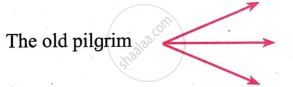
Think and answer in your own words.
Why is the street light compared to a one-red-eyed-giant?
The best punishment is ‘forgiveness’. Discuss the sentence in light of the text you have read. You can make use of the following points.
(a) Forgiveness provides an opportunity to change the behaviour.
(b) Forgiveness leads to repentance.
(c) A person may commit a mistake/crime impulsively or under the force of strong emotions.
(d) ________________________
(e) ________________________
Find out from the internet the poem ‘Song of Youth’ by Dr APJ Abdul Kalam.
- Copy it down in your notebook and write its theme in your own words.
- Using information from your school library or the Internet, prepare a Profile of any great Indian Scientist.
Stories can be told even in the form of poetry. Such poems are called Narrative poems. Narrative poems do not always follow rhythmic patterns of a fixed rhyme scheme. Such poems are written in a style called ‘Free Verse.’
Recall and name some narrative poems you have done/read earlier.
Go through the poem and state whether the following statement is true or false.
The newly planned city looks modern and amazingly beautiful.
Imagine that one of your family members/friends/classmates has recently undergone surgery. You were curious and wanted to learn about his/her experience.
Match the questions you asked with their answers.
| 1. | What health problem did you suffer from? | a. | I was given a bath and I wore a surgical gown. |
| 2. | Whom did you inform about it first? | b. | I was given an injection of anesthesia. |
| 3. | What type of doctor did you consult? | c. | I consulted an orthopedic surgeon. |
| 4 | How did he/she find out that you needed a surgery? | d. | I was relieved and happy that the operation was over. |
| 5. | What preparation was done before the surgery? | e. | I had fractured my ankle while playing hockey. |
| 6. | What did you feel when you were taken to the operation theatre? | f | No, I did not feel anything. I was fast asleep. |
| 7. | What was the first step before the actual surgery? | g. | I recovered and I could walk normally after 3 weeks. |
| 8. | Did you feel any pain during the surgery? | h. | Our school hockey coach. |
| 9. | What did you feel when you opened your eyes after the operation? | i. | The doctor took an X-ray of my ankle, and he found a fracture in my ankle. |
| 10. | How soon did you recover? | j. | I was very nervous. |
Play the roles of an interviewer and a Great Indian Bustard and present the interview in the classroom.
Ask your parents to show you TV programs on animals, wildlife and conservation on channels like the following:
DD National, National Geographic, Discovery, and Animal Planet.
Shakespeare’s poetry has come to be valued for its own sake on the stage. Comment with reference to the play ‘A Midsummer Night’s Dream.’
Explain the following statement with reference to the context.
And it's by no means the small sacrifice the town will have to make.
Apart from the stone, how many things go into the soup?
Collect as many pictures as you can, or draw diagrams of all the sources you have listed above. Make a scrapbook using them.
Read the poem aloud with the proper rhythm. What does the rhythm remind you of?
Form groups of 4-5. Read the following sentences aloud. Using your imagination and with the help of group discussion, write other situations in which the sentences can be used.
- The outcome: disappointment and anger.
- The hour of battle had sounded
- What a chase!
- This was our chance, .........
Write in your own words.
What message does the poem convey?
Gather more information about cold winters in Russia.
Who said the following, to whom, and when?
“As you desire, Huzoor.”
Find two examples of the following from the lesson.
A Statement
What does the poet want to know from the lark?
Helen Keller’s life is the story of ______.
What powers did Prospero posses?
Mention the things that the grandfather imagined.
Identify the speaker/character.
‘Even though I clearly said no!’
Who was the first person to withdraw cash from the ATM?
Read the data below and answer the following question.
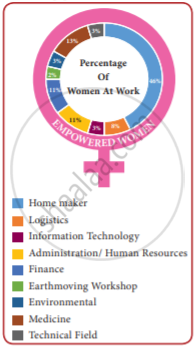
Choose the correct answer.
Percentage of women working in finance is the same as ______.
Tom lay thinking. Presently it occurred to him that he wished he was sick; then he could stay home from school. He examined himself. He found no symptoms or sickness, and he investigated again. This time he felt he had a stomach ache, but it soon grew feeble, and presently died wholly away. He reflected further.
What was the result of Tom’s self-examination?
Usha took shelter in the ______.
Fill in the blank
______ is the festival which fills our hearts with delight.
The terrorists asked Neerja to collect the passports of the passengers because ______.
What is as sharp as a blade?
Narrate the story based on the story map
Read scene I of the play carefully and answer the question below.
List the characters that appear in the scene. What human characteristics do they exhibit?
Where is the key?
What does Megalai do with elders?
Write the rhyming word.
Nature - ______.
What was the age of Robinson Crusoe when he left for sea?
Choose the correct answer.

The brown sparrow laid ________eggs.
______always stays to the last in our needs.
Why did Jana’s friends stop her from going near the tree?
Nithin had many ______toys.
Which problem do you think you can solve with art? How?
Work or play, let us______.
Why did everyone support Megala?
Does the child in the poem like her nose? Why do you think so?
What did Nasruddin boast about?
“Something is wrong,” said Helen’s mother. What was wrong with Helen?
Now, read the following biographical extract on Sujatha Rangarajan, a Sciencefiction writer, and answer the questions that follow.
- Sujatha is the allonym of the Tamil author S. Rangarajan and it is this name that is recognised at once by the Tamil SciFi reading community. You might have seen the Tamil movie ‘Endiran’ where the robot Chitti exhibits extraordinary talents in an incredible manner. The robot could excel a human being in any act, beyond one’s imagination. Jeeno, a robotic dog which appeared in Sujatha’s science fiction novel “En Iniya Iyandhira” (My Dear Robot) formed the basis of Chitti’s character. Like Chitti, Jeeno was an allrounder who could cook, clean and fight. High-tech computer technology terms are used in the story. Jeeno, a pet robot, plays an important role throughout the story. As the story proceeds, it behaves and starts to think on its own like a human and instructs Nila, a human being, on how to proceed further in her crises.
- In the preface of ‘En Iniya Iyandhira’, the writer states the reason for his attraction to the genre: “Science gives us the wonderful freedom to analyse thousands and thousands of alternative possibilities. While using it, and while playing with its new games, a writer needs to be cautious only about one thing. The story should draw some parallels or association from the emotions and desires of the present humankind. Only then it becomes interesting. Jeeno, the robot dog, was intelligent. But the character became popular only because of the robot’s frequently displayed human tendencies.” It is no wonder that all his works echo these words and will remain etched in the minds of the readers who enjoy reading his novels to have a wonderful lifetime experience.
- It was Sujatha, who set the trend for sci-fi stories. He had tracked the origin from Mary Shelly’s Frankenstein to his short stories. He has written 50 sci-fi short stories and these were published in various Tamil magazines. His stories have inspired many readers to extend their reading to English sci-fi writers like Isaac Asimov. The themes were bold, even if there was a dependence on a very well-established characterization of English fiction. Sujatha opened up a new world to us with his writings on holograms, computers and works like ‘En Iniya Iyanthira’ inspire many to study computer science.
- He has been one of the greatest writers for more than four decades. He combined reasoning and science in his writings. Being a multifaceted hi-fi and sci-fi humanistic author, he expressed his views distinctively. He was the one who took Tamil novels to the next level. As an MIT alumnus and an engineer at BHEL, he was very good at technology. He could narrate sci-fi stories impressively. His readers always enjoyed reading all his detective and sci-fi novels which featured the most famous duo ‘Ganesh’ and ‘Vasanth’.
- Sujatha has played a crucial role as a playwright for various Tamil movies which have fascinated movie lovers. Hence, it is fathomable that the writer’s perspective of future India enthuses every reader and paves a new way to reading sci-fi stories in English.
A. Answer the following questions in a sentence or two.
- How was Jeeno different from other robots?
- What precaution should one take while writing Science fiction stories?
- What inspired Sujatha’s themes?
- Why were Sujatha’s sci-fi stories impressive?
B. Find words from the passage which mean the same as the following.
- difficult to believe (para 1)
- a style or category of art, music or literature (para 2)
- having many sides (para 4)
- capable of being understood (para 5)
