Advertisements
Advertisements
Question
Personification is a figure of speech that attributes human qualities to inanimate things and abstract ideas. How has it been used in the poem?
Advertisements
Solution
Padma Sachdev is a Dogri poet that is close to her indigenous language. In her poem Mother Tongue, she is in a melancholic mood for her language is depreciating and that its script has died away. She is admiring her mother tongue Dogri and its native script Sharade and praises it in leaps and bounds. She calls it a “very kind Shahni”, a benevolent mistress, who is always ready to help any author or poet, “ever ready to do her bidding”. Padma transcends the furthest boundary and praises Dogri as if it were the queen of all languages, an empress who is served by all the literature folk and scripts calling them all “her servants”. However, Dogri is just one of many languages spoken in the whole of India. It is one of the 22 scheduled languages in India and is spoken in the Jammu province of J and K and in Northern Himachal and in Azad Kashmir (Neelum Valey). Even the scripts join in and admit that they all are servants of Dogri and helps the poet by giving her a new quill.
APPEARS IN
RELATED QUESTIONS
Answer the following in 120-150 words :
Within a few days of his arrival in Iping, people became suspicious of Griffin. Why?
Big male elephants throw logs at electric fences because
Answer the following in 200-250 words :
Describe Ms. Sullivan's teaching methods?
Tick the statement that is true.
The places mentioned in the story are all imaginary.
Why do you think Professor Gaitonde decided never to preside over meetings again?
The story revolves around characters who belong to a tribe in Armenia. Mourad and Aram are members of the Garoghlanian family. Now locate Armenia and Assyria on the atlas and prepare a write-up on the Garoghlanian tribes. You may write about people, their names, traits, geographical and economic features as suggested in the story.
Discuss the following in pairs or in small groups.
‘Luck is necessary for success in life’.
'The author's treatment of the subject matter makes the readers identify themselves with the experience.' Comment on the statement.
Why has he compared the three passions to great winds?
Many sentences and paragraphs in the excerpt begin with the word ‘And’. To what extent does this contribute to the rhetorical style of the lecture?
Find from the story one word for the following.
a low constant sound made by cats ______
Read the story and complete the following.
When Revathi played her favourite raga, the plants began to move because, ____________.
Add the appropriate Prefix to make the following word opposite in meaning.
continue
Find evidence from the lesson and write in your own words.
We Indians are obsessed with foreign things.
Rearrange the following in the proper order and insert them into a flow chart as per the poem.
- The plate turned to lead when it was gifted to false-hearted claimants.
- Many claimants donated their wealth to receive the plate of gold.
- For almost two years, no claimants received the plate of gold.
- A plate of gold fell in a temple from Heaven.
- The peasant offered comfort and courage to a blind miserable beggar, whom all had ignored.
- The priests announced that the one who loved God most of all would receive the gift from Heaven.
- When the priest gave the plate of gold to that peasant, it shone with thrice its luster.
- A simple peasant, who had nothing to offer, came to that temple.
Go through the poem and state whether the following statement is true or false.
Planners are concerned about the environment of the area.
Discuss with your partner the different ideas connoted by the word 'season'.
- _______________________
- _______________________
- _______________________
Go through the text again to understand the important features of blogs. Discuss various blogs and their features with your friends.
A blog helps us to express our - ___________.
- Feelings
- _________
- _________
- _________
Discuss the question after you have seen a presentation of the ‘ad’.
What does the ad tell you?
Have you seen non-commercial advertisements - those that are not ‘selling’ anything but are only giving people useful information?
Visit a library:
Find and read the biography of your favourite scientist.
Complete the following sentence with reference to the passage:
For six years did Gautama practise ____________.
Discuss:
In the story, human settlements are mentioned but not cities or villages. Why is it so?
The Emperor says he had realised earlier that Abdul has great talent. Does this tally with his actions? Give your opinion.
Read the poem and answer the following.
What are the two different ways of eating strawberries?
An announcement can be made in every class, orally. Or, it can be put up on the school notice-board. Discuss and decide what method should be used for the announcement given here.
Oral aanouncement
Why did he spill the milk?
What does 'Rangaawali' mean?
Guess the meaning of the following word.
fragrant
Answer the following question in about 80-120 word.
If you were to live in the Complaining Street, how would you deal with the people who grumble?
The weather is always too hot or cold; Summer and winter alike they scold. Nothing goes right with the folks you meet Down on that gloomy Complaining Street.
Pick out the rhyming words and identify the rhyme scheme of the above lines.
Activity
It’s fun to help out in the kitchen. You can even practice reading aloud when reading the recipe. And you can learn a little math by figuring out how to measure. Here are a few fun items to make that are “Alice” themed.
Read the poem aloud in pairs
Why does the writer think that the peepul tree is a great show off?
Amma bought the vegetables from the______.
When did Usha Rani start playing Kabaddi?
We don’t use _________ in the soil.
How was he honoured by the Indian government?
Look at the picture and Choose the correct word.

Where was the old man sleeping?
Who is the guest?
Akilan’s passion is to learn ______.
Master trained Akilan on a ______.
Answer using Yes or No and pick sentence from the story to support your answer.
Did Robinson’s ship sink?
What did the archer want to show to the crowd?
What did the five friends call themselves?
______helped Bujju to reach his family.
Match the rhyming words.
| pale | knows |
| boat | gale |
| goes | goat |
The official was transferred.
The villagers took oath not to harm the _______.
What did his mother say in his dream?
Work or play, let us______.
How can we do our work better?
Why did everyone support Megala?
Write the correct word.
| rooster, king, hen, tiger, queen, tigress. |
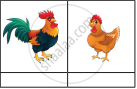
Name a few things that sink.
What did he make out of it?
Read the passage carefully and complete the activities:
A1. Complete the following sentences. [2]
- Female sparrows lay ______.
- Sparrows build their nest out of ______.
- The eggs are ______.
- In cities, sparrows build their nest in ______.
|
A sparrow is a small bird which is found throughout the world. There are many different species of sparrows. Sparrows are only about four to six inches in length. Many people appreciate their beautiful songs. Sparrows prefer to build their nests in low places-usually on the ground clumps of grass low trees and low bushes. In cities, they build their nests in building nooks or holes. They rarely build their nests in high places. They build their nests out of twigs grasses and plant fibers. Their nests are usually small and well-built structures. Female sparrows lay four to six eggs at a time. The eggs are white with reddish-brown spots. They hatch within eleven to fourteen days. Both the male and female parents care for the young. Insects are fed to the young after hatching. The large feet of the sparrows are used for scratching seeds. Adult sparrows mainly eat seeds. Sparrows can be found almost everywhere where there are humans. Many people throughout the world enjoy these delightful birds. The sparrows are some of the few birds that engage in dust bathing. Sparrows will first scratch a hole in the ground with their feet then lie in it and fling dirt or sand over their bodies with flicks of their wings. They will also bathe in water or in dry or melting snow. Water bathing is similar to dust bathing with the sparrow standing in shallow water and flicking water over its back with its wings also ducking its head under the water. Both activities are social with up to a hundred birds participating at once and are followed by preening and sometimes group singing. |
A2. How do sparrows take a bath? [2]
A3. Find out adjectives for the following nouns from the passage. [2]
- ______ Song
- ______ Water
- ______ Bird
- ______ species
A4. Do as directed. [2]
- A sparrow is a small bird which is found throughout the world.
(Underline the subordinate clause) - Female sparrows lay four to six eggs at a time.
(Frame a ‘wh’ type question to get the underlined part as an answer.)
A5. ‘We have to save the birds.’ Do you agree with this statement? Why? [2]
Mention any three details that should not be revealed in public domain.
Write compound word using the pictures.
 |
+ |  |
| ____________ | ||
