Advertisements
Advertisements
प्रश्न
How does the ‘assortment of remarks’ compiled by the author give us an understanding of the ways of science and poetry?
Advertisements
उत्तर
The assortment of remarks compiled by the author helps in providing an answer to the question ‘Why is there a difference in the patterns of creativity among the practitioners in the arts and the practitioners in the sciences?’ It shows how different poets view science and how they use their work to condemn or appreciate the work of the scientists. It even provides a glimpse of how scientists appreciate those poets who acknowledge the importance of science. The remarks also include a narrative of Charles Darwin, a scientist, who was also highly interested in literature during his young years, and of Faraday who introduced some remarkable inventions. An extract from Shelly’s A Defense of Poetry, talks highly about the work of the poets and the importance that poetry holds.
APPEARS IN
संबंधित प्रश्न
Attempt a character sketch of Otto Frank, Anne's father.
Answer any four of the following in 30 − 40 words each:
(a) "It is his karam, his destiny." What is Mukesh's family's attitude towards their situation?
(b) What were the terms of the indigo contract between the British landlords and the Indian peasants?
(c) How will 'keeping quiet' protect our environment?
(d) Which objects of nature does Keats mention as sources of joy in his poem, 'A Thing of Beauty'?
(e) Why did the Tiger King decide to get married?
(f) What was Sadao's father's dream for him? How did Sadao realise it?
(i) The interest of Maharashtra and that of India should be one for the progress of Maharashtra state, because ................
Why do dolphins cover their long noses with sponges or shells ?
Answer the following in 200-250 words :
Describe Ms. Sullivan's teaching methods?
Notice these expressions in the text. Infer their meaning from the context.
-
honing our seafaring skills
-
ominous silence
-
Mayday calls
-
pinpricks in the vast ocean
-
a tousled head
Briefly comment on:
“As a Buddhist, he told me, he knew that it didn’t really matter if I passed away, but he thought it would be bad for business.”
The text is an excerpt from Sesame and Lilies which consists of two essays, primarily, written for delivery as public lectures in 1864. Identify the features that fit the speech mode. Notice the sentence patterns.
Study the Note to Aspects of the Novel given at the end. Discuss the features that mark the piece as a talk as distinguished from a critical essay.
Write words from the poem that describe the following.
- sky ____________
- heart ____________
- hand ____________
- beginning ____________
- surprises ____________
Make sentence of your own using the following expression.
overcome:
Think and answer in your own words in your notebook.
‘Live and let live’ is a famous proverb. Which lines from the poem support this proverb?
Using a dictionary/internet note down the main difference between farm and granary.
Discuss in groups and share with one another.
The daily routine of your mother and father on working days.
State whether the following statement is true or false. Correct the false statement.
The Ear was appointed as a judge.
Answer the following question in short.
Explain the significance of the title.
Comment on the given statement after reading the given dialogue -
It’s a pity some honest man not to be better of that ________________________________________________.
How long a period did Shalihotra allow to find the missing things?
Bassanio borrowed money from Shylock in Antonio’s name.
An activity:
Speak fast, think faster! Form groups of 4-6. Discuss each of the following topics. Then each person in the group should choose a topic and speak about it for one minute. Try to say as many sentences as you can in that time.
Imagine you are watching a scene. For example, someone learning to ride a bicycle; or a cricket match. Give a running commentary on what you see.
‘Monu is sitting on the bicycle. It has side wheels. Monu tries to push the pedal down - No - he stops. His uncle holds the seat in one hand and the handle in the other hand. He says, ‘Come on, Monu’... etc.
This story takes an unexpected turn when the lion decides to spare the camel’s life. Choose any fable, a story that you like, and rewrite it giving it an unexpected turn.
Complete the following sentence with reference to the passage.
They may be composed and sung or recited for many years before __________________.
Write out a few things that you would really miss about your home if you were to stay away from it for long.
Find the meaning of the following word.
starlets
Find out how the following game is played.
Kho-Kho
List and say whether the following statement agrees with the passage or not.
In a discussion, you should share your ideas with others.
Read the word. Write the words that combine to make it.
gentle-hearted
Write other meaningful words that begin/end with snowwhite.
List the polite expressions we use such as ‘Pardon’.
Describe Gulliver’s walk around the city.
What does the poet want to know from the goldfish?
Have you ever seen a bird making its first-ever attempt to fly?
How did Miranda feel when her father raised the storm to destroy the ship?
What made the reporter gaze at the author?
How did Zigzag communicate with the Krishnans?
Read the comic strip and answer the following question.
Which website do you often access? Why?
when to fight for a righteous cause
one did gain considerable applause.
When will one get an applause?
He always had lunch with his family.
Neerja leapt into action when she______.
Read the story and fill in the grid by ticking each character’s qualities.
Discuss in pairs to rate the characteristic and give marks from 1 to 10 depending on the grade of each quality.
Justify your views in one or two sentences.
| Characteristics | Jane Eyre | Mrs. Reed | Bessie | Helen Burns | Miss. Temple |
| arrogant | |||||
| bitter | |||||
| caring | |||||
| courageous | |||||
| cruel | |||||
| emotional | |||||
| friendly | |||||
| kind | |||||
| sensitive | |||||
| rich | |||||
| poor | |||||
| patient | |||||
| self-disciplined | |||||
| unjust |
Raj did not buy______.
In Mars ______ Earth days make a year.
Why did the trees become a green blur?
How does it welcome all?
Pick out the rhyming words from the poem and write.
| Mars | |
| time | |
| be |
Why was the fish floating on top?
Choose and write the adverbs to complete the sentence.

The lion fought _____.
Circle and write the adverbs.
Suddenly the old man fainted. ______
The sparrow solved the problem with her _____.
Pick out the rhyming words and write.
| green | |
| human | |
| will | |
| welfare |
Kamali gave her savings to______.
In real, the test is for______.
Whose word are these? Name the character.
“We do not have money to buy anything.”


Bihar people saved trees by______ painting.
Work or play, let us______.
Write the correct word.
| rooster, king, hen, tiger, queen, tigress. |
Why does the poet feel that the nose is a funny thing?
The passage given below is on Kabbadi. Read the passage and complete the activities that follow.
Kabbadi (கபடி - in Tamil) is a contact team sport that originated in Tamil Nadu, India. It is the national sport of Bangladesh. It is also popular in South Asia and is the state game of the Indian states of Tamil Nadu, Kerala, Andhra Pradesh, Bihar, Haryana, Karnataka, Maharashtra, Punjab, and Telangana.
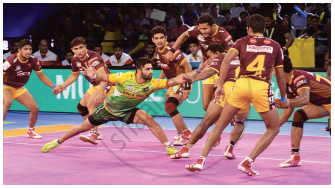
Kabbadi is played between two teams of seven players: the objective of the game is for a single player on offence referred to as a 'raider', to run in to the opposing teams half of a court, tag out as many of their defenders as possible, and return to their own half of the court–all without being tackled by the defenders. Points are scored for each player tagged by the raider, while the opposing team earns a point for stopping the raider. Players are taken out of the game if they are tagged or tackled, but can be 'revived' for each point scored by their team from a tag or tackle. The raider should hold his breath and utter the words like 'kabbadi kabbadi, hututu hututu, chadu kudu' etc. while the opponents try to catch him. If he stops uttering these words, he is considered out.
The game is known by its regional names in different parts of the subcontinent, such as Kabbadi or Chedugudu in Andhra Pradesh, Kabbadi in Kerala and Telangana, Hadudu in Bangladesh, Bhavatik in Maldives, Kauddi or Kabbadi in the Punjab Region, Hu-Tu-Tu in Western India and Hu-Do-Do in Eastern India and Chadakudu in South India. The highest governing body of Kabbadi is the International Kabbadi Federation.
Given below is the visual presentation of the first paragraph.
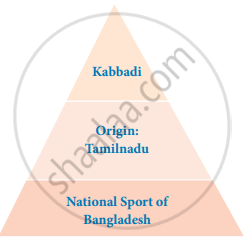
i) Represent the other paragraphs in a visual form of your choice(flow chart, mind-map, pie-chart, etc.).
ii) Choose the correct option.
1. A contact sport usually involves a ______contact between players.
- violent
- gentle
- physical
2. Kabbadi is a game played between ______.
- seven teams of two players
- two teams of seven players
- four teams of seven players
3. A single ______.
- player on offence is referred to as a raider
- offence is referred to as a raider
- raider is an offence by the player
iii) Answer the following.
- How does a raider score points for his team?
- When does a raider concede a point to the opponent team?
- Can a player be revived when he/she is out of the game? Explain your answer.
- Kabbadi is called by different names in different parts of India. Do you know how Pallankuzhi is called in Karnataka, Andhra Pradesh and Kerala?
Being a bachelor, the stranger had no patience with children.
