Advertisements
Advertisements
प्रश्न
The school system often curbs individual talents. Discuss.
Advertisements
उत्तर
A model answer has been provided for students' reference.
It is strongly recommended that students prepare the answer on their own.
Various points to prove the fact that the school system curbs individual talents are:
Focusses more on memorising facts and data rather than encouraging them to understand concepts and ideas.
Thrust on taking exams rather than focussing on increasing the mental and intellectual aptitude of a student;
The irregular student-teacher ratio makes it impossible for the teachers to provide individual attention to each and every student.
One-to-one interaction with the kids have lessened these days.
Quantity matters more than quality.
संबंधित प्रश्न
Answer the following question in 120-150 words:
What kind of life did Silas lead at Lantern Yard?
Read the passage given below and answer the questions that follow:
The term dietary fibres refers collectively to indigestible carbohydrates present in plant foods. The importance of these dietary fibres came into the picture when it was observed that the people having diet rich in these fibres, had low incidence of coronary heart disease, irritable bowel syndrome, dental caries and gall stones.
The foodstuffs rich in these dietary fibres are cereals and grains, legumes, fruits with seeds, citrus fruits, carrots, cabbage, green leafy vegetables, apples, melons, peaches, pears etc.
These dietary fibres are not digested by the enzymes of the stomach and the small intestine whereas most of other carbohydrates like starch and sugar are digested and absorbed. The dietary fibres have the property of holding water and because of it, these get swollen and behave like a sponge as these pass through the gastrointestinal tract. The fibres add bulk to the diet and increase transit time in the gut. Some of these fibres may undergo fermentation in the colon.
In recent years, it has been considered essential to have some amount of fibres in the diet. Their beneficial effects lie in preventing coronary heart disease, and decreasing cholesterol level. The fibres like gums and pectin are reported to decrease postprandial (after meals) glucose level in blood. These types of dietary fibres are recommended for the management of certain types of diabetes. Recent studies have shown that the fenugreek (Methi) seeds, which contain 40 per cent gum, are effective in decreasing blood glucose and cholesterol levels as compared to other gum containing vegetables.
Some dietary fibres increase transit time and decrease the time of release of ingested food in colon. The diet having less fibres is associated with colon cancer and the dietary fibres may play a role in decreasing the risk of it.
The dietary fibres hold water so that stools are soft, bulky and readily eliminated. Therefore high fibre intake prevents or relieves constipation.
The fibres increase motility of the small intestine and the colon and by decreasing the transit time there is less time for exposure of the mucosa to harmful toxic substances. Therefore, there is a less desire to eat and the energy intake can be maintained within the range of requirement. This phenomenon helps in keeping a check on obesity. Another reason in helping to decrease obesity is that the high-fibre diets have somewhat lower coefficients of digestibility.
The dietary fibres may have some adverse effects on nutrition by binding some trace metals like calcium, magnesium, phosphorus, zinc and others and therefore preventing their proper absorption. This may pose a possibility of nutritional deficiency especially when diets contain marginal levels of mineral elements. This may become important constraints on increasing dietary fibres. It is suggested that an intake of 40 grams dietary fibres per day is desirable.
(Extracted from ‘The Tribune’)
(a) On the basis of your reading of the above passage make notes on it in points only, using recognizable abbreviations wherever necessary. Also suggest a suitable title.
(b) Write a summary of the above in about 80 words.
Read the following passage and do the given activities:
B.1) Comparison
Write the comparison between the parts of the modular phone and the human body:
| Modular Phone | Parts of Human Body |
Every phone you buy, no matter how costly and latest it is, will go out of date in a year or so. That’s how quickly the smartphone world is moving right now. To keep yourself up to date with the current specification you will have to keep switching phones every once a while. What’s the solution to this problem?
MODULAR PHONES!
A modular device is a phone, tablet or another device where individual components such as the screen, camera, CPU, battery, memory can be removed by the user and replaced by others with a different specification. Imagine your body to be your phone and your clothes as the components, you can wear anything according to your needs and moods. Similarly, modular phones let you choose between components of different properties and specifications.
This would mean we’ll have the liberty to customize our phones, just like Lego building blocks! The main components of the phone will be Brain (processor), Spine (frame, screen) and Heart (battery). The other components may include a camera, storage memory, GPS, audio jack, speakers, USB module, etc. and the phone will have a motherboard, i.e. a base that will hold all components together
B.2) Give examples:
Write two examples that give the liberty to customize our phone.
• ____________________
• ____________________
B.3) Framing sentence:
Use the given phrases in sentences of your own:
(i) up to date
(ii) once a while
B.4) Write as instructed:
Rewrite the sentence as interrogative:
(i) We’ll have the liberty to customize our phones.
(ii) We will have the liberty to customize our phones. (Rewrite using the present participle form of the underlined word)
B.5) Personal Response
If given a chance to design a modular phone, what new features would you add?
Does the poem have a consistent rhyme scheme?
Nouveau riche and bourgeoise are French words. Collect from newspapers, magazines, and other sources some more French words or expressions that are commonly used in English.
What was the importance of the watch to the author?
What are the criteria that Ruskin feels that readers should fulfil to make themselves fit for the company of the Dead?
The text is an excerpt from Sesame and Lilies which consists of two essays, primarily, written for delivery as public lectures in 1864. Identify the features that fit the speech mode. Notice the sentence patterns.
What would you say are 'the finer growths' that the story supports in a novel?
'Now I hold Creation in my foot' – explain the centrality of this assertion in the poem. What makes the hawk's assertion of its invincibility so categorical?
Read the Preamble of the Constitution of India given in your textbook. Pick out a word that refers to the following.
Brotherhood
Make pair of sentences to show the difference between the meaning of the following Homograph from the story.
interest
You have heard the proverb ‘Plan your work, work your plan’. It means - ________________.
Write four reasons why animals in a zoo suffer more than those who live free in the wild.
Akbar wanted to punish the person who pulled his moustache.
Write a sentence each about three of your friends. Each time you should say what your friend cannot do, and yet, pay a compliment to your friend.
Answer the following question in one sentence.
What examples of man’s progress have been given in the poem?
How long a period did Shalihotra allow to find the missing things?
Write a conversation between a donkey and a dog.
List the lines that begin with 'Here' or 'And here'.
Also, list the sentences or phrases that begin with ‘And there’.
These phrases and sentences tell us about things that appear one after the other as the carriage moves. Can we tell which ones are closer to the train and which ones are at a distance? How?
Read the following and observe the use of tenses.
‘Last week I witnessed a strange accident. Let me tell you about it. The signal flashes green. Vehicles start in the opposite direction. They move fast. Suddenly a speeding motorcyclist tries to cut across, from the wrong side. He is about to collide with a loaded truck. He applies the brakes. He falls and slides out with his bike from under the truck. He comes out unscathed on the other side.’
- When an event, which has occurred in the past, is narrated in the Present Tense to create a dramatic effect its Tense is called the ‘Dramatic Present Tense’.
- Now try to relate Jayant’s sci-fi story, in brief, in the dramatic past tense.
Write in your own words.
What message does the poem convey?
Fill in the blank choosing the appropriate word/idiom from the lesson.
He was dizzy and he ______ the room.
The following thing is mentioned in the poem.
Classify it as a happy and sad thing.
flowers - falling leaves
What are the complaints of the animals?
Guess the meaning of the following word in the poem.
lined
Which event in the story tells us that the scarecrow was intelligent?
List all the pairs of antonyms you find in the passage.
Your parents sometimes behave like the young bird’s parents. They may seem cruel and unrelenting. Does it mean that they do not care for you? Explain your views about it with reference from the story
Rearrange the following sentences in a coherent order.
- He ordered Ariel to torment the inmates of the ship.
- Miranda was attracted by Ferdinand and had more concern towards him.
- Prospero and Miranda came to an island and lived in a cave.
- Prospero forgave them and restored his dukedom, Milan.
- He raised a violent storm in the sea to wreck the ship of his enemies.
- Prospero wanted to test Ferdinand and gave a severe task to perform.
- Using his powers, Prospero released the good spirits from large bodies of trees.
- The King of Naples, and Antonio the false brother, repented the injustice they had done to Prospero.
- Ariel was instructed to bring Ferdinand, the prince of Naples to his cave.
- Ferdinand was the second human whom Miranda had seen after her father
Teach it in accents______ and______.
- soft
- vain
- fear
- joy
- love
- heard
- toiled
- mild
- good
- sand
- life
- harsh
Match the following.
| 1. | A man of ease | Emanuel |
| 2. | John’s trainer | Lalli and Lolly |
| 3. | Mathew’s secretary | John Mathew |
| 4. | John’s chef | Louise |
| 5. | Mathew’s friends | Basky |
Read the poem aloud in groups.
Read the line and answer the question.
And the wheel’s kick and the winds song and the white sail’s shaking
What according to the poet are the pleasures of sailing?
Read the line and answer the question.
And all I ask is a merry yarn from a laughing fellow rover.
What kind of human company does the poet want?
Grandfather helped grandma out with the gardening because he______.
Why did Muthu and his friends step out of the train?
Nilavan unknowingly started the space shuttle.
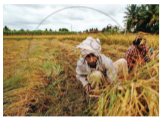
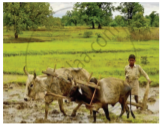
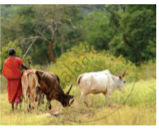
| Mr. Murugan is a farmer. He has a small piece of land and two bulls. He takes good care of his bulls as they help him in farming. Every morning, he takes the bulls for grazing. When it rains he ploughs the land with the bulls. As he has no one to help he starts sowing the seed before sunrise. He irrigates the crop till it grows. He reaps and binds the crop then takes it to thrash the paddy. Finally, with the help of the bulls, he takes the paddy to his house. |
Name the actions of Murugan.
 |
|
 |
|
 |
What was the epidemic that broke out in the story?
Try your own.
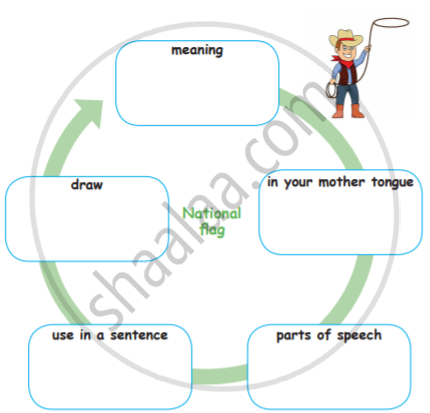
Choose the picture for the passage.
| Our national emblem is taken from Ashoka’s pillar at Sarnath. It is found on all government documents, coins, currency notes, postcards, and envelopes. It consists of four lions standing back to back but, we can see only three lions at a time. There is a Dharma chakra in the centre of the base plate, with the figure of a bull in the right and that of a horse in the left. The entire structure is sitting on a lotus. The words ‘Sathyameva Jayate’ is written under it in Devanagari script. These words mean, ‘Truth alone Triumphs’. |
What does it sing?
What day is it?
Choose the correct option from the given homophones.
I saw a ______ on the flower.
How will you treat your guest?
Where did the bird catcher sit?
Name the character or speaker.
“Learn well, live well!”
They fed fish with______.
______is good at cooking.
Match the rhyming words.
| mars | crime |
| bed | cars |
| time | head |
Match the words with the pictures.
| Robinson |  |
| cannibals |  |
| Friday |  |
| footprint |  |
Match the following.
| pale |  |
| tremble |  |
| fainted |  |
Fill in the blank

Write the rhyming word.
save- ______
The garden Alice saw was
Did the girl buy a picture book?
Read the passage carefully and complete the activities:
A1. Complete the following sentences. [2]
- Female sparrows lay ______.
- Sparrows build their nest out of ______.
- The eggs are ______.
- In cities, sparrows build their nest in ______.
|
A sparrow is a small bird which is found throughout the world. There are many different species of sparrows. Sparrows are only about four to six inches in length. Many people appreciate their beautiful songs. Sparrows prefer to build their nests in low places-usually on the ground clumps of grass low trees and low bushes. In cities, they build their nests in building nooks or holes. They rarely build their nests in high places. They build their nests out of twigs grasses and plant fibers. Their nests are usually small and well-built structures. Female sparrows lay four to six eggs at a time. The eggs are white with reddish-brown spots. They hatch within eleven to fourteen days. Both the male and female parents care for the young. Insects are fed to the young after hatching. The large feet of the sparrows are used for scratching seeds. Adult sparrows mainly eat seeds. Sparrows can be found almost everywhere where there are humans. Many people throughout the world enjoy these delightful birds. The sparrows are some of the few birds that engage in dust bathing. Sparrows will first scratch a hole in the ground with their feet then lie in it and fling dirt or sand over their bodies with flicks of their wings. They will also bathe in water or in dry or melting snow. Water bathing is similar to dust bathing with the sparrow standing in shallow water and flicking water over its back with its wings also ducking its head under the water. Both activities are social with up to a hundred birds participating at once and are followed by preening and sometimes group singing. |
A2. How do sparrows take a bath? [2]
A3. Find out adjectives for the following nouns from the passage. [2]
- ______ Song
- ______ Water
- ______ Bird
- ______ species
A4. Do as directed. [2]
- A sparrow is a small bird which is found throughout the world.
(Underline the subordinate clause) - Female sparrows lay four to six eggs at a time.
(Frame a ‘wh’ type question to get the underlined part as an answer.)
A5. ‘We have to save the birds.’ Do you agree with this statement? Why? [2]
The passage given below is on Kabbadi. Read the passage and complete the activities that follow.
Kabbadi (கபடி - in Tamil) is a contact team sport that originated in Tamil Nadu, India. It is the national sport of Bangladesh. It is also popular in South Asia and is the state game of the Indian states of Tamil Nadu, Kerala, Andhra Pradesh, Bihar, Haryana, Karnataka, Maharashtra, Punjab, and Telangana.

Kabbadi is played between two teams of seven players: the objective of the game is for a single player on offence referred to as a 'raider', to run in to the opposing teams half of a court, tag out as many of their defenders as possible, and return to their own half of the court–all without being tackled by the defenders. Points are scored for each player tagged by the raider, while the opposing team earns a point for stopping the raider. Players are taken out of the game if they are tagged or tackled, but can be 'revived' for each point scored by their team from a tag or tackle. The raider should hold his breath and utter the words like 'kabbadi kabbadi, hututu hututu, chadu kudu' etc. while the opponents try to catch him. If he stops uttering these words, he is considered out.
The game is known by its regional names in different parts of the subcontinent, such as Kabbadi or Chedugudu in Andhra Pradesh, Kabbadi in Kerala and Telangana, Hadudu in Bangladesh, Bhavatik in Maldives, Kauddi or Kabbadi in the Punjab Region, Hu-Tu-Tu in Western India and Hu-Do-Do in Eastern India and Chadakudu in South India. The highest governing body of Kabbadi is the International Kabbadi Federation.
Given below is the visual presentation of the first paragraph.
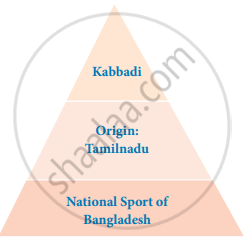
i) Represent the other paragraphs in a visual form of your choice(flow chart, mind-map, pie-chart, etc.).
ii) Choose the correct option.
1. A contact sport usually involves a ______contact between players.
- violent
- gentle
- physical
2. Kabbadi is a game played between ______.
- seven teams of two players
- two teams of seven players
- four teams of seven players
3. A single ______.
- player on offence is referred to as a raider
- offence is referred to as a raider
- raider is an offence by the player
iii) Answer the following.
- How does a raider score points for his team?
- When does a raider concede a point to the opponent team?
- Can a player be revived when he/she is out of the game? Explain your answer.
- Kabbadi is called by different names in different parts of India. Do you know how Pallankuzhi is called in Karnataka, Andhra Pradesh and Kerala?
Which of the following should one avoid while using social media? Tick against the correct options.
