Advertisements
Advertisements
प्रश्न
How does the poet juxtapose the human condition with the behaviour of the political class?
Advertisements
उत्तर
The poem is crafted in the environment when the whole of Germany rose to the ideology of Nazism and the political thinkers were determined to terminate the whole of the Jew community.
The thunderous rumbling of Adolf Hitler that “they must die” shook waves of terror across Europe paralysing Jews to utmost horror. The narrator exclaims at this that they are in his mind! In a public meeting in the USA, where they took refuge, the speaker spoke anti-Jews as well. He possibly meant that if Jews were allowed to settle in they would steal their jobs and food. Jews across America and Europe were looked at with bitter hatred. Everyone wanted them dead. At this time the couple is left destitute at the hands of fate. They are scared and bewildered. They have nothing to go back to the nation that was once there. They suffer the loss of identity and are threatened with death constantly. A striking contrast is drawn between the two sects that the world around them is divided into. One is comprising of people like them, the Jews and the other is the one hunting for them, wanting to kill them. One is the sufferer and the other is the one inflicting pain on the first one.
APPEARS IN
संबंधित प्रश्न
Write a character sketch of Mrs. Van Daan.
Answer any three of the following in 30-40 words each:
(a) Why has the poet’s mother been compared to the ‘late winter’s moon’?
(b) The poet says, ‘And yet, for these Children, these windows, not this map, their world.’ Which world do these children belong to? Which world is inaccessible to them?
(c) What was the plea of the folk who had put up the roadside stand?
(d) What will happen to Aunt Jennifer’s tigers when she is dead?
What role did Mr. Gilman play in Helen Keller's life? (120‒150 words)
Answer any four of the following in 30-40 words each:
(a) Why was the peddler amused at the idea of the world being a rattrap?
(b) Why did Gandhiji agree to a settlement of mere 25 percent?
(c) Aunt Jennifer's efforts to get rid of her fear proved to be futile. Comment.
(d) What does Stephen Spender want to be done for the children of the school in a slum?
(e) How did the ten-day-old baby (the future Tiger King) react to the prediction about his future made by the astrologers?
(f) Why was Dr. Sadao not sent abroad along with the troops?
Dolly Winthrop has a very noble nature. Comment.
Read the following extract and complete the activities given below :
A1 Compare the old and new house and complete the table :
| Points | Old House | New House |
| Surrounding | razzle-dazzle | – |
| Size of the house | – | big |
I was thirteen, the year we moved to the Cantonment at Allahabad. In stark contrast to the razzle-dazzle of the city’s commercial areas like Katra and Chowk, the Cantonment was a quiet, orderly place with broad tree-lined roads that still carried the names of long-dead Britishers. Our bungalow was on a sleepy by-lane called MacPherson Road. When we first saw it, my brothers and I were delighted. It was by far the biggest house we had ever lived in. The task of furnishing those huge, echoing rooms daunted mother.
“Is a slightly smaller house not available?” she asked father, “We do not have enough curtains for this place. And the furniture seems a little inadequate. Why did they have to plan the kitchen at such a distance from the dining-room? It is like doing a route march. And who is going to help me keep this place clean and dusted?”
Her misgivings and objections were undoubtedly valid. But, seeing our crestfallen faces, she sighed and gave in. We made extravagant promises to help in the household chores. Keep our rooms tidy. Put away our toys and books. She smiled with amused disbelief, her mind already working out how many meters of curtain-cloth would be needed and so on.
A2 Complete :
Complete the following list of objections that the mother had with the new house :
(i) Inadequate _______
(ii) Do not have _______
(iii) Kitchen at a distance from _______
(iv) A very big _______
A3 Personal response:
Do you agree with the objections raised by the mother? Explain.
Talk to your partner about the following.
Have you known someone like the author’s grandmother? Do you feel the same sense of loss with regard to someone whom you have loved and lost?
Briefly comment on:
The author’s physical condition in Darchen.
Comment on the indifference that meets Iona's attempts to share his grief with his fellow human beings.
What impression of the character of Iona do you get from this story?
'Constancy' is the theme of the poem. Indicate the words, phrases, and images that suggest the theme.
How does Forster trace the human interest in the story to primitive times?
What makes the urgency of the child's demand seem logical?
Name the world-famous personality who reached great heights despite of humble circumstances.
Complete the following sentence.
Sujoy reported about ___________________.
Discuss in groups and share with one another.
Do you spend time admiring and thinking over the beauties of nature? Elaborate on your response.
Given below are various professions in column A and in column B, the nature of work in respective professions. Match the columns.
| A | B |
| (i) Anaesthetist | (a) Specialist in the treatment of problems concerning the position of teeth and jaws. |
| (ii) Pharmacist | (b) A person who designs buildings and supervises the process of constructing them. |
| (iii) Orthodentist | (c) A person who is in charge of a newspaper or of a part of a newspaper. |
| (iv) Dermitologist | (d) The medical study of the skin and its diseases. |
| (v) Architect | (e) A person who has been trained to prepare medicines and sell them to the public. |
| (vi) Chartered Accountant | (f) A person whose job is to give drugs which makes the person not feel pain especially in preparation for a medical operation. |
| (vii) Editor | (g) A person who is engaged in the profession of accounting and examining the statements and records of accounts. |
Go through the poem and state whether the following statement is true or false.
Planners take public consent for the alterations they make in the old structures of the city.
How do we realize that animals are not feeling well?
Discuss in your class.
Name some gadgets and appliances that we use in day-to-day life?
Say WHY. . . . . .
Mother agreed to send Ramanujan to England.
List the four elements of drama.
Find out the different processes by which fabrics are made. Find illustrations and write a few lines on each process.
Form groups and hold debates on the following topics. Make bulleted lists of points in favour of the topic (pros) and those against it (cons). (3-6 points each)
You should never lose a match.
Write a short note on the following:
The message in the vision.
Read the passage and answer the following:
Why is the tollbooth called a ‘phantom’ tollbooth?
Write five words each -
with the suffix
- -less
- -ly
- -ness
Read the poem aloud with the proper rhythm. What does the rhythm remind you of?
Find the words that mean the following from the first stanza.
- Gold hammered into a flat, thin shape: ______
- show off proudly: ______
- tilt, move at an angle: ______
- across, especially in a slanting direction: ______
Read the following pieces from the story and suggest a title for each as shown in the 1st one.
| From | Up to | Title | |
| 1. | It was a hot afternoon ______ | ______ said the aunt weakly. | ‘Children Pester their Aunt’ |
| 2. | The smaller girl created a diversion ______ | ______ likely to lose his bet. | ______ |
| 3. | In a low confidential voice ______ | ______ it was so stupid,” said Cyril. | ______ |
| 4. | She (Bertha) did all that she was told ______ | ______ must be an extra good child. | ______ |
| 5. | The storyteller paused to let ______ | ______ popular tunes of the day. | ______ |
| 6. | Bertha was trembling very much ______ | ______ the three medals for goodness ______ | ______ |
Write in your own words.
What does the poet miss?
Find out how the following game is played.
Hockey
Was it right for the youngest brother to ask for a share in the money? Why?
Form groups of four or five.
Try to find the answers to the following questions through observation and by talking to your teachers, parents and others. Discuss your answers in the group.
- How is waste generated?
- How is it removed or cleared?
- How can we help in the task of clearing or removing garbage?
What did Ahmad tell Kasim when he dug a channel and began to draw water?
What does the poet want to know from the lark?
Identify the character or speaker.
He imprisoned the spirits in the bodies of large trees.
The taxi driver took away the narrator’s suitcase.
The author left the ties in the taxi.
Read the following line from the poem and answer the question given below.
They growl at that and they growl at this;
Whatever comes, there is something amiss;
- What does the word ‘growl’ mean here?
- Why do they find everything amiss?
Tom lay thinking. Presently it occurred to him that he wished he was sick; then he could stay home from school. He examined himself. He found no symptoms or sickness, and he investigated again. This time he felt he had a stomach ache, but it soon grew feeble, and presently died wholly away. He reflected further.
What did he detect?
Activity
It’s fun to help out in the kitchen. You can even practice reading aloud when reading the recipe. And you can learn a little math by figuring out how to measure. Here are a few fun items to make that are “Alice” themed.
Learning About Nature
Learn about caterpillars and butterflies. Read a book about a caterpillar turning into a butterfly. You can get one from the library or go online and find information with pictures.
Match the following.
| 1. | A man of ease | Emanuel |
| 2. | John’s trainer | Lalli and Lolly |
| 3. | Mathew’s secretary | John Mathew |
| 4. | John’s chef | Louise |
| 5. | Mathew’s friends | Basky |
Complete the sentence given below with word/phrase.
The hole became ______ and ______.
They all stood around the little jewel of blue means______.
Why did the family move to Patna?
Which place was the last stand of the Indian army?
Look at the picture and Choose the correct word.

Choose what the elephant did.
Circle and write the adverbs.
I drink coffee thrice a day. ______
Find and write the clues.
Clue for the load on the camel ______
What are things that we can save? Why should we save them?
What are the difficulties they faced in India?
Jana saw a _______ behind her.
Pick out the rhyming words and write.
| green | |
| human | |
| will | |
| welfare |
Match with their storing places.
Who are already awake?
The passage given below is on Kabbadi. Read the passage and complete the activities that follow.
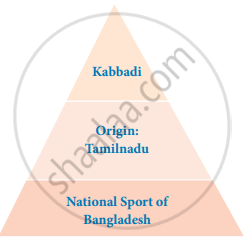
Kabbadi (கபடி - in Tamil) is a contact team sport that originated in Tamil Nadu, India. It is the national sport of Bangladesh. It is also popular in South Asia and is the state game of the Indian states of Tamil Nadu, Kerala, Andhra Pradesh, Bihar, Haryana, Karnataka, Maharashtra, Punjab, and Telangana.
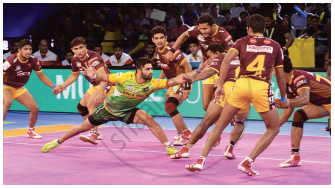
Kabbadi is played between two teams of seven players: the objective of the game is for a single player on offence referred to as a 'raider', to run in to the opposing teams half of a court, tag out as many of their defenders as possible, and return to their own half of the court–all without being tackled by the defenders. Points are scored for each player tagged by the raider, while the opposing team earns a point for stopping the raider. Players are taken out of the game if they are tagged or tackled, but can be 'revived' for each point scored by their team from a tag or tackle. The raider should hold his breath and utter the words like 'kabbadi kabbadi, hututu hututu, chadu kudu' etc. while the opponents try to catch him. If he stops uttering these words, he is considered out.
The game is known by its regional names in different parts of the subcontinent, such as Kabbadi or Chedugudu in Andhra Pradesh, Kabbadi in Kerala and Telangana, Hadudu in Bangladesh, Bhavatik in Maldives, Kauddi or Kabbadi in the Punjab Region, Hu-Tu-Tu in Western India and Hu-Do-Do in Eastern India and Chadakudu in South India. The highest governing body of Kabbadi is the International Kabbadi Federation.
Given below is the visual presentation of the first paragraph.
i) Represent the other paragraphs in a visual form of your choice(flow chart, mind-map, pie-chart, etc.).
ii) Choose the correct option.
1. A contact sport usually involves a ______contact between players.
- violent
- gentle
- physical
2. Kabbadi is a game played between ______.
- seven teams of two players
- two teams of seven players
- four teams of seven players
3. A single ______.
- player on offence is referred to as a raider
- offence is referred to as a raider
- raider is an offence by the player
iii) Answer the following.
- How does a raider score points for his team?
- When does a raider concede a point to the opponent team?
- Can a player be revived when he/she is out of the game? Explain your answer.
- Kabbadi is called by different names in different parts of India. Do you know how Pallankuzhi is called in Karnataka, Andhra Pradesh and Kerala?
Read the following passage and do the activities:
A1. Fill in the blanks: (2)
- ______ percent of our daily communication is non-verbal.
- Eye contact is another type of ______ communication.
- Frequent blinking is a sign of the person feeling ______.
- One can readily detect _______.
|
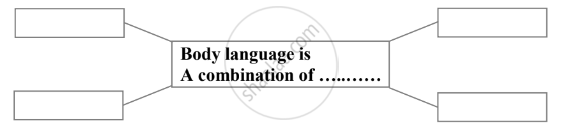
According to some experts, a staggering 93 percent of our daily communication is non-verbal. Facial expressions are easy to decipher. One can readily detect happiness, sadness, anger. Physicians can tell a patient is doing well (or not) by looking at his/her face. Eye contact is another type of non-verbal communication, which can tell a lot about the other person. The eyes convey a range of emotions-happiness, sadness, boredom, surprise, confidence .......... even emotional interest. Staring at someone's forehead may intimidate the recipient, staring at the mouth is sometimes interpretated as a sign of emotional interest. In fact, staring into someone's eyes is a sign of lying, and so is looking away. In certain cultures, lack of eye contact is taken as a sign of respect. If body language is to be defined, it is a combination of facial expression, gestures, eye contact, body movements and posture and voice. Frequent blinking is a sign of the person feeling distressed or uncomfortable. If the pupils are dilated, it ofter indicates interest, even emotional interest. The lips also reflect our body language, and lip biting indicates worry and/or anxiety; tightening of the lips may be an indication of disapproval. Slightly turned-up lips indicate happiness and slightly turned-down lips indicate sadness. |
A2.
A3. Find the antonyms of: (2)
- verbal × ______
- entertaining × ______
- sender × ______
- comfortable × ______
A4. Do as Directed: (2)
- The eyes convey a range of emotions. (Frame a 'Wh' question in order to get the underlined part as answer).
- Physicians can tell about a patient's wellness. (Rewrite using 'able to')
A5. Personal Response: (2)
Non-verbal communication plays an important role in our daily life. Comment.
