Advertisements
Advertisements
प्रश्न
What do the following words in the poem mean?
- crown
- round
- draw
- blind
Do these words have other meanings? List them.
Advertisements
उत्तर
| Words | poem meaning | other meaning |
| crown | an old British silver coin that was used in England in the past |
(i) an object usually made of gold and precious stones that a king/queen wears on his/her (ii) the highest part of something, for example, a hill. (iii) an artificial cover for a damaged tooth. |
| round | circular | (i) shaped like a circle or a ball. (ii) on all sides of something or someone. (iii) moving in a circle. |
| draw | to move to one side | (i) to take pictures of something with a pencil, pen, or chalk. (ii) to move in the direct (iii) to attract or interest to maintain somebody |
| blind | protective covering for a window, a window shade |
(i) not able to see. |
संबंधित प्रश्न
Maggu’s achievements are particularly noteworthy because – as is well known – academic institutions in India are less than sold on the idea of inclusive education. In fact, when Maggu lost her sight in class IV, her school (which she declines to name) expelled her while suggesting she attend a “blind school”. Though shocked, Maggu rejected the advice. “Attending a special school would have tarred me with a handicap forever, which was not how I saw my future. Therefore I did the rounds of other public schools with my father, a small – time merchant, explaining that my case was different Since I had vision till the age of ten,” she recalls.
Impressed by her persistence and ambition, Delhi’s Bluebells School not only admitted her but pulled out all the stops to support her in academics sporting events and also notched up a respectable 73 percent average in the class XII exam with the help of Braille, interactive textbooks and extra coaching.
The respectable average in her CBSE exam paved the way for admission into LSR where again she proved her mettle by winning medals in a slew of inter – collage events (100 200 and 400 metre sprints) high jump, long jump, javelin and discuss throw: resulting in her being declared ‘Athlete of the year’ 2003’ at a sports meet for 100 physically challenged athletes. And the cherry on the cake was the selection to the IBSA Games last year. “It was a tough regimen,” recalls Maggu. “I had to attend sports camps manage my studies and officiates as sports president. But I managed.”
Questions:
(1) What qualities of Maggu are highlighted in this passage?
(2) Why did Maggu refuse to attend a ‘blind school’?
(3) Quote the lines that show that Jyoti Maggu was good in academics as well as in sports.
(4) Use any two phrases in sentences of your own :
(a) To win laurels
(b) To pave the way
(c) To prove one’s mettle
(d) A tough regimen
(5)
(a) I did the rounds of other public schools with my father [Change the voice]
(b) though shocked Maggu rejected the advice [Rewrite as a simple sentence]
(6) Should the physically challenged be sent to special schools? Express your views.
The best punishment is ‘forgiveness’. Discuss the sentence in light of the text you have read. You can make use of the following points.
(a) Forgiveness provides an opportunity to change the behaviour.
(b) Forgiveness leads to repentance.
(c) A person may commit a mistake/crime impulsively or under the force of strong emotions.
(d) ________________________
(e) ________________________
What were the children doing beside the stone wall?
He always had lunch with his family.
Work in pairs and answer the following.
Write the rhyme scheme of the poem.
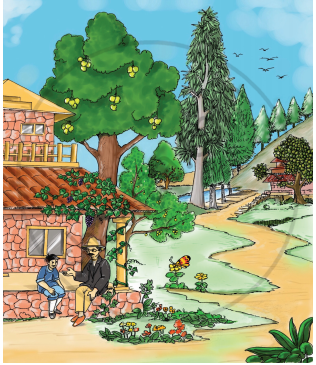
Listen to your teacher read the first part of the story. Many things described in the story can be seen in the picture. Find and name them.
The man destroyed ______.
Identify the character or the speaker.
“Oh no! What shall I do now?”
Who said – “Oh, my ears and whiskers? How late it’s getting!”
Why did he go there?
