Advertisements
Advertisements
प्रश्न
Tick the item that is closest in meaning to the following phrase.
to be wound up
पर्याय
to become active
to stop operating
to be transformed
to be destroyed
Advertisements
उत्तर
to be wound up - to stop operating
APPEARS IN
संबंधित प्रश्न
B1. What does the poet want us to do in the following situation?
(a) While struggling ………..
(b) While making money ………
(c) While dreaming ………………
(d) While losing …………..
It's doing your job the best you can,
And being just to your fellow man;
It's making money-but holding friends,
And being true to your aims and ends.
It's figuring how and learning why,
And looking forward and thinking high;
And dreaming a little and doing much,
It's keeping always in closest touch.
With what is finest in word and deed,
It's being through, yet making speed;
It's daring blithely the field of chance,
While making labour a brave romance.
It’s going onward despite defeat
And fighting staunchly, but keeping sweet;
It's struggling on with the will to win,
But taking loss with a cheerful grin.
B2. Achieving Success
Hints given by the poet to become successful are
(a) Doing your job the best
(b)
(c)
(d)
(e)
B3. Poetic Device
Select the appropriate rhyme scheme for the 3rd stanza.
(1) abab
(2) aabb
(3) aaba
India, my India, where the first human eyes awoke to heavenly light! All Asia’s holy place of pilgrimage, great Motherland of might! World – mother, first giver to humankind of philosophy and sacred lore, knowledge thou gav’st to an, God – love, works, art, religion’s opened door.
O even with all that grandeur dwarfed or turned and can vaunt thy mighty name?
Before us still there floats the idea of those splendid days of gold; a new world in our vision wakes, Love’s India we shall rise to mould. India, my India, who dare call thee a thing for pity’s grace today? Mother of wisdom, worship, works nurse of the spirit inward ray!
(1) The poem is a ……………………
(a) Praise
(b) Prayer
(c) Story in the form of poem
(d) Song of condolence [Choose the correct alternative]
(2) What has India given to the world?
(3) How does the poet visualize New India?
(4) Give the rhyme scheme of the first four lines.
(5) Name and explain the figure of speech that dominates the poem.
The black kite may start a fire because
Read the following passage carefully and complete the activities given below :
A.1) Complete the web :
Write the words from the passage on the web. 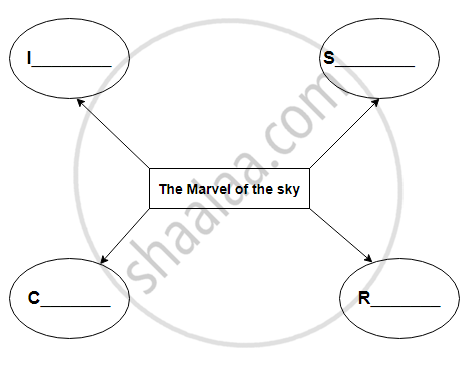
We saw small bits of grass peeping through the small cracks in concrete pavement. It left us thinking: however impossible things may look, there is always an opening…………
We saw a tree bare of all leaves in the cold winter months. We thought its chapter was over. But three months passed, spring set in and the tree was back to its green majesty once again, full of leaves, flowers, birds, and life. What if we too had the conviction that, however difficult things are right now, it will not remain so forever. Remember, this too shall pass.
We saw an army of ants lugging a fly which was at least ten times the ant’s size. The ants organized themselves around the fly, lifted it on frail feelers and carried it to quite a distance. Their teamwork and perseverance were impressive. What if we too are consistent, organized, focused ……… Spider webs are delicate, yet very strong. A rainbow colors the entire sky. Oysters take in a grain of sand they open up with a pearl. Innumerable stars shine across the infinite sky. Clouds take new shapes with every passing moment. The wind makes trees dance with unhindered passion. Water, without a hint of ego, changes its form according to the dictates of the sun and the wind. When we see a caterpillar turn into a butterfly, a flower turns into a fruit, we experience the alchemy of nature ………. We touch it and become gold ourselves.
A.2) Finding meanings :
Write what you mean by :
(i) _______ there is always an opening.
(ii) _______ its chapter was over.
(iii) _______ the tree was back to its green majesty.
(iv) _______ this too shall pass.
A.3) Matching :
Match the words in Column ‘A’ with their synonyms in Column ‘B’:
| Column 'A' | Column'B" | ||
| (i) | conviction | (a) | strong feeling |
| (ii) | alchemy | (b) | delicate |
| (iii) | frail | (c) | mysterious/magical power |
| (iv) | passion | (d) | strong belief |
A.4) Language study :
Rewrite the sentence using the correct question tag given in the brackets :
(i) Water changes its form. (does it?, do it?, do they?, doesn’t it)
(ii) However impossible things may look, there is always an opening. (Rewrite using ‘but’)
A.5) Personal Response :
Nature is the best teacher. Explain.
Read the following passage carefully and complete the activities given below:
B.1) Order :
Rearrange the following sentences in proper order:
(i) Hanmant joined engineering.
(ii) Hanmant got his Diploma and secured a job in Philips.
(iii) Hanmant migrated to Pune when he was in class VI.
(iv) Hanmant took up a painting job to earn.
Hanmant Gaikwad was born in Koregaon in Satara district.
“My native place is Rahimatpur, around 10 km from Koregaon. My father was a clerk in the court and we lived in a small, rented house.”
Hanmant was a brilliant student especially good in mathematics. When he was in class six, the family shifted to Pune. They lived in Phugewadi near Dapodi in a tiny one-room house-10 by 10 feet. At this point, Hanmant realized the difference between himself and those who had money.
Hanmant was then studying at Modern High School. He needed one rupee to buy a bus ticket to and from the everyday. Even that was hard to come by.
Despite the hardships, Hanmant secured 88% in class 10. Hanmant completed his diploma and joined Philips as a trainee. But he wasn’t happy with the work he got there.
The natural choice for a diploma engineer is to go for a B.Tech. But engineering colleges charge hefty fees. At the time, the family’s only source of income was a teacher’s salary of Rs. 2,300 a month……….
And then I decided to also do some earning. “Khud Ka Kamana Chalu Kiya”.
Hanmant took up painting jobs and quickly discovered it was excellent business.
The young engineering student paid his own fees from the third year onwards. But his lifestyle remained frugal.
Life was getting better, but Hanmant had his sights set higher. In the final year of engineering, he was attracted to the writings of Swami Vivekananda.
“I felt Ki Kuch Alag Karna hai. What should I do, I did not know but in 1993 I formed an organization-Bharat Vikas Pratisthan.”
B.2) Complete :
|
Hardships faced by Hanmant Gaikwad |
B.3) Rewrite the following sentence choosing the appropriate word/s for the underlined word/s :
(i) His lifestyle remained frugal:
(a) simple
(b) meager
(c) extravagant
(ii) Despite hardships, Hanmant secured 88% in class X:
(a) In spite of
(b) Regarding
(c) Affected
(iii) Hanmant took up painting jobs:
(a) assumed
(b) to continue
(c) accepted
(iv) Hanmant had his sights set higher:
(a) looked ahead
(b) lofty ambitions
(c) looked above
B.4) Do as Directed
(i) Hanmant secured 88% in class X. ( Begin the sentence as-88%....................)
(ii) In the final year of engineering, he was attracted towards the writings of Swami Vivekananda. (Frame a ‘Wh-question’ to get the underlined part as the answer.)
B.5) “Today’s hardships lead to tomorrow’s success”-Justify.
Look for pictures in newspapers and magazines that depict the urban civic problems discussed in the text. Cut them out and pin them to the text at appropriate places.
Discuss the following statement in groups of two pairs, each pair in a group taking opposite points of view.
A single event may change the course of the history of a nation.
Discuss the following in pairs or in small groups.
Although Paul’s mother liked to be rich she did not approve of betting on horses.
How does G. N. Devy bring out the importance of the oral literary tradition?
What do you understand of the three voices in response to the question 'What does a novel do' ?
Have you heard of birds that fly from one part of the world to another in small or large flocks?
They are called Migratory birds.
Discuss and write down two reasons why they migrate and return.
The writer of the story is William Blake.
Read the lesson and name the following.
The First surgeon to perform operations ______
Human beings can learn from honey bees ______.
Answer the following question in short.
Why was Tenali Raman taken to the court in a palanquin?
Find sentences from the play related to the given points.
The tension between different loyalties
- It’s little we get but abuse from the people, and no choice but to obey our orders.
- ________________________________
- ________________________________
- ________________________________
Explain the use of the following property in the development of the play.
Stick
Write a useful ‘ad’ for the importance of games, drinking enough water, your own school.
Visit a library:
Read more stories from Japan, China, and Korea.
Write the following in short:
The events at the court.
Listen and complete:
Close your books. The teacher will dictate some lines from the poem. She will say the first half and you have to write the entire line/verse.
- I know a funny ____________ As quiet as a ____________ Who does the mischief that is done ____________.
- There’s no one ever sees his face, And yet we all ____________ That every plate we break was ____________ By ____________.
What does the poet want to do?
Fill in the following blanks with reference to the poem.
'In time of rain when spring and life are ______, the butterflies lift ______ wings to catch a ______ cry and trees put forth ______ leaves to sing in ______ beneath the sky as ______ boys and girls too ______ singing down the roadway'.
List the lines that begin with 'Here' or 'And here'.
Also, list the sentences or phrases that begin with ‘And there’.
These phrases and sentences tell us about things that appear one after the other as the carriage moves. Can we tell which ones are closer to the train and which ones are at a distance? How?
Sayali was travelling in space for the first time.
Answer in your own words.
What excuses did Neel give to avoid cleaning his room?
Write the symbol that is used in the poem to represent the following idea.
It was tempting and needed to be tried.
Fill in the blank choosing the appropriate word/idiom from the lesson.
The sight of a snake ______.
Does Marouckla get any of the things she brings?
Find out how the following game is played.
Badminton
Describe Gulliver’s home in Lilliput.
What did he try to take the milk from?
Show the major events in the story of Pheidippides on a ‘time-line’.
Read the following lines from the poem and answer the question that follow.
Let me but live my life from year to year,
With forward face and unreluctant soul;
- Whom does the word ‘me’ refer to?
- What kind of life does the poet want to lead?
Usha went to visit her______ house after shopping in the market.
Teach it in accents______ and______.
- soft
- vain
- fear
- joy
- love
- heard
- toiled
- mild
- good
- sand
- life
- harsh
Why can’t Alice get through the little door into the garden?
He always had lunch with his family.
drenched – thoroughly wet
He is drenched to the skin. ______
Read the line and answer the question.
And all I ask is a windy day with the white clouds flying
Why does the poet ask for a windy day?
Neerja had a sour marriage due to______.
There are seven kinds of sea turtles in the world.
The author did not want to plant saplings in the forest because______.
How does the coconut tree grow?
Amuthan locked the door behind him.
What did Nilavan see through the window?
How did the third daughter use the grain?
Jaswant managed to kill _________ Chinese soldiers.
Vicky wanted a ______ to do all his work.
Name the character or speaker.
“Believe yourself.”
Choose the best answer.
The animals ______ the boat.
Write the word under the correct group and divide it.
bullet
candle
bat
title
ball
tiffin
 |
 |
 |
Fill in the blank
Do you like apple______ orange?
______always stays to the last in our needs.
If we didn’t have boundaries, we don’t need _______.
Why did Jana’s friends stop her from going near the tree?
Write the rhyming word.
save- ______
One day Chris tried to draw a ______.
What should parents do to ensure cyber safety for their wards? (Any three points)
Pick out word which mean the same as
keep a check on (para 3)
