Advertisements
Advertisements
प्रश्न
Read the text below and summarise it.
The Great Desert Where Hippos Once Wallowed
The Sahara sets a standard for dry land. It’s the world’s largest desert. Relative humidity can drop into the low single digits. There are places where it rains only about once a century. There are people who reach the end of their lives without ever seeing water come from the sky.
Yet beneath the Sahara are vast aquifers of fresh water, enough liquid to fill a small sea. It is fossil water, a treasure laid down in prehistoric times, some of it possibly a million years old. Just 6,000 years ago, the Sahara was a much different place.
It was green. Prehistoric rock art in the Sahara shows something surprising: hippopotamuses, which need year-round water.
“We don’t have much evidence of a tropical paradise out there, but we had something perfectly liveable,” says Jennifer Smith, a geologist at Washington University in St Louis.
The green Sahara was the product of the migration of the paleo-monsoon. In the same way that ice ages come and go, so too do monsoons migrate north and south. The dynamics of earth’s motion are responsible. The tilt of the earth’s axis varies in a regular cycle — sometimes the planet is more tilted towards the sun, sometimes less so. The axis also wobbles like a spinning top. The date of the earth’s perihelion — its closest approach to the sun — varies in cycle as well.
At times when the Northern Hemisphere tilts sharply towards the sun and the planet makes its closest approach, the increased blast of sunlight during the north’s summer months can cause the African monsoon (which currently occurs between the Equator and roughly 17°N latitude) to shift to the north as it did 10,000 years ago, inundating North Africa.
Around 5,000 years ago the monsoon shifted dramatically southward again. The prehistoric inhabitants of the Sahara discovered that their relatively green surroundings were undergoing something worse than a drought (and perhaps they migrated towards the Nile Valley, where Egyptian culture began to flourish at around the same time).
“We’re learning, and only in recent years, that some climate changes in the past have been as rapid as anything underway today,” says Robert Giegengack, a University of Pennsylvania geologist.
As the land dried out and vegetation decreased, the soil lost its ability to hold water when it did rain. Fewer clouds formed from evaporation. When it rained, the water washed away and evaporated quickly. There was a kind of runaway drying effect. By 4,000 years ago the Sahara had become what it is today.
No one knows how human-driven climate change may alter the Sahara in the future. It’s something scientists can ponder while sipping bottled fossil water pumped from underground.
“It’s the best water in Egypt,” Giegengack said — clean, refreshing mineral water. If you want to drink something good, try the ancient buried treasure of the Sahara.
Staff Writer, Washington Post
Advertisements
उत्तर
Sahara is the world’s largest desert. Yet beneath its surface could be found vast aquifers of fresh water. The basis of the huge ‘buried treasure’ of water was laid down in prehistoric times. The water found is clean and refreshing.
6000 years ago, Sahara was quite a different place. It was full of greenery and water. Prehistoric rock-art of Sahara indicates the presence of hippopotamuses which need water round the year. Migration of Paleo-monsoon to the Sahara region led to its wet and rainy climatic conditions.
Later, around 5000 years ago, the monsoon shifted towards south, leaving Sahara in a state of drought. This led the inhabitants to migrate to the Nile Valley. The shift in the earth’s axis and decreased precipitation left the place dried out. Consequently, the soil lost its ability to hold water and vegetation decreased. For the past 4000 years Sahara has remained the same.
APPEARS IN
संबंधित प्रश्न
Describe the progress made by Helen Keller during the two years she spent at Wright-Humason School for the Deaf in New York City.
Describe Miss Stapleton's first encounter with Sir Henry in about 125 words
Answer any three of the following questions in 30-40 words each:
(a) What did M. Hamel tell them about the French language? What did he ask them to do and why?
(b) Why does Asokamitran call Subbu, ‘a charitable and improvident man’?
(c) How did the instructor turn Douglas into a swimmer?
(d) Why did Sophie like her brother, Geoff more than any other person?
Helen's struggle has become a source of inspiration for all less fortunate. Comment.
Answer any four of the following questions in 30 – 40 words each :
(a) After initial reluctance why did the lawyers tell Gandhiji that they were ready to follow him into jail?
(b) What is Mukesh's attitude towards the family business of making bangles?
(c) How does the poet show the futility of Aunt Jennifer's efforts?
(d) Stephen Spender in his poem, 'An Elementary School Classroom in a Slum' paints a dismal picture of poverty. Comment.
(e) Jackson went through the contents of Rev. McLeery's suitcase. Which object therein puzzled him sorely? What was his comment on that?
(f) How did the servants react when they realized that Dr. Sadao was going to save the life of an enemy?
Briefly comment on:
The author’s meeting with Norbu.
Tick the item that is closest in meaning to the following phrase.
to give vent to
You will probably agree that this story does not have breathless adventure and exciting action. Then what in your opinion makes it interesting?
Make a list of the expressions that imbue the watch with human attributes.
Why is the speaker’s childhood described as ‘a forgotten boredom’?
Personification is a figure of speech that attributes human qualities to inanimate things and abstract ideas. How has it been used in the poem?
How does the poem emphasise the physical prowess of the Hawk?
Comment on the capitalisation of all the words in the line:
'Children Must be Disciplined'.
'He is free to play the flute all day as well-fed tigers and fat sheep drink from the same pond
with a full stomach for a common bond.'
What do the phrases 'play the flute all day' and 'a common bond' refer to?
Read the extract and state whether the following statement is true or false. Correct the false statement.
Newer hybrid crops have a great appetite for chemicals.
Guess the types of hardships they must have faced in their childhood and youth.
Study the pictures below and note down the differences.
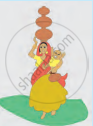
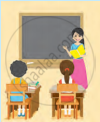
When we look at the sky, we find several objects. They stand for something or the other. Complete the following table by finding the significance of the given objects. One example is given to you.
| Celestial Bodies | Association |
| The Sun | Power, Heat, Energy, Commitment, etc. |
| The Moon | |
| The Rainbow | |
| The Stars |
The poem expresses feelings of serenity. Pick out expressions from the above poem that express the same.
Correct the following statement.
The real ivy leaf did not fall off at all.
The poem is a Petrarchan Sonnet. The poem is divided into two parts -
- An Octave
The first part comprising eight lines. - A sestet
The second part comprising six lines.
Read the first four lines of the poem. The rhyme scheme is a b b a. Read the rhyme scheme for the next four lines. It is a b b a. Now read the first three lines of the sestet and note the rhyme scheme. It is c d c. The rhyme scheme of the last three lines is d c d. This is the common design of a Petrarchan Sonnet.
This is a Petrarchan Sonnet. Complete the given table by giving examples from the poem.
| Features | Examples / Lines |
| Objects used | |
| Praise/blames | |
| Metaphor | |
| Simile | |
| Personification | |
| Number of lines | |
| Rhyme scheme |
Imagine that one of your family members/friends/classmates has recently undergone surgery. You were curious and wanted to learn about his/her experience.
Match the questions you asked with their answers.
| 1. | What health problem did you suffer from? | a. | I was given a bath and I wore a surgical gown. |
| 2. | Whom did you inform about it first? | b. | I was given an injection of anesthesia. |
| 3. | What type of doctor did you consult? | c. | I consulted an orthopedic surgeon. |
| 4 | How did he/she find out that you needed a surgery? | d. | I was relieved and happy that the operation was over. |
| 5. | What preparation was done before the surgery? | e. | I had fractured my ankle while playing hockey. |
| 6. | What did you feel when you were taken to the operation theatre? | f | No, I did not feel anything. I was fast asleep. |
| 7. | What was the first step before the actual surgery? | g. | I recovered and I could walk normally after 3 weeks. |
| 8. | Did you feel any pain during the surgery? | h. | Our school hockey coach. |
| 9. | What did you feel when you opened your eyes after the operation? | i. | The doctor took an X-ray of my ankle, and he found a fracture in my ankle. |
| 10. | How soon did you recover? | j. | I was very nervous. |
Read the description of the Kabaddi match and do the following:
Note down the names of the players and say whether each one belongs to 9 A or 9 B.
Read aloud the account of how Flying Officer Nirmal Jit Singh Sekhon sacrificed his life to defend our country.
Find sentences from the play related to the given points.
The tension between different loyalties
- It’s little we get but abuse from the people, and no choice but to obey our orders.
- ________________________________
- ________________________________
- ________________________________
Form groups and hold debates on the following topic. Make bulleted lists of points in favour of the topic (pros) and those against it (cons). (3-6 points each).
Boys cannot cook or do any housework.
Expand the following ideas in a paragraph or two:- Courage and resourcefulness are the keys to overcome problems.
How early did the preparations for the Science Fair begin?
An activity:
Speak fast, think faster ! Form groups of 4-6. Discuss each of the following topics. Then each person in the group should choose a topic and speak about it for one minute. Try to say as many sentences as you can in that time.
What may happen...
I may study... A bird may fly into the classroom. The Principal may call me... It may rain... A dog may chase a cat... A king may lose his kingdom... My friend may give me a storybook to read... Mother may make idlis today...’ etc.
Write a short note on the following:
Prince Siddharth’s protected life.
Use the following expressions in your own sentences:
- We all agree that
- It is he/she who
- Don’t you see
- None of us
Write in your own words.
How does the poet glorify his home in the first stanza?
Write in your own words.
What makes the poet remember his mother?
Write other meaningful words that begin/end with anywhere.
Identify the character or speaker.
He was the chief of all spirits.
How did Hamid’s friends show that they enjoyed eating the sweets?
Hamid’s heart sank because the price of the tongs was______for him.
‘My tongs are like a tiger among toys.’ It means ______
He exercised with Louise every day.
Can courage be developed suddenly? Why?
Who is Muthu?
Complete the sentence given below with word/phrase.
The hole in the ground was filled______.
What is the setting of the story?
How is water produced in Mars?
Which place was the last stand of the Indian army?
The robot did not obey his master.
Brain of a robot is the______.
Look at the picture and Choose the correct word.

What was the dish served to the old man?
Identify the character or the speaker.
“I hope he is safe.”
______hem the border.
Look at the picture and tick choose the correct word.

Match the rhyming words.
| mars | crime |
| bed | cars |
| time | head |
The official's family visited the rehabilitation centre for ______ years.
Parents help us to overcome our______.
Imagine your world and write its qualities in the cloud.

Pick out the rhyming words and write.
| green | |
| human | |
| will | |
| welfare |
Match with their storing places.
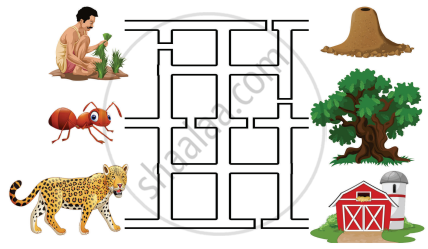
Many may lie and______.
One day Chris tried to draw a ______.
