Advertisements
Advertisements
Question
Read the text below and summarise it.
The Great Desert Where Hippos Once Wallowed
The Sahara sets a standard for dry land. It’s the world’s largest desert. Relative humidity can drop into the low single digits. There are places where it rains only about once a century. There are people who reach the end of their lives without ever seeing water come from the sky.
Yet beneath the Sahara are vast aquifers of fresh water, enough liquid to fill a small sea. It is fossil water, a treasure laid down in prehistoric times, some of it possibly a million years old. Just 6,000 years ago, the Sahara was a much different place.
It was green. Prehistoric rock art in the Sahara shows something surprising: hippopotamuses, which need year-round water.
“We don’t have much evidence of a tropical paradise out there, but we had something perfectly liveable,” says Jennifer Smith, a geologist at Washington University in St Louis.
The green Sahara was the product of the migration of the paleo-monsoon. In the same way that ice ages come and go, so too do monsoons migrate north and south. The dynamics of earth’s motion are responsible. The tilt of the earth’s axis varies in a regular cycle — sometimes the planet is more tilted towards the sun, sometimes less so. The axis also wobbles like a spinning top. The date of the earth’s perihelion — its closest approach to the sun — varies in cycle as well.
At times when the Northern Hemisphere tilts sharply towards the sun and the planet makes its closest approach, the increased blast of sunlight during the north’s summer months can cause the African monsoon (which currently occurs between the Equator and roughly 17°N latitude) to shift to the north as it did 10,000 years ago, inundating North Africa.
Around 5,000 years ago the monsoon shifted dramatically southward again. The prehistoric inhabitants of the Sahara discovered that their relatively green surroundings were undergoing something worse than a drought (and perhaps they migrated towards the Nile Valley, where Egyptian culture began to flourish at around the same time).
“We’re learning, and only in recent years, that some climate changes in the past have been as rapid as anything underway today,” says Robert Giegengack, a University of Pennsylvania geologist.
As the land dried out and vegetation decreased, the soil lost its ability to hold water when it did rain. Fewer clouds formed from evaporation. When it rained, the water washed away and evaporated quickly. There was a kind of runaway drying effect. By 4,000 years ago the Sahara had become what it is today.
No one knows how human-driven climate change may alter the Sahara in the future. It’s something scientists can ponder while sipping bottled fossil water pumped from underground.
“It’s the best water in Egypt,” Giegengack said — clean, refreshing mineral water. If you want to drink something good, try the ancient buried treasure of the Sahara.
Staff Writer, Washington Post
Advertisements
Solution
Sahara is the world’s largest desert. Yet beneath its surface could be found vast aquifers of fresh water. The basis of the huge ‘buried treasure’ of water was laid down in prehistoric times. The water found is clean and refreshing.
6000 years ago, Sahara was quite a different place. It was full of greenery and water. Prehistoric rock-art of Sahara indicates the presence of hippopotamuses which need water round the year. Migration of Paleo-monsoon to the Sahara region led to its wet and rainy climatic conditions.
Later, around 5000 years ago, the monsoon shifted towards south, leaving Sahara in a state of drought. This led the inhabitants to migrate to the Nile Valley. The shift in the earth’s axis and decreased precipitation left the place dried out. Consequently, the soil lost its ability to hold water and vegetation decreased. For the past 4000 years Sahara has remained the same.
APPEARS IN
RELATED QUESTIONS
Answer the following question in 120-150 words:
What kind of life did Silas lead at Lantern Yard?
To what end have humans used their superior intelligence ?
Read the following passage and complete the activities given below :
A1 Find out :
Find from the passage the related words to the sea and write them.

ON FIERCE monsoon nights, about one and a quarter-mile off the Mumbai harbor, there have been occasions when 52-year-old Bikaji Ramchandra Dhuri is the only man on the sea. From the watchtower of the Prongs Reef Lighthouse, which is surrounded on all sides by the Arabian Sea, he has heard the sea rage like a possessed spirit – the darkness dispelled only by the beam of light flung across the waters from the tower he mans.
Dhuri is one of the last breeds of lighthouse keepers on the Indian coast, as a majority of the 182 lighthouses in the country are now unmanned. Built-in 1871, the Prongs Reef lighthouse was modeled on Scotland’s Skerryvore Rocks Lighthouse and is located at a strategic spot on the western coast, marking the entrance to the busy Mumbai Harbour. It was meant to stem the number of shipwrecks off the harbor, which the lone Colaba lighthouse could not illumine on its own. “Even now, during nights, for fishing vessels without any gadgets, it’s the soft light from this tower which directs us to Mumbai,” says Vinayak Koli, a boatsman who helps ferry people and also goes on fishing expeditions.
Throughout the year, Dhuri lives in the lighthouse for 15 days at a stretch, when he is relieved by another keeper. In the monsoon, it becomes his home for three months. “We call it the Kalapana as we are alone in the middle of the sea for days, with basic supplies – and the revolving light that keeps the sea awake,” he says.
A2 Fill in the following information using words from the passage :
(i) The Prongs Reef lighthouse was modeled on _______.
(ii) Dhuri lives in the lighthouse for _______ at a stretch.
(iii) _______ is one of the last breeds of lighthouse keepers on the Indian coast.
(iv) The majority of the _______ lighthouses in the country are now unmanned.
| Violent | Scattered | Place of shelter for ships | Shine light |
A4
A5 Personal Response
Imagine you have to spend a night in a lighthouse. Narrate your experience.
Answer the following question in 200-250 words:
How did Kitty help Anne overcome her loneliness?
Give reasons for the following statement.
The article has been titled ‘Silk Road.’
Give reasons for the following statement.
Tibetan mastiffs were popular in China’s imperial courts.
How, according to you, can peace and liberty be maintained in a state?
Answer in your own words.
Why did the old man have no need to build the bridge, across the chasm?
Using a good dictionary, find the shade of difference in the following:
‘Profession’ refers to ____________
Find proof from the poem for the following.
The colour imagery in the poem.
Pick out a word from the poem to complete the sentence meaningfully.
She ______ (bargained) with the hawker to reduce the price.
Pick out a word from the poem to complete the sentence meaningfully.
Handicapped people should never be ______. (ignored and avoided)
Read the descriptions of the following from the story and describe any one of them using your own words.
- The ivy vine
- Behrman
- The last leaf that Johnsy saw
Think and answer in your own words.
'Beauty' in stanza 5 to 6 can refer to a beautiful maiden as well as nature itself. Explain when and how nature ‘dances’ and also 'smiles'.
Do you have a pet?
Pick out three lines that create an image in your mind of bees busy at work.
Read the passage and answer the following question:
What is seen on the obverse and reverse of the PVC medal?
Correct the given sentence with justification.
Since there is a reference to the Indian boy, there are some scenes from India too.
Show the stages in the process in which Krakatoa collapsed and then Anak Krakatoa formed in the course of volcanic eruptions. Use the flowchart given below.
Give reasons :
Oberon and Titania fight for the custody of the Indian boy because - Oberon wants __________________.
The consequences of Oberon’s jealousy for Titania are comic rather than tragic. Comment.
Explain the use of the following property in the development of the play.
Hat
Portia’s suitors chose the gold and silver caskets.
Explain the idea of ‘Conservation of Nature through Livelihood’ briefly, using the example given here.
Write the following:
The sights mentioned in the third stanza.
Form groups of 5-8. This passage tells us only what the compère says. Try to visualize and write what the other people on the dais must have said in their speeches (Write only the main points.)
- The School Principal
- The Chief Guest
- The Art teacher who offered a vote of thanks
Write in your own words.
How does the poet glorify his home in the first stanza?
Fill in the blank choosing the appropriate word/idiom from the lesson.
In the examination, I did not know the answer, so I ______.
Using the following points frame a character sketch of the narrator. Support each character trait with instances from the lesson.
- Diffident and timid
- Unusual behavior
- Ignorant about banking
- Nervous and careless
- Economical.
Who said the following, to whom, and when?
"Ah no, to thee I sing: he sings to God.”
Listen carefully and guess how the sentence would end.
This step is broken. Please be ______.
Find out how the following game is played.
Badminton
Guess the meaning of the following word.
fragrant
Identify the character or speaker.
Now pray tell me, sir, your reason for raising this sea-storm?
Identify the character or speaker
I must finish my task before I take my rest.”
And whether their station be high or humble,…
Pick out the alliteration from the above line.
Read the data below and answer the following question.
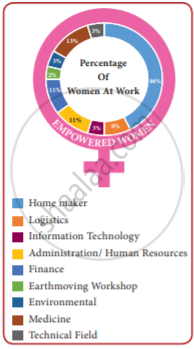
Choose the correct answer.
Identify the three jobs where the same percentage of women work.
Discuss with your partner and complete the table.
| S.No. | Question | Who asked this? | Who answered? | What was the answer? |
|
1. |
Shall we run back together? | |||
| 2. | Can you see something behind the wall? | |||
| 3. | Who said good bye? | |||
| 4 | Was it just the wind? |
The market was ______ away from the village.
What are the disadvantages of speaking harshly?
Selvi asked, 'Did they come in an aeroplane?' because she______.
Read the questions related to the three sports stars you have read about and tick the appropriate boxes.
 |
 |
 |
|
| 1. Who won the Olympic 2016 silver medal in badminton? | |||
| 2. Who is the role model for her siblings? | |||
| 3. Whose mother tongue is Tamil? | |||
| 4. Whose attitude is 'never-say-die spirit'? | |||
| 5. Which player works in the Police Department? | |||
| 6. Which player holds the record for the highest individual score in cricket? |
Read the lines and answer the questions given below.
Summer comes
in a blaze of heat with
sunny smiles
and dusty feet
- Does the poet welcome the summer? How do you know?
- Which line tells you that there is no rain in summer?
We get water by burning _______.
They rode back home quickly.
| Mr. Murugan is a farmer. He has a small piece of land and two bulls. He takes good care of his bulls as they help him in farming. Every morning, he takes the bulls for grazing. When it rains he ploughs the land with the bulls. As he has no one to help he starts sowing the seed before sunrise. He irrigates the crop till it grows. He reaps and binds the crop then takes it to thrash the paddy. Finally, with the help of the bulls, he takes the paddy to his house. |
Choose the main idea of the passage.
Identify the character/speaker.
"Grow the fish at home, Anbu."
Answer using Yes or No and pick sentence from the story to support your answer.
Was Robinson alone in the island?
______ over heard her father’s talking on the phone about the robbery.
______was with Robinson.
Circle and write the adverbs.
I'm waiting here. ______
Try your own.
Pick out the rhyming words and write.
| green | |
| human | |
| will | |
| welfare |
Name the things that good merchant offered for the plate
What is the main idea of the story?
What should we do for success?
Who agreed to help Helen?
Read the following passage and answer the questions that follow:
The Stationmaster’s Supreme Sacrifice by Sanchari Pal (Adapted)
- Thirty-three years ago, on the night of December 2, 1984, Bhopal was hit by a catastrophe that had no parallel in the world’s industrial history. An accident at the Union Carbide pesticide plant in Bhopal had released almost 30 tons of a highly toxic gas called methyl isocyanate, turning the city into a vast gas chamber. The result was a nightmare; more than 600,000 people were exposed to the deadly gas cloud that left thousands dead and many more breathless, blind and in agonizing pain. Few people know that during the Bhopal gas tragedy a heroic stationmaster risked his own life to save others.
- On the evening of December 3, 1984, Ghulam Dastagir was settling down in his office to complete some pending paperwork. This work kept him in his office till 1am in the night, when he emerged to check the arrival of the Gorakhpur Mumbai Express. As he stepped on to the platform, the deputy stationmaster felt his eyes burn and a queer itching sensation in his throat. He did not know that poisonous fumes leaking from Union Carbide’s pesticide factory were stealthily enveloping the railway station.
- Beginning to choke, Dastagir did not know then that twenty-three of his railway colleagues, including his boss, station superintendent Harish Dhurve, had already died. It was later reported that Dhurve had heard about the deadly gas and had immediately tried stopping the movement of trains passing through Bhopal before collapsing in his office chamber. His suddenly worsening health and years of experience told Dastagir that something was very wrong. Though he did not fully comprehend what was happening, he decided to act immediately when he did not get any response from the station master. He alerted the senior staff at nearby stations, like Vidisha and Itarsi, to suspend all train traffic to Bhopal.
- However, the jam-packed GorakhpurKanpur Express was already standing at the platform and its departure time was 20 minutes away. Listening to his gut instinct, Dastagir summoned his staff and told them to immediately clear the train for departure. When they asked if they should wait until the order to do so came from the head office, Dastagir replied that he would take complete responsibility for the train’s early departure. He wanted to ensure that the train left immediately, without any delay. His colleagues later recalled that Dastagir could barely stand and breathe as he spoke to them. Breaking all rules and without taking permission from anyone, he and his brave staff personally flagged off the train.
- But Dastagir’s work was not done. The railway station was filling up with people, desperate to flee the fumes. Some were gasping, others were vomiting, and most were weeping. Dastagir chose to remain on duty, running from one platform to another, attending, helping and consoling victims. He also sent an SOS to all the nearby railway offices, asking for immediate medical help. As a result, four ambulances with paramedics and railway doctors arrived at the station. It was winter and the gas was staying low to the ground, a thick haze poisoning everything in its path. Besieged by hordes of suffering people, the station soon resembled the emergency room of a large hospital. Dastagir stayed at the station, steadfastly doing his duty, knowing that his family was out there in the ill-fated city. That day all he had for his protection was a wet handkerchief on his mouth.
- Ghulam Dastagir’s devotion to duty saved the lives of hundreds of people. However, the catastrophe didn’t leave him unscathed. One of his sons died on the night of the tragedy and another developed a lifelong skin infection. Dastagir himself spent his last 19 years shuttling in and out of hospitals; he developed a painful growth in the throat due to prolonged exposure to toxic fumes. When he passed away in 2003, his death certificate mentioned that he was suffering from diseases caused as a direct result of exposure to MIC (Methyl Isocyanate) gas. A memorial has been built at platform No.1 to pay tribute to those who sacrificed their lives in the line of duty on the fateful night of December 3, 1984. However, Ghulam Dastagir, who died later, is not one of them. A forgotten hero whose sense of duty and commitment saved countless lives, Dastagir’s story deserves to be recognized and remembered by our fellow countrymen.
- Why was the accident at Union Carbide unparalleled in the world’s industrial history?
- How was Dastagir affected by the poisonous gas?
- What was the action taken by the station superintendent?
- How did Dastagir and his staff break rules?
- What was the cause of Dastagir’s death?
- Find words from the passage which mean the opposite of the following.
- safeguard (para 1)
- common or familiar (para 2)
- prompt (para 4)
- cause (para 6)
Look up the following entries in the Language Study pages given at the end.
- stress
- intonation
- sound
- consonant
- vowel
