Advertisements
Advertisements
Question
Does the poem have a consistent rhyme scheme?
Advertisements
Solution
No, the poem does not follow a consistent rhyme scheme.
APPEARS IN
RELATED QUESTIONS
He asked. Boy, did he ask! First he asked me for a chance, then he asked nearly all the people he came across if they wanted to buy a telephone system from him. And his asking paid off. As he likes to put it, “Even a blind hog finds an acorn every once in a while.” That simply means that if you ask enough, eventually someone will say ‘yes’.
He cared. He cared about me and his customers. He discovered that when he cared more about taking care of his customers than he cared about taking care of himself, it wasn’t long before he didn’t have to worry about taking care of himself.
Most of all, Cowboy started every day as a winner! He hit the front door expecting something good to happen. He believed that things were going to go his way regardless of what happened. He had no expectation of failure, only an expectation of success. And I’ve found that when you expect success and take action on that expectation, you almost always get success.
Cowboy has made millions of dollars. He has also lost it all, only to get it all back again. In his life as in mine, it has been that once you know and practice the principles of success, they will work for you again and again.
He can also be an inspiration to you. He is proof that it’s not environment or education or technical skills and ability that make you success. He proves that it takes more: it takes the principles we so often overlook or take for granted. These are the principles of that Ya Gotta’s for success.
Question:
(1) What was the cowboy’s motto?
(2) What did the cowboy learn after he lost millions of dollars?
(3) Why did the cowboy firmly believe that asking would pay off?
(4) When you expect success and take action on that expectation you almost always succeed. [Name the part of speech of the underlined words]
(5)
(a) He cared about me and his customers. [Rewrite using ‘not only ……………….but also’’]
(b) Cowboy has made millions of dollars [Add a question tag]
(6) In what way is the cowboy a source of inspiration for you?
Attempt the following in 150-200 words.
What was the incident of the Frost King? How did it affect Helen?
How did Helen benefit when Dr. Graham Bell accompanied her to the World Fair?
What inference can you draw from the action of the female gorilla described in para 2 ?
Read the following passage carefully and complete the activities given below:
B.1) Order :
Rearrange the following sentences in proper order:
(i) Hanmant joined engineering.
(ii) Hanmant got his Diploma and secured a job in Philips.
(iii) Hanmant migrated to Pune when he was in class VI.
(iv) Hanmant took up a painting job to earn.
Hanmant Gaikwad was born in Koregaon in Satara district.
“My native place is Rahimatpur, around 10 km from Koregaon. My father was a clerk in the court and we lived in a small, rented house.”
Hanmant was a brilliant student especially good in mathematics. When he was in class six, the family shifted to Pune. They lived in Phugewadi near Dapodi in a tiny one-room house-10 by 10 feet. At this point, Hanmant realized the difference between himself and those who had money.
Hanmant was then studying at Modern High School. He needed one rupee to buy a bus ticket to and from the everyday. Even that was hard to come by.
Despite the hardships, Hanmant secured 88% in class 10. Hanmant completed his diploma and joined Philips as a trainee. But he wasn’t happy with the work he got there.
The natural choice for a diploma engineer is to go for a B.Tech. But engineering colleges charge hefty fees. At the time, the family’s only source of income was a teacher’s salary of Rs. 2,300 a month……….
And then I decided to also do some earning. “Khud Ka Kamana Chalu Kiya”.
Hanmant took up painting jobs and quickly discovered it was excellent business.
The young engineering student paid his own fees from the third year onwards. But his lifestyle remained frugal.
Life was getting better, but Hanmant had his sights set higher. In the final year of engineering, he was attracted to the writings of Swami Vivekananda.
“I felt Ki Kuch Alag Karna hai. What should I do, I did not know but in 1993 I formed an organization-Bharat Vikas Pratisthan.”
B.2) Complete :
|
Hardships faced by Hanmant Gaikwad |
B.3) Rewrite the following sentence choosing the appropriate word/s for the underlined word/s :
(i) His lifestyle remained frugal:
(a) simple
(b) meager
(c) extravagant
(ii) Despite hardships, Hanmant secured 88% in class X:
(a) In spite of
(b) Regarding
(c) Affected
(iii) Hanmant took up painting jobs:
(a) assumed
(b) to continue
(c) accepted
(iv) Hanmant had his sights set higher:
(a) looked ahead
(b) lofty ambitions
(c) looked above
B.4) Do as Directed
(i) Hanmant secured 88% in class X. ( Begin the sentence as-88%....................)
(ii) In the final year of engineering, he was attracted towards the writings of Swami Vivekananda. (Frame a ‘Wh-question’ to get the underlined part as the answer.)
B.5) “Today’s hardships lead to tomorrow’s success”-Justify.
Mention three reasons why the author’s grandmother was disturbed when he started going to the city school.
Which language do you use to talk to elderly relatives in your family?
Give reasons for the following statement.
The author thought that his positive thinking strategy worked well after all.
|
The energy stored in coal and petroleum originally came to the earth from the sun. The bulk of the present-day supplies was laid down some 200 to 600 million years ago, when tropical conditions were widespread. Lush, swampy forests produced huge trees; warm coastal seas swarmed with microscopic forms of life. When these organisms died, much of their tissue was recycled as it is today — through scavenging and decay. But a significant amount of dead plant and animal material was covered with mud, which prevented complete decomposition. With the passage of time, layer upon layer of the fine sediment was deposited over the once-living material; the sheer weight turned the sediments to rock. Sandwiched between the layers, both coal and petroleum were produced and preserved under pressure. Coal was formed mostly of giant fern-like plants that have only small counterparts today. Coal may still be forming here and there on earth, but conditions are not right for the production of significant quantities. |
Number the points.
Discuss in small groups.
Poetry and science are incompatible.
Find from the story one word for the following.
a very narrow passage between buildings ______
Answer in your own words.
What explanation did he give to the fellow-pilgrim for his thoughtful deed?
Answer in your own words.
In what ways is Ashangbi different from other women of her community?
Discuss with your partner the different ideas connoted by the word 'season'.
- _______________________
- _______________________
- _______________________
Answer the following question in short.
On what condition did Tenali Raman agree to take up the challenge?
Describe the following with the help of the story.
Thiruvalluvar
Mayor Peter Stockmann is a contrast to Dr. Thomas Stockmann. Justify.
Explain the use of the following property in the development of the play.
Hat
Discuss the following question after you have seen a presentation of the ‘ad’.
What would happen if you ate proper meals like rice and dal or dal-roti?
Form a pair. Write at least one short dialogue for the following expression.
I agree.
Find two examples of the word made by using the following suffix.
-ness
If you saw someone abusing an animal, what would you do? Write about it in 5 lines.
How did the students prepare for their stalls/presentations?
Write any three of the silly remarks made by the characters other than Alice. Write why you think the remark is silly.
Read the following sentence aloud. Write who said it and to whom.
“I would rather not go to the party.”
From the play, find all the words that are related to the following:
knowledge and learning
Add other related words you know to the list.
The items in the programme below have got mixed up. Rearrange them in the proper order. Just add the number in the left-hand column.
| Balanand Vidyalaya Art Festival Programme | |
| ( ) | → Koli Dance |
| ( ) | → igniting the Lamp |
| ( ) | → Chief Guest Speaks |
| ( ) | → Appraisal of the Art Festival |
| ( ) | → Dignitaries Arrive |
| ( ) | → Recital of ‘Taal kacheri’ |
| ( ) | → Welcome and Introduction of Guests |
| ( ) | → Prize Distribution |
| ( ) | → The Boy Comes Home - A skit by Std IX |
| ( ) | → Vote of Thanks |
Write in your own words.
What does the poet miss?
Summarise this poem in your own words in 8 to 10 lines, highlighting only the main points.
Who said the following, to whom, and when?
“O Holy Master, bless us with thy song !”
Describe the following with the help of the (The Twelve Months) story.
Summer
Find out how the following game is played.
Lawn Tennis
What more difficulties would they have to face, if the roads are not cleared?
There were many toys in the stall. Three of Hamid’s friends had bought some toys.
Write the names of Hamid’s friends in column A and the toys they bought in column B
| A | B |
Write the name of the toys against each picture.

Read the line and answer the question.
And quiet sleep and a sweet dream when the long trick’s over
What does the poet want to do after his voyage is over?
Neerja passed on the warning in a code to the pilots because she______.
Write a summary based on the flow chart.
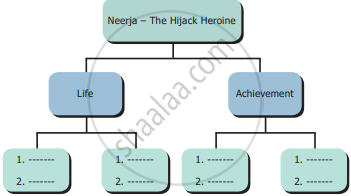
What made Grandfather plant saplings on the rocky island?
The author did not want to plant saplings in the forest because______.
Why did Muthu and his friends step out of the train?
The eggs hatched and the babies flew away.
We get water by burning _______.
He offered _______ to his daughters.
When did the battle of Nauranang start? How long did it continue?
According to the Indian army, Jaswant is still serving.
Where did we visit a mermaid?
Why should we read?
Write the correct form for the present perfect tense.
They ______ (start) playing.
Who is the hero of this story?
The old man is _____.
______ over heard her father’s talking on the phone about the robbery.
Amir switched off the fan wheFalsen he walked out.
Why did Jana’s friends stop her from going near the tree?
What does she paint?
What incident made Mugund make a wooden drum?
How did the boy enjoy the company of the tree?
What did the boy make with the branches of the tree?
The passage given below is on Kabbadi. Read the passage and complete the activities that follow.
Kabbadi (கபடி - in Tamil) is a contact team sport that originated in Tamil Nadu, India. It is the national sport of Bangladesh. It is also popular in South Asia and is the state game of the Indian states of Tamil Nadu, Kerala, Andhra Pradesh, Bihar, Haryana, Karnataka, Maharashtra, Punjab, and Telangana.
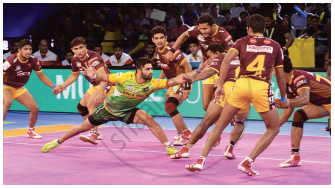
Kabbadi is played between two teams of seven players: the objective of the game is for a single player on offence referred to as a 'raider', to run in to the opposing teams half of a court, tag out as many of their defenders as possible, and return to their own half of the court–all without being tackled by the defenders. Points are scored for each player tagged by the raider, while the opposing team earns a point for stopping the raider. Players are taken out of the game if they are tagged or tackled, but can be 'revived' for each point scored by their team from a tag or tackle. The raider should hold his breath and utter the words like 'kabbadi kabbadi, hututu hututu, chadu kudu' etc. while the opponents try to catch him. If he stops uttering these words, he is considered out.
The game is known by its regional names in different parts of the subcontinent, such as Kabbadi or Chedugudu in Andhra Pradesh, Kabbadi in Kerala and Telangana, Hadudu in Bangladesh, Bhavatik in Maldives, Kauddi or Kabbadi in the Punjab Region, Hu-Tu-Tu in Western India and Hu-Do-Do in Eastern India and Chadakudu in South India. The highest governing body of Kabbadi is the International Kabbadi Federation.
Given below is the visual presentation of the first paragraph.
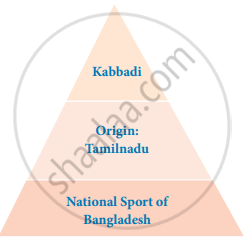
i) Represent the other paragraphs in a visual form of your choice(flow chart, mind-map, pie-chart, etc.).
ii) Choose the correct option.
1. A contact sport usually involves a ______contact between players.
- violent
- gentle
- physical
2. Kabbadi is a game played between ______.
- seven teams of two players
- two teams of seven players
- four teams of seven players
3. A single ______.
- player on offence is referred to as a raider
- offence is referred to as a raider
- raider is an offence by the player
iii) Answer the following.
- How does a raider score points for his team?
- When does a raider concede a point to the opponent team?
- Can a player be revived when he/she is out of the game? Explain your answer.
- Kabbadi is called by different names in different parts of India. Do you know how Pallankuzhi is called in Karnataka, Andhra Pradesh and Kerala?
What should parents do to ensure the safety of children in cyber space?
