Advertisements
Advertisements
Question
Tick the item that is closest in meaning to the following phrase.
to be wound up
Options
to become active
to stop operating
to be transformed
to be destroyed
Advertisements
Solution
to be wound up - to stop operating
APPEARS IN
RELATED QUESTIONS
He asked. Boy, did he ask! First he asked me for a chance, then he asked nearly all the people he came across if they wanted to buy a telephone system from him. And his asking paid off. As he likes to put it, “Even a blind hog finds an acorn every once in a while.” That simply means that if you ask enough, eventually someone will say ‘yes’.
He cared. He cared about me and his customers. He discovered that when he cared more about taking care of his customers than he cared about taking care of himself, it wasn’t long before he didn’t have to worry about taking care of himself.
Most of all, Cowboy started every day as a winner! He hit the front door expecting something good to happen. He believed that things were going to go his way regardless of what happened. He had no expectation of failure, only an expectation of success. And I’ve found that when you expect success and take action on that expectation, you almost always get success.
Cowboy has made millions of dollars. He has also lost it all, only to get it all back again. In his life as in mine, it has been that once you know and practice the principles of success, they will work for you again and again.
He can also be an inspiration to you. He is proof that it’s not environment or education or technical skills and ability that make you success. He proves that it takes more: it takes the principles we so often overlook or take for granted. These are the principles of that Ya Gotta’s for success.
Question:
(1) What was the cowboy’s motto?
(2) What did the cowboy learn after he lost millions of dollars?
(3) Why did the cowboy firmly believe that asking would pay off?
(4) When you expect success and take action on that expectation you almost always succeed. [Name the part of speech of the underlined words]
(5)
(a) He cared about me and his customers. [Rewrite using ‘not only ……………….but also’’]
(b) Cowboy has made millions of dollars [Add a question tag]
(6) In what way is the cowboy a source of inspiration for you?
Answer any three of the following in 30-40 words each:
(a) Why has the poet’s mother been compared to the ‘late winter’s moon’?
(b) The poet says, ‘And yet, for these Children, these windows, not this map, their world.’ Which world do these children belong to? Which world is inaccessible to them?
(c) What was the plea of the folk who had put up the roadside stand?
(d) What will happen to Aunt Jennifer’s tigers when she is dead?
Answer any four of the following in 30–40 words each :
(a) Describe the irony in Saheb's name.
(b) Why was Gandhiji opposed to C.F. Andrews helping him in Champaran?
(c) Aunt Jennifer's efforts to get rid of her fear proved to be futile. Comment.
(d) What does Stephen Spender want to be done for the children of the school in a slum?
(e) When he was only ten days old, a prediction was made about the future of the Tiger King. What was ironic about it?
(f) What was his father's chief concern about Dr. Sadao?
Read the passage given below and answer the questions that follow:
The term dietary fibres refers collectively to indigestible carbohydrates present in plant foods. The importance of these dietary fibres came into the picture when it was observed that the people having diet rich in these fibres, had low incidence of coronary heart disease, irritable bowel syndrome, dental caries and gall stones.
The foodstuffs rich in these dietary fibres are cereals and grains, legumes, fruits with seeds, citrus fruits, carrots, cabbage, green leafy vegetables, apples, melons, peaches, pears etc.
These dietary fibres are not digested by the enzymes of the stomach and the small intestine whereas most of other carbohydrates like starch and sugar are digested and absorbed. The dietary fibres have the property of holding water and because of it, these get swollen and behave like a sponge as these pass through the gastrointestinal tract. The fibres add bulk to the diet and increase transit time in the gut. Some of these fibres may undergo fermentation in the colon.
In recent years, it has been considered essential to have some amount of fibres in the diet. Their beneficial effects lie in preventing coronary heart disease, and decreasing cholesterol level. The fibres like gums and pectin are reported to decrease postprandial (after meals) glucose level in blood. These types of dietary fibres are recommended for the management of certain types of diabetes. Recent studies have shown that the fenugreek (Methi) seeds, which contain 40 per cent gum, are effective in decreasing blood glucose and cholesterol levels as compared to other gum containing vegetables.
Some dietary fibres increase transit time and decrease the time of release of ingested food in colon. The diet having less fibres is associated with colon cancer and the dietary fibres may play a role in decreasing the risk of it.
The dietary fibres hold water so that stools are soft, bulky and readily eliminated. Therefore high fibre intake prevents or relieves constipation.
The fibres increase motility of the small intestine and the colon and by decreasing the transit time there is less time for exposure of the mucosa to harmful toxic substances. Therefore, there is a less desire to eat and the energy intake can be maintained within the range of requirement. This phenomenon helps in keeping a check on obesity. Another reason in helping to decrease obesity is that the high-fibre diets have somewhat lower coefficients of digestibility.
The dietary fibres may have some adverse effects on nutrition by binding some trace metals like calcium, magnesium, phosphorus, zinc and others and therefore preventing their proper absorption. This may pose a possibility of nutritional deficiency especially when diets contain marginal levels of mineral elements. This may become important constraints on increasing dietary fibres. It is suggested that an intake of 40 grams dietary fibres per day is desirable.
(Extracted from ‘The Tribune’)
(a) On the basis of your reading of the above passage make notes on it in points only, using recognizable abbreviations wherever necessary. Also suggest a suitable title.
(b) Write a summary of the above in about 80 words.
What has the camera captured?
Notice these expression in the text. Infer their meaning from the context.
swathe
Briefly comment on:
The purpose of the author’s journey to Mount Kailash.
Briefly explain the following statement from the text.
“You need some interaction to cause a transition.”
What was the importance of the watch to the author?
What do the references to the birds and animals made in the poem suggest?
Read the story and complete the following.
Revathi won the prize for the ‘Best plant’ because, ____________.
‘But the peasant bowed and prayed to God ...........’ What could he have prayed for?
Behrman was a hard-hearted person.
The tongue justifies the possession of the spectacles on behalf of the nose. Pick up the expressions from the poem that argues in favour of the Nose and complete the following web diagram.

Write in short about what your parents/guardians feel when they send you to school.
Find one more example which shows that a beautiful appearance is not enough.
Look at the following words carefully for one minute. Now close your book and try to write down as many of the words as you can remember.
| crust, tremendous, lava, crater, volcanic, tsunami, island, extinct, disaster, dormant, eruption, plume, inland, molten, active, coast |
Answer the following question in one sentence.
What should human beings do in order to make progress?
The merchant ships brought spices and other treasures from India and other countries to Italy.
Hold a mock trial for the following offence. There should be a complainant, a defendant, and lawyers to argue the case on behalf of them. The whole class can vote to pass the judgment. On what occasions will you plead for justice? What punishment will you suggest? When will you plead for mercy?
A poor man stole some ornaments from a rich girl.
Write about one occasion when you have behaved like -
Mr. Nobody
Does the poet expect anything in return? What is the poet’s reward?
Read: ‘Last Chance to See’ by Douglas Adams and Mark Carwardine.
Read the passage and name the following.
She was the wife of King Menelaus.
Complete the following diagram.

Answer in your own words.
What task did Grandpa wish to avoid?
Answer in your own words.
What did Neel realise from his encounter with his ancestors?
List the phrases which have the expression 'many a ______'.
Rearrange the following in their proper order as in the poem. Write the serial number against each line:-
(a) The Ostad sang the Malkous Raga enchantingly.
(b) Akbar followed Tansen, dressed miserably.
(c) I request you to sing such a song that will I experience unmatched joy.
(d) Ostad was nowhere to be seen.
(e) O Divine Teacher, please gift us the joy of your song.
(f) One day, the singer sang Deepak Raga in the court.
(g) Akbar expressed his wish to meet the Teacher.
(h) He experienced heavenly delight.
(i) Tansen sings to please the earthly king but Ostad devotes his songs to God.
(j) She sang Raga Malhar, which had a cooling effect.
Listen carefully and guess how the sentence would end.
When the students saw the question paper, they were ______.
Read the poem and answer the following.
Which are the two different places where strawberries grow?
Why does the poet say that the dewdrops greet the dawn?
Why had Prospero raised a violent storm in the sea?
What conclusions did grandfather jump to when he saw the cops?
Is the bird a crow?
Who am I?
Who Am I? is a guessing game where players use ‘yes’ or ‘no’ questions to guess the identity of a famous person. Questions are based upon the traits and characteristics of a person everyone will be able to identify.
Divide the class into groups. One group should decide the personality while the other group should ask ‘yes’ or ‘no’ type questions. To win the game, a team needs to find out the person within 10 clues.
Sample questions to ask. Answers must be ‘yes’ or ‘no’ only
- Are you a male (female)?
- Are you a famous personality?
- Are you a singer (dancer, actor)?
- Are you a historical figure?
- Are you young (old)?
- Are you alive now?
- Does your name start with ‘___’?
- Is he/she ____ ?
Who baked the homemade cookies?
Read the data below and answer the following question.
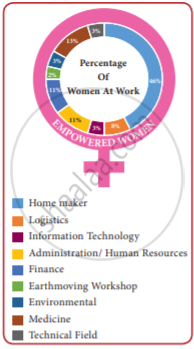
Choose the correct answer.
Identify the three jobs where the same percentage of women work.
What are the skills/values a teacher should teach their students to live in this competitive world?
Neerja leapt into action when she______.
Give an example for dazzling light.
According to the author the tendril was moving towards grandfather because it______.
Read the lines and answer the question given below.
Faster than fairies, faster than witches,
Bridges and houses, hedges and ditches;
- What is faster than fairies and witches?
- Why does the poet mention ‘bridges and houses, hedges and ditches’? Where are the
How do we see the earthworm often?
Does it work its best?
A robot advised her to______.
Why did the old man disguise himself as a beggar?
Choose the correct option from the given homophones.
You should never ______ to your parents.
Who is incharge of this case?
Which disaster had hit the village?
Find and write the clues.
Clue for lost teeth ______.
List the things that humans should save.
If we didn’t have boundaries, we don’t need _______.
Leaf cutter ants drink ______.
How was the stump of the tree useful?
Why is the play called ‘The Giving Tree’?
What did the library door say?
Where did the naughty boy go?
