Advertisements
Advertisements
Question
The passage given below is on Kabbadi. Read the passage and complete the activities that follow.
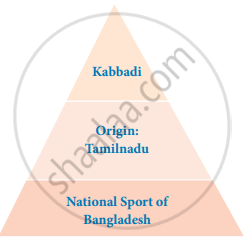
Kabbadi (கபடி - in Tamil) is a contact team sport that originated in Tamil Nadu, India. It is the national sport of Bangladesh. It is also popular in South Asia and is the state game of the Indian states of Tamil Nadu, Kerala, Andhra Pradesh, Bihar, Haryana, Karnataka, Maharashtra, Punjab, and Telangana.
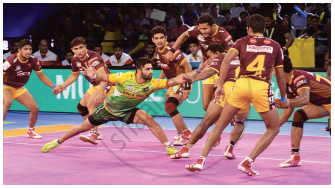
Kabbadi is played between two teams of seven players: the objective of the game is for a single player on offence referred to as a 'raider', to run in to the opposing teams half of a court, tag out as many of their defenders as possible, and return to their own half of the court–all without being tackled by the defenders. Points are scored for each player tagged by the raider, while the opposing team earns a point for stopping the raider. Players are taken out of the game if they are tagged or tackled, but can be 'revived' for each point scored by their team from a tag or tackle. The raider should hold his breath and utter the words like 'kabbadi kabbadi, hututu hututu, chadu kudu' etc. while the opponents try to catch him. If he stops uttering these words, he is considered out.
The game is known by its regional names in different parts of the subcontinent, such as Kabbadi or Chedugudu in Andhra Pradesh, Kabbadi in Kerala and Telangana, Hadudu in Bangladesh, Bhavatik in Maldives, Kauddi or Kabbadi in the Punjab Region, Hu-Tu-Tu in Western India and Hu-Do-Do in Eastern India and Chadakudu in South India. The highest governing body of Kabbadi is the International Kabbadi Federation.
Given below is the visual presentation of the first paragraph.
i) Represent the other paragraphs in a visual form of your choice(flow chart, mind-map, pie-chart, etc.).
ii) Choose the correct option.
1. A contact sport usually involves a ______contact between players.
- violent
- gentle
- physical
2. Kabbadi is a game played between ______.
- seven teams of two players
- two teams of seven players
- four teams of seven players
3. A single ______.
- player on offence is referred to as a raider
- offence is referred to as a raider
- raider is an offence by the player
iii) Answer the following.
- How does a raider score points for his team?
- When does a raider concede a point to the opponent team?
- Can a player be revived when he/she is out of the game? Explain your answer.
- Kabbadi is called by different names in different parts of India. Do you know how Pallankuzhi is called in Karnataka, Andhra Pradesh and Kerala?
Advertisements
Solution
i)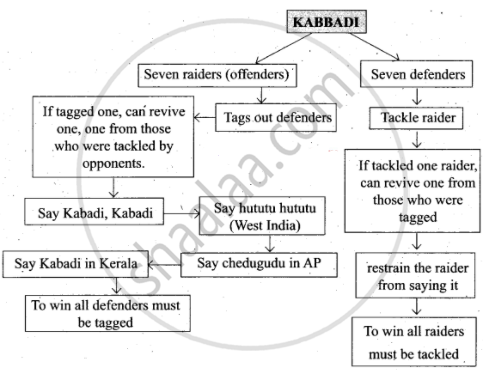
ii)
- A contact sport usually involves a Physical contact between players.
- Kabbadi is a game played between two teams of seven players.
- A single player on offence is referred to as a raider.
iii)
- A raider runs into the area of opponents (i.e.) defenders who are secure in half part of the Kabbadi court. He tries to tag out as many as possible. If he. tags two defenders, the offence team wins two points.
- A raider concedes a point to the opponent team when he is tackled successfully by the defenders.
- If a defender is tagged by a raider, one member from the raider’s team can be revived. Similarly, a defender can be revived if his team tackles a raider.
- Pallanguzhi/Pallankuzhi is called Ali gulimare in Karnataka; Vamana gun talk in Andhra Pradesh and Kuzhipara in Kerala.
APPEARS IN
RELATED QUESTIONS
Read the following passage and do the given activities:
A.1) True or False
State whether the following statements are true or false:
(i) The patient stirred and looked about in cheerful anticipation
(ii) The patient’s wife wanted to know the truth …………
The lady went away to the kitchen. She felt restless. She felt she must know the truth whatever it was. Why was the great man so evasive? The suspense was unbearable. Perhaps he could not speak so near the patient’s bed. She beckoned to him from the kitchen doorway.
The doctor rose and went over. She asked, “What about him now? How is he?” The doctor bit his lips and replied, looking at the floor, “Don’t get excited. Unless you must know about it, don’t ask now.” Her eyes opened wide in terror. She clasped her hands together and implored, “Tell me the truth.” The doctor replied, “I would rather not talk to you now.” He turned around and went back to his chair. terrible wailing shot through the still house; the patient stirred and looked about in bewilderment. The doctor got up again, went over to the kitchen door, drew it in securely and shut off the wail.
A.2) Give reasons for the following:
(i) Her eyes opened wide in terror.
(ii) The lady went away to the kitchen.
A.3) How, according to you, should the nature of the doctor be?
Answer the following in 200-250 words :
What are Helen's opinions about examinations?
Give reasons for the following statement.
Tibetan mastiffs were popular in China’s imperial courts.
Nouveau riche and bourgeoise are French words. Collect from newspapers, magazines, and other sources some more French words or expressions that are commonly used in English.
What impression would you form of a state where the King was 'just and placid'?
Which are the lines in the poem that impressed you the most and why?
Study each of the following sentences and notice the balance between its parts. Pick out other sentences in the text that reflect this kind of balance
a. It is right that a false Latin quantity should excite a smile in the House of Commons; but it is wrong that a false English meaning should not excite a frown there.
b. Let the accent of words be watched, by all means, but let the meaning be watched more closely still, and fewer will do the work.
Give a brief account of the interaction between Grandpa and Jo.
Make groups and discuss the following:
Name a few scientists/explorers/social reformers/inventors/discoverers, who spent most of their lives to find solutions to some major problems/setbacks, that mankind faced.
Correct the following statement.
The last leaf was a real leaf that survived.
Form pairs. Make a list of as many games as you can. (At least 25) Then classify the games using the following criteria:
- Indoor and outdoor games.
- Games played with and without any equipment.
- Games which have one-to-one matches and those in which teams play against each other (Single-player or team)
- Games played mostly by children and games played by adult players.
- Shape and size of the court or field.
Use the following figures to show your classification.
Wash your handkerchief clean. Hang it with a peg to dry in the wind. Watch how it flutters.
What were the three things that Sushruta discovered?
Listen carefully and guess how the sentence would end.
This step is broken. Please be ______.
How did Helen overcome her handicaps?
Identify the character or speaker.
He was the chief of all spirits.
Identify the character/speaker.
Go to my cottage and fetch my gloves and fan.
What is the poem about?
Write a summary based on the story map.

Work in pair, find answer for the question and share in the class.
When is it autumn in India? Why does the poet say this? Is there an autumn season in India?
How did Santhosh record his diary?
_________ is the memorial for the soldiers.
Do you love to seek answers to the questions?
Parents help us to overcome our______.
Write the rhyming word.
countries- ______.
Join the word with the correct prefix.
| paid | un |
| send | dis |
| able | re |
| continue | pre |
He started selling wooden toys at a high price.
The fir tree was sad ______.
Are these sentence TRUE or FALSE
The poet tells the child to be afraid when it is dark.
What did the library door say?
