Advertisements
Advertisements
प्रश्न
Using your imagination, write about a beautiful region - its landforms, water bodies, flora and fauna, night sky, people, etc.
Advertisements
उत्तर
Welcome to the magical fairyland of Twatsa. The Mother Fairy, Tossamer Walfrost lives in butterfly islands and insect grottos. All around the wonderland are swift bubbling streams of treacle, cascading from hillocks of orange marmalade. The candy floss flowers invite butterflies with transparent wings. Once in a while, across the dark chocolate sky, shooting stars are seen. They drip and fall on land covered in caramel wafer. Little gnomes, goblins, and elves fly swiftly visiting children in their dreams. The mermaids in the sugary seas use doughnuts to keep them from drowning. And somewhere, sometimes a dreamy kid makes castles of walnut and kennel for his pet in this fairyland of Twatsa.
APPEARS IN
संबंधित प्रश्न
Notice these expression in the text. Infer their meaning from the context.
swathe
Study each of the following sentences and notice the balance between its parts. Pick out other sentences in the text that reflect this kind of balance
a. It is right that a false Latin quantity should excite a smile in the House of Commons; but it is wrong that a false English meaning should not excite a frown there.
b. Let the accent of words be watched, by all means, but let the meaning be watched more closely still, and fewer will do the work.
Find proof from the poem for the following.
The struggle of the cherry tree for survival.
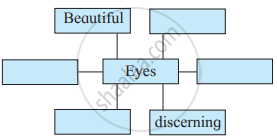
Complete the web with the help of adjectives used to describe eyes and nose in all respects. Two are done for you.

Read the poem: ‘Home they brought her warrior dead’ by Alfred Lord Tennyson.
Write an imaginary telephone conversation in which you invite your friend to the above function.
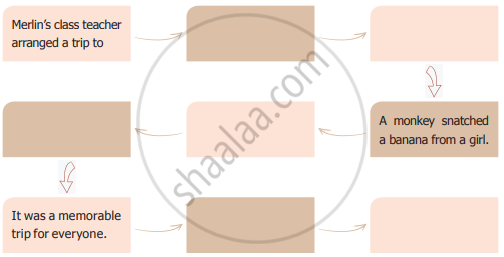
Recall Merlin’s memories and complete the story map.
Divide the following word.
man
What did the children buy with money they have?
Read the following passage and do the activities:
A1. Fill in the blanks: (2)
- ______ percent of our daily communication is non-verbal.
- Eye contact is another type of ______ communication.
- Frequent blinking is a sign of the person feeling ______.
- One can readily detect _______.
|
According to some experts, a staggering 93 percent of our daily communication is non-verbal. Facial expressions are easy to decipher. One can readily detect happiness, sadness, anger. Physicians can tell a patient is doing well (or not) by looking at his/her face. Eye contact is another type of non-verbal communication, which can tell a lot about the other person. The eyes convey a range of emotions-happiness, sadness, boredom, surprise, confidence .......... even emotional interest. Staring at someone's forehead may intimidate the recipient, staring at the mouth is sometimes interpretated as a sign of emotional interest. In fact, staring into someone's eyes is a sign of lying, and so is looking away. In certain cultures, lack of eye contact is taken as a sign of respect. If body language is to be defined, it is a combination of facial expression, gestures, eye contact, body movements and posture and voice. Frequent blinking is a sign of the person feeling distressed or uncomfortable. If the pupils are dilated, it ofter indicates interest, even emotional interest. The lips also reflect our body language, and lip biting indicates worry and/or anxiety; tightening of the lips may be an indication of disapproval. Slightly turned-up lips indicate happiness and slightly turned-down lips indicate sadness. |
A2.

A3. Find the antonyms of: (2)
- verbal × ______
- entertaining × ______
- sender × ______
- comfortable × ______
A4. Do as Directed: (2)
- The eyes convey a range of emotions. (Frame a 'Wh' question in order to get the underlined part as answer).
- Physicians can tell about a patient's wellness. (Rewrite using 'able to')
A5. Personal Response: (2)
Non-verbal communication plays an important role in our daily life. Comment.
