Advertisements
Advertisements
प्रश्न
Discuss in pairs or in small groups
The description of novels as organisms.
Advertisements
उत्तर
Novels are like organisms. They have structure just as organisms have structure. A novel has a solid base in the story line. The story is the backbone of the novel. Just as an organism has birth, growth and decay, so does a novel. A novel is like a system.
APPEARS IN
संबंधित प्रश्न
Read the following passage and do the given activities:
B.1) Comparison
Write the comparison between the parts of the modular phone and the human body:
| Modular Phone | Parts of Human Body |
Every phone you buy, no matter how costly and latest it is, will go out of date in a year or so. That’s how quickly the smartphone world is moving right now. To keep yourself up to date with the current specification you will have to keep switching phones every once a while. What’s the solution to this problem?
MODULAR PHONES!
A modular device is a phone, tablet or another device where individual components such as the screen, camera, CPU, battery, memory can be removed by the user and replaced by others with a different specification. Imagine your body to be your phone and your clothes as the components, you can wear anything according to your needs and moods. Similarly, modular phones let you choose between components of different properties and specifications.
This would mean we’ll have the liberty to customize our phones, just like Lego building blocks! The main components of the phone will be Brain (processor), Spine (frame, screen) and Heart (battery). The other components may include a camera, storage memory, GPS, audio jack, speakers, USB module, etc. and the phone will have a motherboard, i.e. a base that will hold all components together
B.2) Give examples:
Write two examples that give the liberty to customize our phone.
• ____________________
• ____________________
B.3) Framing sentence:
Use the given phrases in sentences of your own:
(i) up to date
(ii) once a while
B.4) Write as instructed:
Rewrite the sentence as interrogative:
(i) We’ll have the liberty to customize our phones.
(ii) We will have the liberty to customize our phones. (Rewrite using the present participle form of the underlined word)
B.5) Personal Response
If given a chance to design a modular phone, what new features would you add?
Give reasons for the following statement.
The author’s experience at Hor was in stark contrast to earlier accounts of the place.
What do the following utterance indicate?
(i)“I told her, through Daniel ...”
(ii)“It’s a cold,” he said finally through Tsetan.
What do you understand of Einstein’s nature from his conversations with his history teacher, his mathematics teacher and the head teacher?
This play, written in the 1950s, is a humorous and satirical depiction of the status of the mother in the family.
What are the issues it raises?
We 'draw up a deed'. Complete the following phrase with an appropriate word.
________one's word
Discuss in pairs or groups of four.
Replacing old machines with new is better than getting them repaired.
Discuss in pairs or in small groups.
People with foibles are often not conscious of them.
Adi Song for the Recovery of Lost Health' is in Miri Agom while Adi Agom is the Adi community's language for routine conversation. How does this reflect upon the high level of language sensitivity of the Adi? Can you think of other parallels in modern languages between the literary variety and the colloquial variety?
Why is the poem entitled 'Hawk Roosting'?
How did Kumudini react to her mother's death?
How does the banyan tree stand out as different from other trees? What details of the tree does the poet highlight in the poem?
What are the unpleasant aspects of the human condition that the poet wants to escape from?
Think, choose and fill up the labels with what a ‘sunrise’ symbolizes.
(jewellery/art/hope/birth/anger/new opportunities/good manners/inspiration/new achievements/happiness/misery/bright moments/new aims/money/new surprises)

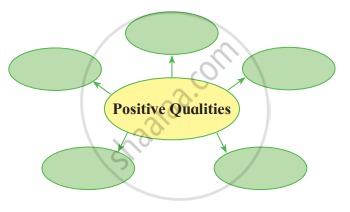
Find from the poem, positive qualities to fill up the web.
Make a list of archaic words from the poem and give their modern equivalents.
Write four reasons why animals in a zoo suffer more than those who live free in the wild.
Imagine that one of your family members/friends/classmates has recently undergone surgery. You were curious and wanted to learn about his/her experience.
Match the questions you asked with their answers.
| 1. | What health problem did you suffer from? | a. | I was given a bath and I wore a surgical gown. |
| 2. | Whom did you inform about it first? | b. | I was given an injection of anesthesia. |
| 3. | What type of doctor did you consult? | c. | I consulted an orthopedic surgeon. |
| 4 | How did he/she find out that you needed a surgery? | d. | I was relieved and happy that the operation was over. |
| 5. | What preparation was done before the surgery? | e. | I had fractured my ankle while playing hockey. |
| 6. | What did you feel when you were taken to the operation theatre? | f | No, I did not feel anything. I was fast asleep. |
| 7. | What was the first step before the actual surgery? | g. | I recovered and I could walk normally after 3 weeks. |
| 8. | Did you feel any pain during the surgery? | h. | Our school hockey coach. |
| 9. | What did you feel when you opened your eyes after the operation? | i. | The doctor took an X-ray of my ankle, and he found a fracture in my ankle. |
| 10. | How soon did you recover? | j. | I was very nervous. |
Use the following word/phrase to make a sentence of your own.
enthusiasm
Answer the following question in short.
Why did Pundit Shahane visit Vijaynagar?
Answer the following question in short.
On what condition did Tenali Raman agree to take up the challenge?
Fill in the gap, choosing a word from the bracket to make an appropriate comparison.
(tall / quiet / humble / merry / busy / slippery / fast / sly / slow / big)
as ______ as a giraffe
State the difference between poetry and drama.
Correct the given sentence with justification.
The play is restricted to only a part of the woods.
Discuss the following question after you have seen a presentation of the ‘ad’.
What would happen if you never ate fruits and vegetables?
Write about the various wheel-like objects you see at home, in school, and on the road.
Note that most of the time well-known works are parodied, because people can enjoy the parody better when they know the original. Try to find more examples of parodies in English or other languages.
Complete the following diagram.
Choose the appropriate phrase to insert in the gap, to make the sentence meaningful. Use the appropriate form of the verb.
Before we do the experiment in the Laboratory, let me ______ you all about it.
Often the brook speaks of itself as if it is human.
For example, 'I bicker down a valley.'
Find two other examples of the human activities of the brook.
How did the middle brother use rice?
List and say whether the following statement agrees with the passage or not.
If you don’t understand something, don’t let the others know about it.
Write other meaningful words that begin/end with gentle-hearted.
List the polite expressions we use such as ‘Pardon’.
How did the parents support and encourage the young seagull’s brothers and sister?
How did the bird try to reach its parents without having to fly?
Do you think that the young seagull’s parents were harsh to him? Why?
Who was the first person to withdraw cash from the ATM?
Write about Hamid in one or two sentences.
What do you infer about speaking with others from this poem?
Fill in the table
| Problems Faced By Mr. Fogg And His Team | Solution |
| The train stopped in the middle of the forest. | |
| They couldn’t hire the elephant. | |
| They were in need of an elephant driver. |
The terrorists asked Neerja to collect the passports of the passengers because ______.
Who is Raj?
Why did the farmer have to travel far?
Amuthan locked the door behind him.
The robot did not obey his master.
______is a Do It Yourself kid.
Name the character or speaker.
“Learn well, live well!”
What was the age of Robinson Crusoe when he left for sea?
Try your own.
Find and write the clues.
Clue for blind eye ______
The king gave______ seeds.
Mugund learnt the art from his ______.
Match the words with similar meaning.
| truck | subway |
| underground | lorry |
| tap | wallet |
| purse | faucet |
Match the rhyming words.
| strokes | floor |
| shore | rush |
| brush | chokes |
The child won’t ______ anything, if he closes his ears.
Match with the opposite gender.
| 1. | prince | bridegroom |
| 2. | hero | princess |
| 3. | bride | heroine |
Write the correct word.
| rooster, king, hen, tiger, queen, tigress. |
Although Helen could not hear or see, what kind of girl was she?
Pick out word which mean the same as
stop doing something (para 1)
