Advertisements
Advertisements
प्रश्न
Discuss in pairs or in small groups
'Our daily life reflects a double allegiance to 'the life in time' and 'the life by values'.
Advertisements
उत्तर
We all owe a double allegiance to the life in time and the life by values. Life in time refers to the exact sequence in which events occur in our lives. We often think of life, our experiences in a proper sequence. But in our thinking we may chose to think about events in a sequence of our choice. We may select experiences or events or impressions from any point of time according to their value or importance. This ability on our part shows that we can lead life by values also.
APPEARS IN
संबंधित प्रश्न
Aunt Jennifer's tigers prance across a screen,
Bright topaz denizens of a world of green.
They do not fear the men beneath the tree;
They pace in sleek chivalric certainty.
(a) Why are the tigers called Aunt Jennifer's tigers?
(b) How are they described here?
(c) How are they different from Aunt Jennifer?
(d) What does the word, 'chivalric' mean?
Read the following extract and answer the questions given below:
How do you know
Peace is a woman?
I know, for
I met her yesterday
on my winding way
to the world's fare.
She had such a wonderful face
just like a golden flower faded
before her prime.
(1) How does the poet describe the face of peace?
(2) Do you think there is a way out of the war-ridden world? What is it?.
(3) Name and explain the figure of speech in the following line:
"I met her yesterday
on my winding way."
(4) The poet asks the question and herself answers it. What effect does it create in the extract?
Read the extract and do the following activities:
A1 Complete :
| Night |
Morning |
| (i) | (i) |
| (ii) | (ii) |
There was a roaring in the wind all night;
The rain came heavily and fell in floods;
But now the sun is rising calm and bright,
The birds are singing in the distant woods;
Over his own sweet voice the Stock-dove broods;
The Jay makes answer as the Magpie chatters;
And all the air is filled with pleasant noise of waters
All things that love the sun are out of doors;
The sky rejoices in the morning’s birth;
The grass is bright with raindrops-on the moors
The hare is running races in her mirth;
And with her feet she from the plashy earth
Raises a mist; that, glittering in the sun,
Runs with her all the way, wherever she doth run.
A2 What do the different birds do? Discuss.
A3 The sky rejoices in the morning’s birth. (Name and explain the figure of speech)
Answer the following question in 150-200 words:
How did Miss Sullivan help Helen Keller when she was studying at Cambridge School?
Notice this expression in the text. Infer their meaning from the context.
the thought was almost revolting
What does the phrase ‘as if he were on needles’ mean? Can you think of another phrase with a similar meaning substituting the word ‘needles’?
'It is not an accident that the most discrimination literary criticism of Shelley's thought and work is by a distinguished scientist, Desmond King-Hele.' How does this statement bring out the meeting point of poetry and science?
Discuss the following in pairs or in groups of four:
“Tribal arts are not specifically meant for sale.” Does this help or hamper their growth and preservation?
How does Forster trace the human interest in the story to primitive times?
Discuss in pairs or in small groups
The description of novels as organisms.
Name the world-famous personality who reached great heights despite of humble circumstances.

Find from the story one word for the following.
the highest-ranking officer in the Municipality of a city/town ______
Read the story and complete the following.
When Revathi played her favourite raga, the plants began to move because, ____________.
complete the following sentence.
Ajoy reported about ________________.
Make a list of the preparations made for an assault on Tiger Hill.
Individual guns ___________.
Who gives medicine/treatment to sick animals and birds?
Discuss with your partner the different ideas connoted by the word 'season'.
- _______________________
- _______________________
- _______________________
Proverbs associated with the word season: for eg: Make hay while the sun shines.
- _________________________
- _________________________
List five of your favourite Hindi or Marathi poems or songs. Try to translate any one of them into English.
Visit a library:
This story is a fable. Find two more fables. Share them with your friends.
Correct the given sentence with justification.
The play is restricted to only a part of the woods.
Form groups and hold debates on the following topics. Make bulleted lists of points in favour of the topic (pros) and those against it (cons). (3-6 points each)
You should never lose a match.
Read aloud/Enact the play.
Have you seen a newborn young one of an animal?
The merchant ships brought spices and other treasures from India and other countries to Italy.
Use the following expressions in your own sentences:
- We all agree that
- It is he/she who
- Don’t you see
- None of us
Think and answer:
Is the poet talking about heavy rains in the rainy season or rain that has come after a long time?
Complete the following diagram.

Rewrite in your own words.
One of the Caesar’s traits that makes you laugh.
Pick out three examples of interrogation (rhetorical questions) from the poem.
Explain in your own words the point that each one makes.
| Interrogation | Explanation |
| (1) | |
| (2) | |
| (3) |
Present any one of these announcements yourself, orally.
Write some more expressions like ‘hundreds of’. Expand each expression.
Example, ‘Hundreds of children in the school.’
When and where was the first ATM installed?
Read the data below and answer the following question.
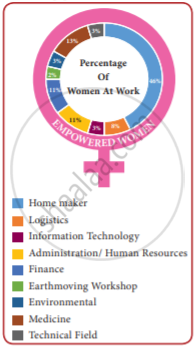
Choose the correct answer.
Percentage of women working in finance is the same as ______.
Hamid’s friends are ______
The author did not want to plant saplings in the forest because______.
What does the tamarind give?
What is the setting of the story?
Vicky decided to______ the robot at the end.
The robot did not obey his master.
Name the character or speaker.
"Play me a pleasant song."
Arrange the pictures by using numbers.

Why do we discover a mystery?
What is your hobby?
The bird-catcher had a pigeon in his _______.
Why did the bird catcher need fire?
Who was Akilan’s inspiration?
Identify the character/speaker.
He set the fish free.
What was the lesson learnt by Uthaman?
______ over heard her father’s talking on the phone about the robbery.
______was with Robinson.
Write the word under the correct group and divide it.
bullet
candle
bat
title
ball
tiffin
 |
 |
 |
Find and write the clues.
Clue for lost teeth ______.
What would you like to learn in school? why?
Why was Chris worried?
Where did the rabbit go?
