Advertisements
Advertisements
प्रश्न
The lecture was delivered in 1864. What are the shifts in style and diction that make the language different from the way it is used today?
Advertisements
उत्तर
The shifts in style and diction are very evident in the text. Certain words like ‘assuredly’ is less used and words like ‘most distant’ are now incorrect because it has become ‘most distant’. Certain phrases like ‘peerage of words’ or national noblesse of words’ is no more used because aristocracy or nobility hardly exist anymore. Certain formations of sentences are also different like ‘no one has yet said it’ as opposed to how it is said today- ‘no one has said it yet’.
APPEARS IN
संबंधित प्रश्न
B1. Complete the following statements:
(i) The poet is talking about............................. .
(ii) As a nation weare missing our .................................... .
(iii) Old people havekeys ........................... .
(iv) The elderly remember .......................... .
"Oh the value of the elderly! How could anyone not know? They hold so many keys, so many
things they can show.
We all will read the other side this I firmly believe.
And the elderly are closest oh what clues we could retrieve.
For their characters are closest to how we'll be on high.
They are the ones most developed, you can see it if you try.
They've let go of the frivolous and kept things that are dear.
The memories of so sweet, of loved ones that were near.
As a nation we are missing our greatest true resource,
To get to know our elders and let them guide our course."
B2 Express
State what the underlined words mean:
(i) Oh the value of the elderly! State the value ............. .
(ii) They are the ones most developed. 'They' stand for ............. .
B3: Match the words in Column A with their rhyming word in Column B:
| Column A | Column B |
| (i) Course | (a) Show |
| (ii) Believe | (b) resource |
| - | (c) retrieve |
Who was Selden? Why was he on the moor?
Read the following extract and then do all the activities that follow :
I rain into a stranger as he passed by
“Oh, excuse me please” was my reply.
He said, “please excuse me too; wasn't even watching for you.”
We were very polite, this stranger and I.
We went on out way and we said good-bye.
But at home a different story is told.
How we treat out loved ones, young and old.
Later that day, cooking the evening meal,
My daughter stood beside me very still.
When I turned, I nearly knoked her down.
“Move out of the way,” I said with a frown.
She walked away, her little heart broken.
I didn't realize how harshly I'd spoken.
While I lay awake in bed,
God's still small voice came to me and said,
“While Dealing with a stranger, common courtesy you use,
But children you love, you seem to abuse.”
A1. Order-
The incidents narrated in the extract are arranged in a jumbled manner here, Rearrange them in a proper order as they occur in the extract:
(i) The poet and the stranger went on their way saying good-bye.
(ii) Seeking excuse politely from the stranger, she went her way.
(iii) The poet ran into a stranger on the road.
(iv) The poet yelled at her daughter.
A2. Poetic device:
Make a list of rhyming pairs from the second stanza and note down the rhyme scheme of the same stanza.
A3. Personal Response:
Understanding and politeness are the essentials of out everyday life. Explain your views in brief.
A4. Creativity -
Frame two poetic lines on the following situation using a rhyming pattern with the help of clues given:
“While introducing great personalities, we praise them highly and talk about their qualities, but while speaking
about our friends we may not follow the same trend.”
While introducing great personalities, — a
------------------------------------ — a
But while speaking about our friends, — b
------------------------------------ — b
What caused a blow to man’s ego ?
Discuss in groups of four.
The reasons why people willingly undergo the travails of difficult journeys.
Discuss the following in pairs
Empathy and understanding are going out of modern society. The individual experiences intense alienation from the society around him or her.
Why has he compared the three passions to great winds?
How is the idyllic juxtaposed with the pedestrian in the poem?
|
Little things Little drops of water, Thus the little minutes, Little deeds of kindness, |
What important message does the above poem convey?
Kite - flying in Gujarat, is a competitive sport - cum - festival.
Discuss in groups and share with one another.
When you go for a picnic, what and how do you enjoy?
Your friend fell down learning to ride a bicycle and now has given it up altogether. What do you think will be the poet’s advice? Write it down.
What changes in the stage setting would you suggest.
Discuss the following question after you have seen a presentation of the ‘ad’.
How many times is the name Krispy Krunchy repeated in the ad? Why?
Explain the following statement with reference to the context.
From now on The Herald shall be my artillery.
Apart from class/school, where else are you likely to find a time table useful?
Explain the idea of ‘Conservation of Nature through Livelihood’ briefly, using the example given here.
Find the different units of measurement mentioned in the passage and get more information about them from the internet.
Write the symbol that is used in the poem to represent the following idea.
Some other time.
Pick out three examples of interrogation (rhetorical questions) from the poem.
Explain in your own words the point that each one makes.
| Interrogation | Explanation |
| (1) | |
| (2) | |
| (3) |
Form groups of five. Discuss how you can complete the rest of the story without referring to Part II of the story.
Describe the following in one or two lines.
The first little house of the bird.
Form a group of 4 or 5. Make a ‘storyboard’ for the story ‘Three Sacks of Rice’.
Arrange the story in the form of a sequence of pictures.
Decide what you will show in each picture; what words/lines you will write with each picture to explain what happens in it.
You can also add ‘speech balloons’ for the people in the pictures.
Write what you can do to welcome birds in your surroundings.
What is meant by being ‘online’?
How did Miranda feel when her father raised the storm to destroy the ship?
Answer the question in a paragraph of about 100 – 150 word.
Narrate how Prospero made his enemies repent to restore his dukedom.
What did the narrator think the unusual sound was?
What conclusions did grandfather jump to when he saw the cops?
Is the bird a crow?
Read the following line from the poem and answer the question given below.
Let us learn to walk with a smile and a song,
No matter if things do sometimes go wrong;
- What does the poet expect everyone to learn?
- What should we do when things go wrong sometimes?
Hamid’s friends enjoyed the ride in the merry-go-round. But Hamid didn’t go on it. Why?
Why did Alice follow the rabbit?
How does Alice feel after all these changes?
He woke up very late in the morning.
drenched – thoroughly wet
He is drenched to the skin. ______
What is the ‘breath of life’?
What did Grandmother feel about trees growing in the house?
Who is Raj?
Why did the girls snigger?
Where did the boys and girls go?
Geetha madam couldn’t stop the children running out of the train because they ______.
How did Santhosh know that the river was clean?
A man in ______ clothes stopped near him.
Fruits and shadows are free under the _______.
Match the rhyming words.
| mars | crime |
| bed | cars |
| time | head |
The old man is _____.
Match the following.
| pale |  |
| tremble |  |
| fainted |  |
Why did Meena call the official 'Appa'? Do you think we need to be a family to care for others?
Kani took Teddy out for a ____.
In real the plate was made of ______.
Choose the correct one.
Rooster

The brush ______ to her will.
The garden Alice saw was
What does the earth do when the day is over?
Are these sentence TRUE or FALSE
The poet tells the child to think of friends after it is dark.
Where did the naughty boy go?
Read the following passage and do the activities.
A1. State whether the following sentences are True or false. [2]
- The king’s temperament also changed.
- The king was happy with prediction of the astrologer.
- The courtiers sought an audience with Tenali Raman.
- Courtiers advised the king to regulate his diet.
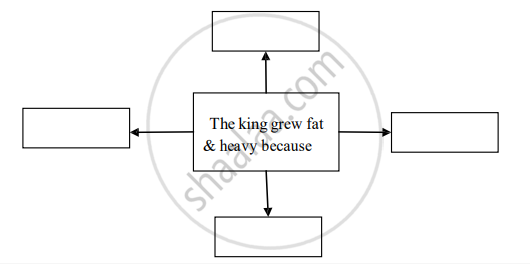
A2. Complete the web. [2]
|
King Krishnadeva Raya would perform heavy exercises every morning. He regularly applied oil on his body and thereafter worked out till all the oil came out with the sweat. This was followed by a long ride on his horse. Once the king started leading a sedentary lifestyle, and he stopped exercising. He no longer went horse-riding either. The king overate and as a result grew fat and heavy. The king‟s temperament also underwent a sea change. Noticing this, the royal physicians cautioned the king against the ill effects of overeating and explained to him the risks posed by obesity. They advised the king to regulate his diet, exercise, and take care of his health. The repeated advice he got from the physicians to eat less made him so angry that one day he announced a reward for anyone who could find him an easy cure. But there was one condition: those who failed would have their heads off. None dared to advise the king in this regard. The situation became precarious and as usual Tenali Raman was approached by the courtiers for a remedy. Tenali heard the problem and assured the courtiers of a viable solution. The next day, an astrologer predicted that the king had only a month left to live. When the king came to know of this, he was furious. The astrologer was ordered by the king to be imprisoned for a month so that his prediction could be put to test and so the hapless forecaster was sent to prison. |
A3. Find out describing words from the passage for the words given below. [2]
- exercise - ...........
- lifestyle - ...........
- ride - ...........
- physician - ...........
A4. Do as directed. [2]
- King Krishnadeva Raya would perform heavy exercises every morning.
(Use ‘used to’) - They advised the king to regulate his diet. (Pick out the infinitive)
A5. What are the benefits of daily exercise? [2]
How can we identify insecure websites?
