Advertisements
Advertisements
प्रश्न
What makes the urgency of the child's demand seem logical?
Advertisements
उत्तर
The child is young and impatient. When he hears the mother discussing things with the father, on hearing her voice reminds him that he is hungry. So, he goes up to her asking for food. Even on being gestured by the mother to wait for five minutes, he demands food throwing his logic at her that he will not be hungry anymore. The argument is appealing to the father, he feels that a boy, so young, who is “such a logician deserves his dinner straight away.” The urgency with which the boy demands and with such wittiness makes the mother laugh. This joy held the three together. The mother then agrees to serve the dinner and they go inside the house.
APPEARS IN
संबंधित प्रश्न
Read the passage carefully.
1. I remember my childhood as being generally happy and can recall experiencing some of the most carefree times of my life. But I can also remember, even more vividly, moments of being deeply frightened. As a child, I was truly terrified of the dark and getting lost. These fears were very real and caused me some extremely uncomfortable moments.
2. Maybe it was the strange way things looked and sounded in my familiar room at night that scared me so much. There was never total darkness, but a street light or passing car lights made clothes hung over a chair take on the shape of an unknown beast. Out of the corner of my eye, I saw curtains move when there was no breeze. A tiny creak in the floor would sound a hundred times louder than in the daylight and my imagination would take over, creating burglars and monsters. Darkness always made me feel helpless. My heart would pound and I would lie very still so that 'the enemy' wouldn't discover me.
3. Another childhood fear of mine was that I would get lost, especially on the way home from school. Every morning, I got on the school bus right near my home ‒ that was no problem. After school, though, when all the buses were lined up along the curve, I was terrified that I would get on the wrong one and be taken to some unfamiliar neighbourhood. I would scan the bus for the faces of my friends, make sure that the bus driver was the same one that had been there in the morning, and even then ask the others over and over again to be sure I was in the right bus. On school or family trips to an amusement park or a museum, I wouldn't let the leaders out of my sight. And of course, I was never very adventurous when it came to taking walks or hikes because I would go only where I was sure I would never get lost.
4. Perhaps, one of the worst fears I had as a child was that of not being liked or accepted by others. First of all, I was quite shy. Secondly, I worried constantly about my looks, thinking people wouldn't like me because I was too fat or wore braces. I tried to wear 'the right clothes' and had intense arguments with my mother over the importance of wearing flats instead of saddled shoes to school. Being popular was very important to me then and the fear of not being liked was a powerful one.
5. One of the processes of evolving from a child to an adult is being able to recognise and overcome our fears. I have learnt that darkness does not have to take on a life of its own, that others can help me when I am lost and that friendliness and sincerity will encourage people to like me. Understanding the things that scared us as children helps to cope with our lives as adults.
(a) On the basis of your reading of the above passage, make notes using headings and subheadings. Use recognizable abbreviations wherever necessary.
(b) Make a summary of the passage in not more than 80 words using the notes made and also suggest a suitable title.
Describe Miss Stapleton's first encounter with Sir Henry in about 125 words
Answer any four of the following questions in 30 - 40 words each:
(a) What does the poet's smile in the poem, 'My Mother at Sixty-six' show?
(b) Listening to them, I see two distinct worlds ... ." In the context of Mukesh, the bangle maker's son, which two worlds is Anees Jung referring to ?
(c) Though the sharecroppers of Champaran received only one-fourth of the compensation, how can the Champaran struggle still be termed a huge success and victory?
(d) Which article in McLeery's suitcase played perhaps the most significant role in Evans' escape and how?
(e) Why does Derry’s mother not want him to go back to visit Mr. Lamb?
(f) What considerations influenced the Tiger King to get married?
Answer any four of the following in 30-40 words each:
(a) Why was the peddler amused at the idea of the world being a rattrap?
(b) Why did Gandhiji agree to a settlement of mere 25 percent?
(c) Aunt Jennifer's efforts to get rid of her fear proved to be futile. Comment.
(d) What does Stephen Spender want to be done for the children of the school in a slum?
(e) How did the ten-day-old baby (the future Tiger King) react to the prediction about his future made by the astrologers?
(f) Why was Dr. Sadao not sent abroad along with the troops?
Read the following extract carefully and complete the activities given below :
A1 Complete the following :
(i) Books were found on the _____________ and ____________.
(ii) The tales are described as ______________ and __________.
|
Have you forgotten? Don't you know?
We'll say it very loud and slow:
THEY ... USED ... TO ... READ! They'd READ and READ,
AND READ and READ, and then proceed
To READ some more. Great Scott! Gadzooks!
One-half of their lives was reading books!
The nursery shelves held books galore!
Books cluttered up the nursery floor!
And in the bedroom, by the bed,
More books were waiting to be read!
Such wondrous, fine, fantastic tales
Of dragons, gypsies, queens, and whales
And treasure isles, and distant shores
Where smugglers rowed with muffled oars,
And pirates wearing purple pants,
And sailing ships and elephants,
And cannibals crouching 'round the pot,
Stirring away at something hot.
(It smells so good, what can it be?
Good gracious, it's Penelope.)
|
What does “this circumstance” refer to?
|
The energy stored in coal and petroleum originally came to the earth from the sun. The bulk of the present-day supplies was laid down some 200 to 600 million years ago, when tropical conditions were widespread. Lush, swampy forests produced huge trees; warm coastal seas swarmed with microscopic forms of life. When these organisms died, much of their tissue was recycled as it is today — through scavenging and decay. But a significant amount of dead plant and animal material was covered with mud, which prevented complete decomposition. With the passage of time, layer upon layer of the fine sediment was deposited over the once-living material; the sheer weight turned the sediments to rock. Sandwiched between the layers, both coal and petroleum were produced and preserved under pressure. Coal was formed mostly of giant fern-like plants that have only small counterparts today. Coal may still be forming here and there on earth, but conditions are not right for the production of significant quantities. |
Underline the important words and phrases.
Tick the statement if its true.
Rajendra Deshpande was a historian.
What do you think are the reasons for the references made to the English people and the British monarchy?
What was Uncle Williams' comment on the 'tinkerers' of the world?
Explain the contradiction in the similies, ‘Like a child from the womb, like a ghost from the tomb’.
How did Kumudini react to her mother's death?
Read the extract and state whether the following statement is true or false. Correct the false statement.
The author is an example of ‘reverse migration’.
Complete the following sentence.
Sujoy reported about ___________________.
Imagine that one of your family members/friends/classmates has recently undergone surgery. You were curious and wanted to learn about his/her experience.
Match the questions you asked with their answers.
| 1. | What health problem did you suffer from? | a. | I was given a bath and I wore a surgical gown. |
| 2. | Whom did you inform about it first? | b. | I was given an injection of anesthesia. |
| 3. | What type of doctor did you consult? | c. | I consulted an orthopedic surgeon. |
| 4 | How did he/she find out that you needed a surgery? | d. | I was relieved and happy that the operation was over. |
| 5. | What preparation was done before the surgery? | e. | I had fractured my ankle while playing hockey. |
| 6. | What did you feel when you were taken to the operation theatre? | f | No, I did not feel anything. I was fast asleep. |
| 7. | What was the first step before the actual surgery? | g. | I recovered and I could walk normally after 3 weeks. |
| 8. | Did you feel any pain during the surgery? | h. | Our school hockey coach. |
| 9. | What did you feel when you opened your eyes after the operation? | i. | The doctor took an X-ray of my ankle, and he found a fracture in my ankle. |
| 10. | How soon did you recover? | j. | I was very nervous. |
Find at least five other Akbar and Birbal stories and share them with your friends. Make a list of the stories collected by the entire class. Put your list in alphabetical order.
Fill in the gap, choosing a word from the bracket to make an appropriate comparison.
(tall / quiet / humble / merry / busy / slippery / fast / sly / slow / big)
as ______ as a fox
Divide the story into different sections to show the different events and time periods in it. Give a suitable title to each section.
Answer the following question in one sentence.
What does the man who misses all the fun do?
Complete the following sentence with reference to the passage:
The king was determined to prevent his beloved son from ____________.
Explain the idea of ‘Conservation of Nature through Livelihood’ briefly, using the example given here.
Think and answer:
Does the last line make you happy or sad? Why?
Correct the following sentence and rewrite it.
The best shoes that Papa Panov had made were a pair of lady’s shoes.
Read the word. Write the words that combine to make it.
stepmother
Guess the meaning of the following word.
postponed
Write other meaningful words that begin/end with springtime.
Write what you can do to welcome birds in your surroundings.
What did Ahmad tell Kasim when he dug a channel and began to draw water?
What did the Judge tell Ahmad?
Have you ever seen or used a computer?
Identify the character or speaker.
I will tie you neck and feet together.
Identify the character or speaker
He repented and implored his brother’s forgiveness.
The author left the ties in the taxi.
How did Hamid’s friends enjoy the games in the fair?
Find a sentence/word from the text which express the following.
The parent’s earlier view of the child
Who told the children the story about the ghosts on Haunted Hill?
Usha took shelter in the ______.
Teachers help me to learn ______ things.
- new
- bad
- difficult
What should we learn from our teachers?
What did Mr. Fogg mean by, ‘it was foreseen’?
Read the line and answer the question.
I must go down to the sea again, to the lonely sea and the sky
Where does the poet want to go?
Read the line and answer the question.
And quiet sleep and a sweet dream when the long trick’s over
What does the poet want to do after his voyage is over?
Read the following article about the amazing similarities between the assassination of John F. Kennedy and Abraham Lincoln; then underline the passive forms.
Abraham Lincoln was elected to Congress in 1846. Voters elected John F. Kennedy to Congress in 1946.
Lincoln was elected president in 1860. Voters elected Kennedy president in 1960.
Both men were particularly concerned with civil rights.
Both wives lost their children while living in the White House.
Lincoln was shot on a Friday. Someone shot Kennedy on a Friday.
Lincoln was shot in the head. The gunman shot Kennedy in the head.
Lincoln’s secretary was called Kennedy. Kennedy’s secretary was called Lincoln.
Lincoln was assassinated by a Southerner. A Southerner assassinated Kennedy.
Lincoln was succeeded by a Southerner named Johnson. A Southerner named Johnson succeeded Kennedy.
Andrew Johnson, who succeeded Lincoln, was born in 1808.
Lyndon Johnson, who succeeded Kennedy, was born in 1908.
John Wilkes Booth, who assassinated Lincoln, was born in 1839. Lee Harvey Oswald, who assassinated Kennedy, was born in 1939.
Both assassins were known by their three names and both names are composed of fifteen letters.
Lincoln was shot at a theatre named “Ford”. The gunman shot Kennedy in a car called a “Lincoln” that the company Ford made.
Booth ran from the theatre and was caught in a warehouse. Oswald ran from a warehouse and the police caught him in a theatre.
Booth was assassinated before his trial. Someone assassinated Oswald before his trial.
Rearrange the following jumbled sentences in the correct order.
- Payal’s house was a home for abandoned animals.
- It was a small ball of brown and grey.
- She found an owlet in one corner.
- Payal’s mother picked her up gently.
- Payal’s mother opened the carton.
- One day they got a carton.
The pit was comfortable for the wild boar to sleep in.
Match the following.
| cuckoo | blows |
| breeze | sings |
| river | swims |
| fish | flows |
Why do the soldiers (people) die? When will it stop?
How should we treat everyone?
What was the dish served to the old man?
Where did the bird catcher sit?
Why did the bird catcher need fire?
Anbu got ______ fish this week.
Who is the hero of this story?
Divide the following word.
hotel
Name the character or speaker.
"Why does Nandhini look so sad?"
Who were the guest to Kani’s home?
The squirrel ran to the _________ tree.
Let us learn a few more word by joining the dots. Join the dots and fill the table below.
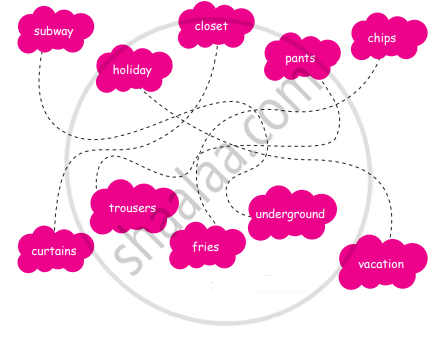
| subway | |
| holiday | |
| closet | |
| pants | |
| chips |
Why did he rub the circle again and again?
What did Helen learn when the teacher put her hand into running water?
