Advertisements
Advertisements
Question
Why does the poet prefer to be a primitive Pagan rather than a member of civilised society?
Advertisements
Solution
Wordsworth is deeply disturbed by the materialism and consumerism, brought to us by the industrialisation. It has encompassed humanity, who is too busy “getting and spending”. He mourns that humanity has such wonderful powers that are being laid waste. The mankind has given her heart away to this destructive blessing, the poet calls it a “sordid boon”, an oxymoron. Thus, Wordsworth decides to become a Pagan and prays to God. Pagans were the people of Southern Europe, they were not worshippers of a monotheistic God. They were rustics or rural folk. Wordsworth admires their tradition and perceives that to be close to nature he should be one of them. He wishes to feed on and relish the mesmerising beauty of nature. He wishes to enjoy the lea he stands on so that he might feel a little less lonely. He wants to have the glimpses of the countryside and wants to taste the rural and rustic life that a Pagan lives. He wishes to go back in time where he might get a chance to see “The Old Man of the Sea”, Proteus, rising from the sea. He wishes to see “The Messenger of the Sea”, Triton, the son of Poseidon. Wordsworth wishes to be in absolute harmony with nature.
APPEARS IN
RELATED QUESTIONS
A1. Order
Arrange the following sentences in the chronological order as they appear in the passage:
(i) On celebrations, parents can invest Rs. 200 and plant a sapling of a tree representing the child’s birth star.
(ii) He wants to create Brihat Panchvati.
(iii) He has been able to increase the areas of the Pavitra VanaVana.
(iv) Plans are afoot to create a Saptaswara forest.
Today, Reddy is one of the most well - known environment specialists in India. With his influence, he has been able to increase the areas of the Pavitra Vana and has plans to bring about awareness of Puranic trees and flowers for the knowledge of the Indian citizen.
He wants to create near the Pavitra Vana, a Brihat Panchavati so that parents can show their children the forest where Shakuntala lived or Sita spent her final days. There will also be a hillock where people can meditate. Plans are also afoot create a Saptaswara forest, pertaining to different ragas in music. Scientists have found that certain plants react in a particular way to different ragas. So in such a forest, when a musician performs certain ragas, the plants will reach in such a manner that it will benefit the audience, the musician and the whole environment. The other idea is an ecopark for children. On celebrations, like birthdays, parents can invest Rs. 200 and plant a sapling of a tree representing the child's birth star. The plant will also carry the child's name. The Pavitra Vana also houses a garden of Prophet Mohammed, which has some plants mentioned in the Holy Quran. There is the date plant - sacred to Islam - and the Mimosops elengi, the latter a highly fragrant variety. There is also the garden of Eden for housing plants sacred to Christianity, but the Pavitra Vana authorities have to procure most of them in the new sections.
A2. Find specialities
Write down the specialities of the following:
(i) Brihat Panchavati: ........................ ..... . .
(ii) Saptaswara Forest: ..................... ..... .............. . .
(iii) Eco-park: ..................................... . .
(iv) A garden of Prophet Mohammed:
A3. Antonyms Find antonyms for the following words from the passage:
(i) same
(ii) decrease
(iii) destroy
(iv) lost
A4. Language study
(i) He wants to create near the Pavitra Vana, a Brihat Panchavati. [Pick out an infinitive from the given line and use it in your own sentence]
(ii) Reddy is one of the most well-known environment specialists in India. [Begin with: Very few ………]
A5. Personal Response
Do you think one person alone can create an awareness towards environment conservation ? Support, your answer with appropriate reasons.
Answer any four of the following in 30 − 40 words each :
(a) What does Saheb look for in the garbage dumps?
(b) How was Gandhi treated at Rajendra Prasad's house?
(c) Why does one feel 'a sudden strangeness' on counting to twelve and keeping quiet?
(d) Mention any two things which cause pain and suffering. (A Thing of Beauty)
(e) When was the Tiger King in danger of losing his throne?
(f) What role did the American professor play in bringing Hana and Sadao together?
Read the passage given below and answer the questions that follow:
The term dietary fibres refers collectively to indigestible carbohydrates present in plant foods. The importance of these dietary fibres came into the picture when it was observed that the people having diet rich in these fibres, had low incidence of coronary heart disease, irritable bowel syndrome, dental caries and gall stones.
The foodstuffs rich in these dietary fibres are cereals and grains, legumes, fruits with seeds, citrus fruits, carrots, cabbage, green leafy vegetables, apples, melons, peaches, pears etc.
These dietary fibres are not digested by the enzymes of the stomach and the small intestine whereas most of other carbohydrates like starch and sugar are digested and absorbed. The dietary fibres have the property of holding water and because of it, these get swollen and behave like a sponge as these pass through the gastrointestinal tract. The fibres add bulk to the diet and increase transit time in the gut. Some of these fibres may undergo fermentation in the colon.
In recent years, it has been considered essential to have some amount of fibres in the diet. Their beneficial effects lie in preventing coronary heart disease, and decreasing cholesterol level. The fibres like gums and pectin are reported to decrease postprandial (after meals) glucose level in blood. These types of dietary fibres are recommended for the management of certain types of diabetes. Recent studies have shown that the fenugreek (Methi) seeds, which contain 40 per cent gum, are effective in decreasing blood glucose and cholesterol levels as compared to other gum containing vegetables.
Some dietary fibres increase transit time and decrease the time of release of ingested food in colon. The diet having less fibres is associated with colon cancer and the dietary fibres may play a role in decreasing the risk of it.
The dietary fibres hold water so that stools are soft, bulky and readily eliminated. Therefore high fibre intake prevents or relieves constipation.
The fibres increase motility of the small intestine and the colon and by decreasing the transit time there is less time for exposure of the mucosa to harmful toxic substances. Therefore, there is a less desire to eat and the energy intake can be maintained within the range of requirement. This phenomenon helps in keeping a check on obesity. Another reason in helping to decrease obesity is that the high-fibre diets have somewhat lower coefficients of digestibility.
The dietary fibres may have some adverse effects on nutrition by binding some trace metals like calcium, magnesium, phosphorus, zinc and others and therefore preventing their proper absorption. This may pose a possibility of nutritional deficiency especially when diets contain marginal levels of mineral elements. This may become important constraints on increasing dietary fibres. It is suggested that an intake of 40 grams dietary fibres per day is desirable.
(Extracted from ‘The Tribune’)
(a) On the basis of your reading of the above passage make notes on it in points only, using recognizable abbreviations wherever necessary. Also suggest a suitable title.
(b) Write a summary of the above in about 80 words.
You are Smitha/Sunil, Secretary AVM Housing Society. You are going to organize a yoga camp. Write a notice in not more than 50 words, urging the members of your society to come in large numbers to attend the camp. Invent all the necessary details.
Which language do you think the author and his grandmother used while talking to each other?
Divide the article into four sections based on the shifts in the sub-topics and give a suitable sub-heading for each section. One has been done for you in the article as an example.
Discuss in groups plays or films with a strong message of social reform that you have watched.
What do you think are the reasons for the references made to the English people and the British monarchy?
The ending of the story is an instance of irony. Suppose Paul had not died at the end, how would you have reacted to the story?
Discuss the following in pairs or in groups of four:
“Tribal arts are not specifically meant for sale.” Does this help or hamper their growth and preservation?
What does the line 'I never writ, nor no man ever loved' imply?
What is the emphasis placed by Ruskin on accuracy?
What makes the urgency of the child's demand seem logical?
How does the poet juxtapose the human condition with the behaviour of the political class?
Arrange the following set of words in the alphabetical order in your notebook.
ship, small, successful, scoldings, stone, saving, someone, stood, streets, still, screamed, sat, seemed, saint, share.
Find from the story one word for the following.
a small room just below a sloping roof - ...........
What decision taken by Dick changed his fortune?
Correct the following statement.
Johnsy was eager to recover from her illness.
State whether the following statement is true or false. Correct the false statement.
The Ear was appointed as a judge.
Go through the poem and state whether the following statement is true or false.
Planners deliberately find drawbacks in the old city planning.
Discuss in your class.
How can we take help of robots in our daily life?
Write 3 to 4 lines about the following in your own words.
'Sushruta Samhita'
What are the clothes compared to? Give two examples.
Mayor Peter Stockmann is a contrast to Dr. Thomas Stockmann. Justify.
Answer the following question in one sentence.
What would he do if he had the power to do it?
List the characters in the play and write one or two lines about each.
Read aloud/Enact the play.
Form a pair. Write at least one short dialogue for the following expression.
I agree.
The merchant ships brought spices and other treasures from India and other countries to Italy.
Visit a library:
Find and read stories and poems written by Edith Nesbit.
Find the pairs of rhyming words used at the end of the lines in the poem.
Write the following:
The sights mentioned in the second stanza.
Complete the following sentence with reference to the passage.
It is believed that _________ Homer, who __________ and who ________ to all who __________________.
Sayali made a hasty purchase.
What did Gopal Bhand say he was doing?
Discuss how you will measure the worth of a friend.
Why were the policeman prevented from entering grandfather's room?
Read the following line from the poem and answer the question given below.
Let us learn to walk with a smile and a song,
No matter if things do sometimes go wrong;
- What does the poet expect everyone to learn?
- What should we do when things go wrong sometimes?
Based on your reading, rearrange the following sentences in the correct sequence.
- Since all her methods failed, finally she gave him a pain-killer.
- He told his aunt that Peter had no aunt, so he gave him the medicine.
- The pain-killer triggered adverse reactions on Peter.
- It jumped out of the open window.
- Tom was dull and depressed.
- This incident upset Aunt Polly and she questioned him.
- But, Tom gave that painkiller to the cat Peter.
- So, Aunt Polly tried different types of remedies on him.
Identify the character/speaker.
Oh no, I'll never get back to the right size.
Neerja had a sour marriage due to______.
What made Grandfather plant saplings on the rocky island?
Match the planet with its feature.
| 1. | Mars | blue ice giant |
| 2. | Saturn | red storm |
| 3. | Jupiter | red planet |
| 4. | Neptune | ring and moons |
"I think it would be nice if we moved quickly from here.”
- Who does ‘I’ refer to?
- Why did they want to move quickly from there?
Why did Santhosh forget to watch television or play video games?
How did the old man disguise himself?
Identify the character or the speaker.
“Do not feel sad dear.”
Identify the character/speaker.
He bought a new fish tank.
Read the passage three times and colour a cup for eachtime.
There is a table under a tree. A man with a big hat and a hare with long ears are sitting. A young girl is sitting between them. There are many cups on the table. The girl has a cup in her hand, and the man has a pot in his hand. It seems like they are having tea. Yes, they are having tea at the tea party in Wonderland. The girl is Alice, and she is in Wonderland.

Recite the poem 'A Voyage' with correct intonation.
The villagers took oath not to harm the _______.
Moles dig ______ to catch earth worms.
Write the rhyming word.
larder- ______.
What will help you say the truth?
Mugund loved wild animals.
Write the correct word.
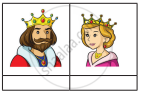
| rooster, king, hen, tiger, queen, tigress. |
What would you have done if your grandmother would have slipped?

Are these sentence TRUE or FALSE
The poet says that stars will always shine at night.
How was the stump of the tree useful?
Pick out word which mean the same as
keep a check on (para 3)
