Advertisements
Advertisements
Question
Bring out the parallel suggested between the predatory instincts of the bird and human behaviour.
Advertisements
Solution
Ted Hughes has always known to have cited examples of animals or birds or even fishes in his poems to draw a parallelism between the animal world and human behaviour. We, humans, are social animals; however, the animal instinct is still seated within us. Hughes explores this proclivity of humans when the predatory instinct takes over. In the poem, the Hawk hungers for power and authority, similarly humans lust for power and exercise their supremacy. The Hawk's perspective is blinded or limited by its vision and even with humans, their ignorance is their bliss. There is a constant battle, the survival of the fittest. It is jungle raj. The Hawk talks of its inherited power from the roost it resides in. It blathers its pride and self-assertion. The way any other human does. It matters little of whether there is an element of truth in it or not, but whether the Hawk or a human, they proclaim their supremacy over the rest of the world. They believe themselves to be the rulers of the Creation and mock God, thankless beings who weave their own fall.
APPEARS IN
RELATED QUESTIONS
Who was Selden? Why was he on the moor?
Answer any four of the following questions in 30 – 40 words each :
(a) After initial reluctance why did the lawyers tell Gandhiji that they were ready to follow him into jail?
(b) What is Mukesh's attitude towards the family business of making bangles?
(c) How does the poet show the futility of Aunt Jennifer's efforts?
(d) Stephen Spender in his poem, 'An Elementary School Classroom in a Slum' paints a dismal picture of poverty. Comment.
(e) Jackson went through the contents of Rev. McLeery's suitcase. Which object therein puzzled him sorely? What was his comment on that?
(f) How did the servants react when they realized that Dr. Sadao was going to save the life of an enemy?
With reference to ‘The Story of My Life’, describe how a teacher can positively impact a child’s life ?
Read the following extract carefully and complete the activities given below :
A1 Complete the following :
(i) Books were found on the _____________ and ____________.
(ii) The tales are described as ______________ and __________.
|
Have you forgotten? Don't you know?
We'll say it very loud and slow:
THEY ... USED ... TO ... READ! They'd READ and READ,
AND READ and READ, and then proceed
To READ some more. Great Scott! Gadzooks!
One-half of their lives was reading books!
The nursery shelves held books galore!
Books cluttered up the nursery floor!
And in the bedroom, by the bed,
More books were waiting to be read!
Such wondrous, fine, fantastic tales
Of dragons, gypsies, queens, and whales
And treasure isles, and distant shores
Where smugglers rowed with muffled oars,
And pirates wearing purple pants,
And sailing ships and elephants,
And cannibals crouching 'round the pot,
Stirring away at something hot.
(It smells so good, what can it be?
Good gracious, it's Penelope.)
|
Read the following passage carefully and do the given activities:
A.1) True or False:
Write the statements and state whether they are true or false:
(i) Those who choose to live well must help others.
(ii) If neighbors grow inferior corn, cross-pollination will steadily improve the quality.
(iii) The farmer grew award-winning corn.
(iv) The reporter discovered that the farmer didn’t share his seed corn with his neighbors.
There once was a farmer who grew award-winning corn. Each year he entered his corn in the state fair where it won a blue ribbon. One year a newspaper reporter interviewed him and learned something interesting about how he grew it. The reporter discovered that the farmer shared his sweet corn with his neighbors. “How can you afford to share your best seed corn with your neighbors when they are entering corn in competition with yours each year?” the reporter asked.
“Why sir”, said the farmer, “didn’t you know? The wind picks up pollen from the ripening corn and swirls it from field to field. If my neighbors grow inferior corn, cross-pollination will steadily degrade the quality of my corn. If I am to grow good corn, I must help my neighbors grow good corn.” He is very much aware of the connectedness of life. His corn cannot improve unless his neighbor's corn also improves. So it is with our lives. Those who choose to live in peace must help their neighbors to live in peace. Those who choose to live well must help others to live well, for the value of a life is measured by the lives it touches.
The lesson for each of us is this: if we are to grow good corn, we must help our neighbors grow good corn.
A.2) Consequences:
Write the consequences:
(i) The farmer shares the corn.
(ii) The farmer doesn’t share the corn.
A.3) Antonyms:
Find out the words opposite in meaning from the passage:
(i) superior x _______
(ii) lost x _______
(iii) improve x _______
(iv) inconstantly x _______
A.4) Language study:
(i) We must help our neighbors. (Replace the modal auxiliary showing advice).
(ii) The wind picks up pollen from ripening corn and swirls it field to field. (Use “not only…….. but also” and rewrite)
A.5) Personal Response:
What do you learn from the story? Suggest a suitable title.
Read the following extract and do the given activities:
B.1) Fill in the Balloons with suitable ideas from the poem:
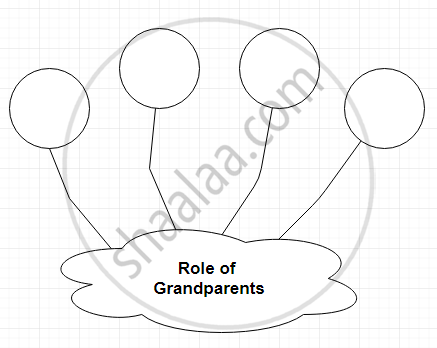 “Oh, the value of the elderly! How could anyone not know?
They hold so many keys, so many things they can show.
We all will read the other side this I firmly believe
And the elderly are closest oh what clues we could retrieve.
For their characters are closest to how we’ll be on high.
They are the ones most developed, you can see it if you try.
They’ve let go of the frivolous and kept things that are dear
The memories of so sweet, of loved ones that were near.
As a nation, we are missing our greatest true resource,
To get to know our elders and let them guide our course.”
B.2) Find Evidence:
Pick out the line from the extract which supports the given ideas:
(i) The elders have many things to share.
(ii) Everybody knows the value of elderly people.
(iii) The elderly people have vast experience.
(iv) The elderly people are a boon to the nation.
B.3) Write a pair from the extract that rhymes with the given word:
| Fear | ........................... | .......................... |
Answer the following question in 150-200 words:
Attempt a character sketch of Mr. Gilman.
How do you distinguish between information gathering and insight formation?
The Cloud ‘fuses together a creative myth, a scientific monograph, and a gay picaresque tale of cloud adventure': explain.
Why is the speaker’s childhood described as ‘a forgotten boredom’?
The power of poetry lies in suggestion and understatement. Discuss this with reference to the poem.
How does Forster trace the human interest in the story to primitive times?
'He is free to play the flute all day as well-fed tigers and fat sheep drink from the same pond
with a full stomach for a common bond.'
What do the phrases 'play the flute all day' and 'a common bond' refer to?
Read the following statement and mark those that apply to you.
I have a large group of friends but no best buddy.
Read the following words :
Brigadier, Commander, capture, evicting, enemy, defense
All these words are related to war affairs and war.
Find more such words from the passage.
Using a dictionary/internet note down the main difference between a remote-sensing satellite and a natural satellite.
Say where . . . . . . .
______ does Beauty’s smile begin?
Write any five illnesses of the animals in the poem that you find most amusing / laughable.
Form suitable groups and discuss the following.
You have heard/read stories of Akbar and Birbal, Tenali Raman, Mulla Nasruddin. Recollect and write down the names of those stories.
Pick out those aspects of a story that you find a common in all their stories.
- Humour
- Supernatural event
- Wisdom
- Suspense
- Magic
- Beauty of Nature
- Wit
- Play upon words
- Sadend
- Violence
Explain the meaning of the following phrase:
An eagle’s eye
To whom is the poem addressed?
Read aloud a paragraph of your choice from the passage.
Apart from class/school, where else are you likely to find a time table useful?
Does the poet expect anything in return? What is the poet’s reward?
Answer in your own words.
What chores did the boys from 1000 CE and 1st Century CE, do on their farms/fields?
Why did Marouckla’s stepmother hate her?
List and say whether the following statement agrees with the passage or not.
You should try to talk most of the time whenever there is a discussion.
Write how the travellers crossed the second gulf.
What is meant by being ‘online’?
How did Helen Keller help other blind people?
Find out what 'Braille' is.
What does 'Rangaawali' mean?
Answer the following question in about 80 – 100 word.
Describe the journey of life as depicted in the poem by Henry Van Dyke.
Bring out a few differences between the two art forms: Therukoothu and Bommalattam.
In New York, Mr. Scotti left the plane because he thought he.
Based on your reading, rearrange the following sentences in the correct sequence.
- Since all her methods failed, finally she gave him a pain-killer.
- He told his aunt that Peter had no aunt, so he gave him the medicine.
- The pain-killer triggered adverse reactions on Peter.
- It jumped out of the open window.
- Tom was dull and depressed.
- This incident upset Aunt Polly and she questioned him.
- But, Tom gave that painkiller to the cat Peter.
- So, Aunt Polly tried different types of remedies on him.
Describe the elephant driver in your own words.
What does the teak tree give us?
Amma bought the vegetables from the______.
Read the lines and answer the question given below.
Here is a child who clambers and scrambles,
All by himself and gathering brambles;
- Where do you think the child is?
- What does ‘gathering brambles’ mean?
The pit was comfortable for the wild boar to sleep in.
You don’t need ______ and ______ in the Earth.
Who was challenged for a race?
Imagine you are the girl and give a different ending to the story.
Be humble like a _____.
How did the second daughter use the grain?
Read scene I of the play carefully and answer the question below.
Match the following.
| Sr.No. | CHARACTER | TRAIT |
| a. | Father Wolf | with a grey nose…feeds her four cubs |
| b. | Tabaqui | the big one from Waingunga River with a lame foot |
| c. | Mother Wolf | the chief of the Wolves |
| d. | Shere Khan | begs for meat and thanks for the meal/warns the wolves about the arrival of Shere Khan |
It keeps the sack in every little______.
What does Megalai do with elders?
They would rest on the tree.
What was the lesson learnt by Uthaman?
Who guessed the location of the real necklace?
Pick and write the adverbs to complete the sentence.
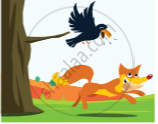
A jackal cheated the crow ______.
Did Nandhini have fever?
What will you do with your savings?
Moles dig ______ to catch earth worms.
The king gave______ seeds.
Name a few things that sink.
Find words from the passage which mean the same as the following.
- a malevolent desire for revenge (para 1)
- tactful (para 2)
- despise (para 3)
