Advertisements
Advertisements
Question
Read the following passage and do the activities.
A1. State whether the following sentences are True or false. [2]
- The king’s temperament also changed.
- The king was happy with prediction of the astrologer.
- The courtiers sought an audience with Tenali Raman.
- Courtiers advised the king to regulate his diet.
A2. Complete the web. [2]
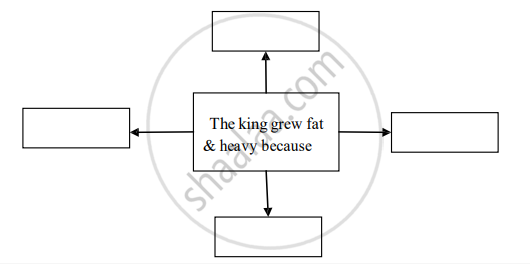
|
King Krishnadeva Raya would perform heavy exercises every morning. He regularly applied oil on his body and thereafter worked out till all the oil came out with the sweat. This was followed by a long ride on his horse. Once the king started leading a sedentary lifestyle, and he stopped exercising. He no longer went horse-riding either. The king overate and as a result grew fat and heavy. The king‟s temperament also underwent a sea change. Noticing this, the royal physicians cautioned the king against the ill effects of overeating and explained to him the risks posed by obesity. They advised the king to regulate his diet, exercise, and take care of his health. The repeated advice he got from the physicians to eat less made him so angry that one day he announced a reward for anyone who could find him an easy cure. But there was one condition: those who failed would have their heads off. None dared to advise the king in this regard. The situation became precarious and as usual Tenali Raman was approached by the courtiers for a remedy. Tenali heard the problem and assured the courtiers of a viable solution. The next day, an astrologer predicted that the king had only a month left to live. When the king came to know of this, he was furious. The astrologer was ordered by the king to be imprisoned for a month so that his prediction could be put to test and so the hapless forecaster was sent to prison. |
A3. Find out describing words from the passage for the words given below. [2]
- exercise - ...........
- lifestyle - ...........
- ride - ...........
- physician - ...........
A4. Do as directed. [2]
- King Krishnadeva Raya would perform heavy exercises every morning.
(Use 'used to) - They advised the king to regulate his diet. (Pick out the infinitive)
A5. What are the benefits of daily exercise? [2]
Advertisements
Solution
A1.
- This statement is true.
- This statement is false.
- This statement is true.
A2.
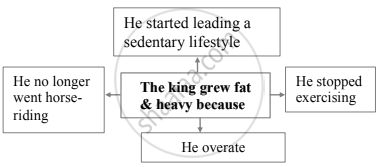
A3.
- Heavy
- Sedentary
- Long
- Royal
A4.
- King Krishnadeva Raya used to perform heavy exercises every morning.
- to regulate
A5. Daily exercise helps to keep a person fit. It reduces the chances of falling sick. It keeps our body weight under check. It is good for our muscles and bones. It improves our mental health. It improves our energy levels. It helps keep our thinking, learning, and judgment skills sharp as we age.
APPEARS IN
RELATED QUESTIONS
Answer any four of the following questions in 30-40 words each :
(a) Why was Franz not scolded for reaching the school late that day?
(b) Sophie was dreaming of so many things in her life. What were they?
(c) Why are the youngsters described as springing? (My Mother at Sixty-six)
(d) In the hot season, how do man and beast get comfort? (A Thing of Beauty)
(e) How did the Maharaja deal with a high ranking British officer who wanted to shoot a tiger?
(f) Having got rid of his stink, what problem did Roger Skunk face?
You are Smitha/Sunil, Secretary AVM Housing Society. You are going to organize a yoga camp. Write a notice in not more than 50 words, urging the members of your society to come in large numbers to attend the camp. Invent all the necessary details.
Answer any three of the following in 30-40 words each:
(a) Why has the poet’s mother been compared to the ‘late winter’s moon’?
(b) The poet says, ‘And yet, for these Children, these windows, not this map, their world.’ Which world do these children belong to? Which world is inaccessible to them?
(c) What was the plea of the folk who had put up the roadside stand?
(d) What will happen to Aunt Jennifer’s tigers when she is dead?
Read the following extract and answer the questions given below:
If you do not get lowered in your own eyes
While you raise yourself in those of others,
If you do not give in to gossips and lies
Rather heed them not, saying, 'who bothers?'
You may be the person I am looking for.
If you crave not for praise when you win
And look not for sympathy while you lose,
If cheers let not your head toss or spin
And after a set-back, you offer no excuse,
You may be the person I and looking for.
(1) What should be your reaction towards gossips and lies?
(2) Who are your role models? Why?
(3) Give the rhyming pairs of words from the first stanza.
(4) Which line is repeated in this extract and what is its effect?
How do chimps drink water from the waterholes?
Look for a story, a poem and a newspaper article on environment conservation and see how the style of each is different from the other.
We 'draw up a deed'. Complete the following phrase with an appropriate word.
________a deaf ear to
Examine the communication channels in the story between Paul's mother and his uncle.
What two things are compared in the poem?
Guess the meaning of the following words and phrases:
untold wealth, closest to the Emperor’s heart, grave offence, banish.
Read aloud the account of how Flying Officer Nirmal Jit Singh Sekhon sacrificed his life to defend our country.
Comment on the given statement after reading the given dialogue -
And if we get him itself, nothing but abuse on our heads for it from the people, and maybe from our own relations -
you may begin like this
We do not think about society at large _________________________________________________.
The merchant ships brought spices and other treasures from India and other countries to Italy.
Relate the themes of the Fair to your science textbook by writing the relevant chapter numbers under each theme.
Find, in your science textbook, the topics of the stalls handled by students of VI A.
(Write the page number.)
Visit a library:
Find and read the biography of your favourite scientist.
Form groups of 5-8. This passage tells us only what the compère says. Try to visualize and write what the other people on the dais must have said in their speeches (Write only the main points.)
- The School Principal
- The Chief Guest
- The Art teacher who offered a vote of thanks
What is direct and indirect.
Find from the Internet and write down.
Which character from the play sings this song?
Be a poet. Try to complete the following poem with words that rhyme with each other.
| I’d love to live a life that’s ______ Relax under a shady t______ And fall into a dreamy s______p, With no strict hours, forced to k______ And sing aloud a merry ______, Untrodden paths, as I walk a______g. You ask me what I’d get to ______? Fruits and nuts and berries sw______ You ask me with whom I’d get to p______ Birds and animals, happy and g______ And if a woodcutter put a c______p Firmly, I would put a st______ So that’s the life I’d like l______d Free from worries, free from gr______d |
Correct the following sentence and rewrite it.
Jesus had actually visited Papa Panov only once on Christmas Eve.
Find out when and where we get strawberries in Maharashtra.
Rewrite the following line in your own words.
'Never one comes flying by
But will flutter down to drink.'
How did the bird try to reach its parents without having to fly?
Answer the following question in about 100-150 word.
Describe the funny incident that caused the confusion in the house.
The captain presented a gift to Vasantha because ______
Female Olive Ridleys come ashore at night to lay eggs.
What did Grandmother feel about trees growing in the house?
What did Raj buy?
What word could best replace ‘charges’ in the poem - marches, rushes or pushes?
Identify the speaker/character.
He felt something moving along his body almost up to his chin.
Why did he grow crops?
Write the events won by these players.
![]() |
______ |
![]() |
______ |
![]() |
______ |
Divide the following word.
butter
The official's family visited the rehabilitation centre for ______ years.
Why did Meena call the official 'Appa'? Do you think we need to be a family to care for others?
Speak and win.
Join in one of the two groups. Choose two characters. Support or oppose any one of the characters. Say some sentences for the one you support and say some sentences against the other one, to win.
| I support | I oppose |
One day Chris tried to draw a ______.
What did the carpenter buy?
Read the following passage and answer the questions that follow:
The Stationmaster’s Supreme Sacrifice by Sanchari Pal (Adapted)
- Thirty-three years ago, on the night of December 2, 1984, Bhopal was hit by a catastrophe that had no parallel in the world’s industrial history. An accident at the Union Carbide pesticide plant in Bhopal had released almost 30 tons of a highly toxic gas called methyl isocyanate, turning the city into a vast gas chamber. The result was a nightmare; more than 600,000 people were exposed to the deadly gas cloud that left thousands dead and many more breathless, blind and in agonizing pain. Few people know that during the Bhopal gas tragedy a heroic stationmaster risked his own life to save others.
- On the evening of December 3, 1984, Ghulam Dastagir was settling down in his office to complete some pending paperwork. This work kept him in his office till 1am in the night, when he emerged to check the arrival of the Gorakhpur Mumbai Express. As he stepped on to the platform, the deputy stationmaster felt his eyes burn and a queer itching sensation in his throat. He did not know that poisonous fumes leaking from Union Carbide’s pesticide factory were stealthily enveloping the railway station.
- Beginning to choke, Dastagir did not know then that twenty-three of his railway colleagues, including his boss, station superintendent Harish Dhurve, had already died. It was later reported that Dhurve had heard about the deadly gas and had immediately tried stopping the movement of trains passing through Bhopal before collapsing in his office chamber. His suddenly worsening health and years of experience told Dastagir that something was very wrong. Though he did not fully comprehend what was happening, he decided to act immediately when he did not get any response from the station master. He alerted the senior staff at nearby stations, like Vidisha and Itarsi, to suspend all train traffic to Bhopal.
- However, the jam-packed GorakhpurKanpur Express was already standing at the platform and its departure time was 20 minutes away. Listening to his gut instinct, Dastagir summoned his staff and told them to immediately clear the train for departure. When they asked if they should wait until the order to do so came from the head office, Dastagir replied that he would take complete responsibility for the train’s early departure. He wanted to ensure that the train left immediately, without any delay. His colleagues later recalled that Dastagir could barely stand and breathe as he spoke to them. Breaking all rules and without taking permission from anyone, he and his brave staff personally flagged off the train.
- But Dastagir’s work was not done. The railway station was filling up with people, desperate to flee the fumes. Some were gasping, others were vomiting, and most were weeping. Dastagir chose to remain on duty, running from one platform to another, attending, helping and consoling victims. He also sent an SOS to all the nearby railway offices, asking for immediate medical help. As a result, four ambulances with paramedics and railway doctors arrived at the station. It was winter and the gas was staying low to the ground, a thick haze poisoning everything in its path. Besieged by hordes of suffering people, the station soon resembled the emergency room of a large hospital. Dastagir stayed at the station, steadfastly doing his duty, knowing that his family was out there in the ill-fated city. That day all he had for his protection was a wet handkerchief on his mouth.
- Ghulam Dastagir’s devotion to duty saved the lives of hundreds of people. However, the catastrophe didn’t leave him unscathed. One of his sons died on the night of the tragedy and another developed a lifelong skin infection. Dastagir himself spent his last 19 years shuttling in and out of hospitals; he developed a painful growth in the throat due to prolonged exposure to toxic fumes. When he passed away in 2003, his death certificate mentioned that he was suffering from diseases caused as a direct result of exposure to MIC (Methyl Isocyanate) gas. A memorial has been built at platform No.1 to pay tribute to those who sacrificed their lives in the line of duty on the fateful night of December 3, 1984. However, Ghulam Dastagir, who died later, is not one of them. A forgotten hero whose sense of duty and commitment saved countless lives, Dastagir’s story deserves to be recognized and remembered by our fellow countrymen.
- Why was the accident at Union Carbide unparalleled in the world’s industrial history?
- How was Dastagir affected by the poisonous gas?
- What was the action taken by the station superintendent?
- How did Dastagir and his staff break rules?
- What was the cause of Dastagir’s death?
- Find words from the passage which mean the opposite of the following.
- safeguard (para 1)
- common or familiar (para 2)
- prompt (para 4)
- cause (para 6)


