Advertisements
Advertisements
Question
Why is the poem entitled 'Hawk Roosting'?
Advertisements
Solution
The poem is about the speaker, the Hawk, who is looking down from where it is roosting, the highest point in the woods. It is a dramatic monologue in a non-human voice. The Hawk boasts of its superiority and is self-assertive. It is symbolic of we humans who tend do not think beyond what has been defined to us by society beyond our perspective. Our ignorance is our bliss as in the case of the Hawk. The Hawk, who narrates its story of how it perceives the world, is personified incarnating it as the most superior of all the beings. The Hawk believes itself to be the center of the cosmos. The whole poem is from the perspective of the Hawk, the bird of prey. The poem is from Hughes' second book, Lupercal, published in 1960. Once in an interview, he explained, “Actually what I had in mind was that in this hawk Nature is thinking. Simply Nature. It's not so simple because maybe Nature is no longer so simple.” in many of Huges' poems animals serve as a metaphor. He takes their help to describe his perspective on life. Ted is known for evoking violent imagery and his description of the ultimate battle of survival. In Hawk Roosting, the Hawk goes on blathering about its inherited supremacy and its ignorance is its bliss, which it celebrates.
APPEARS IN
RELATED QUESTIONS
A1. Order
Arrange the following sentences in the chronological order as they appear in the passage:
(i) On celebrations, parents can invest Rs. 200 and plant a sapling of a tree representing the child’s birth star.
(ii) He wants to create Brihat Panchvati.
(iii) He has been able to increase the areas of the Pavitra VanaVana.
(iv) Plans are afoot to create a Saptaswara forest.
Today, Reddy is one of the most well - known environment specialists in India. With his influence, he has been able to increase the areas of the Pavitra Vana and has plans to bring about awareness of Puranic trees and flowers for the knowledge of the Indian citizen.
He wants to create near the Pavitra Vana, a Brihat Panchavati so that parents can show their children the forest where Shakuntala lived or Sita spent her final days. There will also be a hillock where people can meditate. Plans are also afoot create a Saptaswara forest, pertaining to different ragas in music. Scientists have found that certain plants react in a particular way to different ragas. So in such a forest, when a musician performs certain ragas, the plants will reach in such a manner that it will benefit the audience, the musician and the whole environment. The other idea is an ecopark for children. On celebrations, like birthdays, parents can invest Rs. 200 and plant a sapling of a tree representing the child's birth star. The plant will also carry the child's name. The Pavitra Vana also houses a garden of Prophet Mohammed, which has some plants mentioned in the Holy Quran. There is the date plant - sacred to Islam - and the Mimosops elengi, the latter a highly fragrant variety. There is also the garden of Eden for housing plants sacred to Christianity, but the Pavitra Vana authorities have to procure most of them in the new sections.
A2. Find specialities
Write down the specialities of the following:
(i) Brihat Panchavati: ........................ ..... . .
(ii) Saptaswara Forest: ..................... ..... .............. . .
(iii) Eco-park: ..................................... . .
(iv) A garden of Prophet Mohammed:
A3. Antonyms Find antonyms for the following words from the passage:
(i) same
(ii) decrease
(iii) destroy
(iv) lost
A4. Language study
(i) He wants to create near the Pavitra Vana, a Brihat Panchavati. [Pick out an infinitive from the given line and use it in your own sentence]
(ii) Reddy is one of the most well-known environment specialists in India. [Begin with: Very few ………]
A5. Personal Response
Do you think one person alone can create an awareness towards environment conservation ? Support, your answer with appropriate reasons.
Answer any two of the following questions in about 30‒40 words:
(a) How does Kamala Das try to put away the thoughts of her ageing mother?
(b) Which is the exotic moment that the poet refers to in 'Keeping Quiet'?
(c) What are the difficulties that aunt Jennifer faced in her life?
Complete the flow-chart :

Give reasons for the following statement.
The author thought that his positive thinking strategy worked well after all.
How does the horse serve as a true friend and companion to Iona?
Look up the dictionary for the meaning of the word ‘diaspora’. What do you understand of the Indian diaspora from this piece?
What do you understand of the natures of Ramanand and Azam Khan from the episode described?
Suggest a few instances in the poem which highlight humour and irony.
How has the author linked the symbol of the rocking-horse to Paul's triumphs at the races?
Comment on the lines that make you visualise the colourful image of the peacock.
The power of poetry lies in suggestion and understatement. Discuss this with reference to the poem.
How is the idyllic juxtaposed with the pedestrian in the poem?
Discuss the following in pairs or in small groups.
Exceptionally talented people are born so; talent cannot be cultivated
The significance of reading an autobiography lies in drawing lessons from another life. What is the significance of Kumudini's account for us as readers?
Discuss the activities carried out by a farmer.

A bridge connects people on either side of a river or valleys in cities or villages. Discuss with your partner the importance of a bridge to both the cities and the villages and complete the table.
| Cities | Villages |
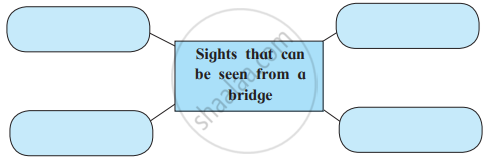
You might have visited a bridge. Complete the web describing the sights you could see from the bridge.
The last leaf fell off during the rain.
You have heard the proverb ‘Plan your work, work your plan’. It means - ________________.
Fill in the gaps in the table of Degrees of Comparison.
| Positive | Comparative | Superlative | |
| (1) | ____________ | ____________ | oldest |
| (2) | ____________ | healthier | ____________ |
| (3) | near | ____________ | ____________ |
| (4) | ____________ | finer | ____________ |
| (5) | ____________ | ____________ | earliest |
| (6) | small | ____________ | ____________ |
| (7) | ____________ | faster | ____________ |
| (8) | high | ____________ | ____________ |
Join the sentence using appropriate Co-ordinators. (but, or, so, and)
He places his fingers into the master controls. He operates all four arms of the Da Vinci.
The soldier-bees carry home ______.
The emperor-bee supervises the building of ______.
Your friend fell down learning to ride a bicycle and now has given it up altogether. What do you think will be the poet’s advice? Write it down.
What is described in the poem?
The description of the character is given below. Identify the character from the play. Find some sentences which support your choice.
He is a major character. He dominates in the story.
Match the columns :
| A | B |
| (1) Theseus | (1) Robin Goodfellow |
| (2) Titania | (2) Queen of the Amazons |
| (3) Puck | (3) Duke of Athens |
| (4) Hippolyta | (4) Faeries |
| (5) Cobweb, Moth | (5) Queen of the Faeries |
Write the conditions that Portia put down to warn Shylock.
What do the following events/actions tell us about the characters? Discuss.
Sir Ector kneeled before Arthur.
Find pairs of rhyming words from the poem.
Rewrite in your own words.
One of the Caesar’s traits that makes you laugh.
Which other things in nature can say –
'For men may come and men may go,
But I go on for ever.'
Fill in the blank choosing the appropriate word/idiom from the lesson.
In the examination, I did not know the answer, so I ______.
What is meant by browsing or surfing?
What different names is ‘Rangoli’ known by in different regions?
____________ had provided Prospero formerly with books and provisions.
Identify the character or speaker
I must finish my task before I take my rest.”
Give two reasons why Miranda was so concerned about Ferdinand.
In New York, Mr. Scotti left the plane because he thought he.
What values did the child learn?
What did Usha buy in the market? List them.
What kind of a life do you want to lead in this world?
Read the lines and answer the questions.
Deep inside the mountain
the adventures hide themselves.
Where do adventures hide?
Why does Alice drink from the bottle that says ‘DRINK ME’ and why does she eat from the cake that says ‘EAT ME’?
Why do we need trees? List four reasons that Grandfather gives.
The pit was comfortable for the wild boar to sleep in.
"I think it would be nice if we moved quickly from here.”
- Who does ‘I’ refer to?
- Why did they want to move quickly from there?
Work in groups. Discuss and have a debate on life in bustling cities and life in calm towns.
Complete the following sentence using the prepositions from the option.
The summer vacation ends _____ Monday.
Connect and write the homophones in the box.
|
Sea |
 |
|
One |
 |
|
Flower |
 |


Pick out the rhyming words from the poem and write.
| Mars | |
| time | |
| be |
Some words sound the same but their spelling and meaning are different. Such words are called homophones. There are many homophones.
Recite the poem 'A Voyage' with correct intonation.
Pick and write the adverbs to complete the sentence.
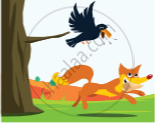
A jackal cheated the crow ______.
Do you think you treat everyone equally? Justify with an example.
What are the difficulties they faced in India?
Fill in the blank

Do you think it is right for the tanker to take water? Why?
Match the rhyming words.
| Say | grow |
| All | time |
| Go | day |
| Rhyme | fall |
If the fisher draws his net soon, he won’t get ______ in the net.
