Advertisements
Advertisements
Question
Form pairs. Present in the class, the conversation between Thiruvalluvar and the young man.
Advertisements
Solution
| Young Man: | Namaskaram, Thiruvalluvar! How can I live a good life? |
| Thiruvalluvar: | Live with patience, speak kindly, and act righteously. "Virtue is the foundation of happiness." |
| Young Man: | What about wealth? Is it important? |
| Thiruvalluvar: | Wealth is essential but must be earned honestly. "Righteous wealth brings joy, while ill-gotten wealth brings sorrow." |
| Young Man: | What should I do when others wrong me? |
| Thiruvalluvar: |
Forgive them. |
| Young Man: | What is the ultimate purpose of life? |
| Thiruvalluvar: | To live with love and compassion. "Love is the essence of all virtues." |
| Young Man: | Thank you, wise one! I will follow your teachings. |
| Thiruvalluvar: | Go forth and inspire others with your actions. |
RELATED QUESTIONS
Complete the call-outs:
A.1)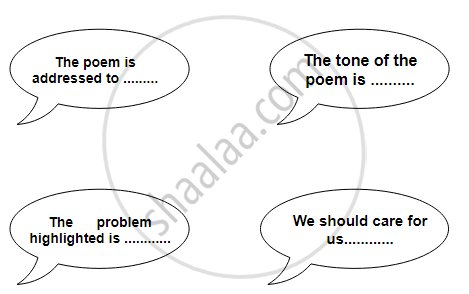
Our world is an institution
Of environmental pollution
We choose not to care
For our future generations
And I for one am guilty
For buying the hundreds of electronic gadgets
That attracts the industries to produce like maggots
environmental pollution is at the heart of our planet
The forests are dying
Wildlife is crying
Millions of fish are dying
Mother earth is sighing
Tell me is it right
That we sleep well at night
Replenishing ourselves
For tomorrow’s greedy fight
Overcrowded trains
Overloaded brains
Where is the light? What is our plight?
While the river break their banks
And greedy industries play their polluted pranks.
A.2) Find the examples that show that we do not care for our future generation
A.3) Match:
Match the lines in Column ‘A’ with the figures of speech in Column ‘B’:
| Column ‘A’ | Column ‘B’ | ||
| (i) | Our world is an institution | (a) | Personification |
| (ii) | Mother earth is sighing | (b) | Simile |
| (c) | Metaphor |
Why have the words, 'pretended' and 'seemed' been used in the lines:
...Pretended to believe every single word
of what the tiger king said.
And seemed to be taken in by all the lies.
How does the sense of these lines connect with the line 'Ajamil wasn't a fool'?
Find proof from the poem for the following.
The poet’s minute observations of the steady growth of the cherry tree.
What would happen if children didn’t go to school? Discuss the question in groups of 5-8 and prepare a short composition on it.
Choose the appropriate phrase to insert in the gap, to make the sentence meaningful. Use the appropriate form of the verb.
After I took the medicine, I ______ ______ the pain.
Read the following words aloud and copy them in your notebook.
- idle
- enough
- exclaimed
- commotion
- astounded
- antics
- wander
- wielding
Describe the following with the help of the (The Twelve Months) story.
Winter
Write a short note on ‘money’.
What does the tamarind give?
The monster tree was protecting the ______.
