Advertisements
Advertisements
Question
'Now I hold Creation in my foot' – explain the centrality of this assertion in the poem. What makes the hawk's assertion of its invincibility so categorical?
Advertisements
Solution
As posed in the poem, the Hawk appears to be absolute and indomitable. It ascribes itself to the summit of the jungle. The highest of all the social ladder, it sits on the highest point from where it can see it all beneath and small. The Hawk exaggerates that it took the whole of the Creation to design it. It sits on a bark that is rough and it at the highest point of the tree. The perspective of the Hawk is bounded by its vision. The little of the wood that it sees from its seat it takes it to be the whole of the world and presumes itself as its God. The little bird's petty egocentricity is amusing as when it flies it believes itself to be the one rotating the planet and moving the whole of the life. So now that the roles are reversed, the Hawk exclaims, “Now I hold Creation in my foot.” The Hawk declaring its assertion as invincibly categorical. It is the Hawk who is in control of the whole creation, even the Sun abides by it. Nothing that its eyes do not permit can flourish or even exist.
APPEARS IN
RELATED QUESTIONS
Answer any three of the following questions in 30-40 words each:
(a) What did M. Hamel tell them about the French language? What did he ask them to do and why?
(b) Why does Asokamitran call Subbu, ‘a charitable and improvident man’?
(c) How did the instructor turn Douglas into a swimmer?
(d) Why did Sophie like her brother, Geoff more than any other person?
Answer any four of the following in 30 − 40 words each :
(a) What does Saheb look for in the garbage dumps?
(b) How was Gandhi treated at Rajendra Prasad's house?
(c) Why does one feel 'a sudden strangeness' on counting to twelve and keeping quiet?
(d) Mention any two things which cause pain and suffering. (A Thing of Beauty)
(e) When was the Tiger King in danger of losing his throne?
(f) What role did the American professor play in bringing Hana and Sadao together?
How is the social life at Raveloe different from that at Lantern Yard ?
A1 Web :
Complete the following web with the help of the passage :
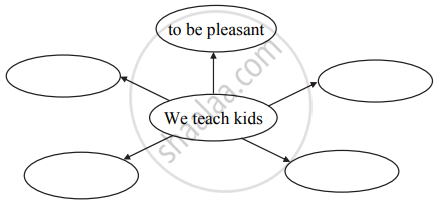
My dictionary tells me that personality is the “Personal or individual quality that makes one person be different and act differently from another.” Personality is, “the total physical, intellectual and emotional structure of an individual, including abilities, interests, and attitudes.”
There are many benefits to having a pleasant personality. There is only one opportunity to make a first impression, and all of us instinctively make decisions or judgments about an individual within the first few seconds of crossing paths. With that in mind, I believe when we teach our kids to smile, to be pleasant and cheerful, to be courteous and respectful of others, to pleasantly respond to requests or questions, we are helping them develop a personality that will open many doors for them. Once the doors are opened, the character will keep them open; but personality, not character, is on display in the first few seconds. Therefore, it’s important to develop a pleasant personality and use it for life.
A2 Personality :
Personality of an individual is recognized by :
(i) _______ (ii) _______
(iii) _______ (iv) _______
A3 Vocabulary :
Find out words for the following from the passage and write:
(i) polite =
(ii) relating to feelings =
(iii) to do anything naturally without thinking =
(iv) a chance to do something =
A4 Complete the following table :
| Noun | Adjective | Adverb |
| – | different | differently |
| Instinct | – | instinctively |
Select any word from the table and use it meaningfully in a sentence of your own.
A5 Personal Response :
Why do you thing, personality development is necessary?
Answer the following question in 30-40 words:
“The sight of the food maddened him.” What does this suggest? (His First Fight)
Briefly comment on:
“As a Buddhist, he told me, he knew that it didn’t really matter if I passed away, but he thought it would be bad for business.”
Look for pictures in newspapers and magazines that depict the urban civic problems discussed in the text. Cut them out and pin them to the text at appropriate places.
Why did the narrator of the story want to forget the address?
Paul's final bet his family richer but cost him his life. Explain.
How does Shelley's attitude to science differ from that of Wordsworth and Keats?
The peacock is the national bird of India. Why do you think the peacock has been chosen?
What does the bird in the poem announce? How is this related to the title, ‘Coming’?
Say why the speaker of the poem wishes to be a-
hawker
Complete the following sentence.
Sujoy reported about ___________________.
Think and answer in your own words in your notebook.
Why do you think God created worms? What is their ecological importance?
Using points from the lesson, give the details of the following in a short paragraph.
International Kite Festival at Ahmedabad.
Read the story and choose the appropriate meaning.
Skeleton branches ____________.
Go through the poem and state whether the following statement is true or false.
Planners plan to construct buildings wherever they find a place.
Imagine that one of your family members/friends/classmates has recently undergone surgery. You were curious and wanted to learn about his/her experience.
Match the questions you asked with their answers.
| 1. | What health problem did you suffer from? | a. | I was given a bath and I wore a surgical gown. |
| 2. | Whom did you inform about it first? | b. | I was given an injection of anesthesia. |
| 3. | What type of doctor did you consult? | c. | I consulted an orthopedic surgeon. |
| 4 | How did he/she find out that you needed a surgery? | d. | I was relieved and happy that the operation was over. |
| 5. | What preparation was done before the surgery? | e. | I had fractured my ankle while playing hockey. |
| 6. | What did you feel when you were taken to the operation theatre? | f | No, I did not feel anything. I was fast asleep. |
| 7. | What was the first step before the actual surgery? | g. | I recovered and I could walk normally after 3 weeks. |
| 8. | Did you feel any pain during the surgery? | h. | Our school hockey coach. |
| 9. | What did you feel when you opened your eyes after the operation? | i. | The doctor took an X-ray of my ankle, and he found a fracture in my ankle. |
| 10. | How soon did you recover? | j. | I was very nervous. |
Write a sentence each about three of your friends. Each time you should say what your friend cannot do, and yet, pay a compliment to your friend.
List all the words specially used in the game of Kabaddi.
State the difference between drama and novel.
Find sentences from the play related to the given points.
Loyalty in Irish Nationalism:
- Maybe Sergeant you’ll be on the side of the country yet.
- ____________________________
- ____________________________
- ____________________________
Shakespeare’s poetry has come to be valued for its own sake on the stage. Comment with reference to the play ‘A Midsummer Night’s Dream.’
Form pairs. Discuss and prepare a list of things that can be and will be done in future. (5 things) Spot the modal verbs in your answer.
Find what Hirabai tells the traveller by reading her words from right to left.
What does the poet pray for? Why?
Visit a library:
Find and read the biography of your favourite scientist.
List the various things that the Lethargarians do or want to do. Can you sum up all of it in one word or phrase?
Read the following proverb that has a biblical reference.
‘Do unto others as you would have others do unto you.’ Now find at least 5 other proverbs/ axioms/quotations which convey the same message. Search the internet/dictionary of proverbs.
You want to start human settlement somewhere else other than the earth, in the universe. Will you select a star or a planet? Why? What features supporting life will you look for? Try to find answers to such questions and make a presentation using scientific information and your imagination.
Read: ‘The Psalm of Life’- a poem by H. W. Longfellow.
Do you know of similar stories in your mother tongue or in other languages? Narrate it in short.
Pick out Archaic words from the poem and give their modern equivalents.
| Archaic Words | Modern Equivalents | |
| (a) | ||
| (b) | ||
| (c) | ||
| (d) | ||
| (e) |
Find out how the following game is played.
Table Tennis
List the characters in the story and write a few lines about each of them.
Read the following and say whether the statement tells you about a fact or whether it is imaginary.
There is a man in the Moon.
Make a collection of Rangoli motifs and patterns.
Write about each motif or pattern in your own words -
it could just be a label or a description or some information or comment.
Read the following line from the poem and answer the question given below.
The worst thing is that if anyone stays
Among them too long, he will learn their ways;
- What is the worst thing that can happen if anyone stays with them?
- What are the ways of the Grumble family?
Answer the following question in about 80-120 word.
If you were to live in the Complaining Street, how would you deal with the people who grumble?
Rearrange the jumbled sentences and write them in the correct order.
- But Hamid bought a pair of tongs.
- Granny Ameena felt proud of her grandson.
- Hamid’s friends bought different toys of their choice.
- Hamid proudly compared his tongs with a brave tiger.
- Hamid had less money than his friends.
- Granny Ameena was worried as he had to go to the Eidgah alone.
What do you think are the two most important lessons that the speaker mentions?
Fill in the blank.
______ is referred to as a festival of sacrifice.
Look at the number pattern. Fill the blank in the middle of the series or end of the series.
ELFA, GLHA, ILJA, ______, MLNA
“I will die, but not run away.” – Justify the saying of Neerja.
Work in pairs and answer the following.
Pick out the rhyming words.
What are the two reasons the author gives for the plants moving towards grandfather?
Selvi asked, 'Did they come in an aeroplane?' because she______.
How does the poet describe the Indian seasons? Write in your own words in about 50 words.
Jaswant managed to kill _________ Chinese soldiers.
Robot asked Vicky to sell him to an ______ master.
Write the rhyming word.
Bird - ______.
Fruits and shadows are free under the _______.
Identify the character or the speaker.
“I was cruel and selfish.”
Why did Uthaman become angry with the old man?
When do you feel proud?
Why did the greedy merchant get angry?
What was Farhan's father's advice to his son?
How can we do our work better?
How should teenagers guard against cyber crimes?
