Advertisements
Advertisements
प्रश्न
'Now I hold Creation in my foot' – explain the centrality of this assertion in the poem. What makes the hawk's assertion of its invincibility so categorical?
Advertisements
उत्तर
As posed in the poem, the Hawk appears to be absolute and indomitable. It ascribes itself to the summit of the jungle. The highest of all the social ladder, it sits on the highest point from where it can see it all beneath and small. The Hawk exaggerates that it took the whole of the Creation to design it. It sits on a bark that is rough and it at the highest point of the tree. The perspective of the Hawk is bounded by its vision. The little of the wood that it sees from its seat it takes it to be the whole of the world and presumes itself as its God. The little bird's petty egocentricity is amusing as when it flies it believes itself to be the one rotating the planet and moving the whole of the life. So now that the roles are reversed, the Hawk exclaims, “Now I hold Creation in my foot.” The Hawk declaring its assertion as invincibly categorical. It is the Hawk who is in control of the whole creation, even the Sun abides by it. Nothing that its eyes do not permit can flourish or even exist.
APPEARS IN
संबंधित प्रश्न
Answer any four of the following questions in 30-40 words each:
(a) What did Franz wonder about when he entered the class that day?
(b) What shocking experience did Douglas have at YMCA pool?
(c) Why does Kamala Das compare her mother to 'a pale winter's moon'?
(d) What rich bountry has the heaven given us? (A Thing of Beauty)
(e) Why did the Maharaja have to pay a bill of three lakh rupees to the British jewellers?
(f) What problem did Roger Skunk face when he went to play with his friends. How did he solve it?
Read the following extract and answer the questions given below:
If you do not get lowered in your own eyes
While you raise yourself in those of others,
If you do not give in to gossips and lies
Rather heed them not, saying, 'who bothers?'
You may be the person I am looking for.
If you crave not for praise when you win
And look not for sympathy while you lose,
If cheers let not your head toss or spin
And after a set-back, you offer no excuse,
You may be the person I and looking for.
(1) What should be your reaction towards gossips and lies?
(2) Who are your role models? Why?
(3) Give the rhyming pairs of words from the first stanza.
(4) Which line is repeated in this extract and what is its effect?
Briefly explain the following statement from the text.
“You need some interaction to cause a transition.”
Astrologers' perceptions are based more on hearsay and conjecture than what they learn from the study of the stars. Comment with reference to the story.
Why does Russell call the three passions 'simple'?
How do the patterns of creativity displayed by scientists differ from those displayed by poets?
Love is presented as the subject or the doer of actions in the poem. Why do you think the poet has used this form rather than involving human agents?
Read the story and complete the following.
Revathi won the prize for the ‘Best plant’ because, ____________.
Study the pictures below and note down the differences.


Think and write down how the following creature can be useful:
Dragon fly:
Read the Preamble of the Constitution of India given in your textbook. Pick out a word that refers to the following.
Brotherhood
Compare and contrast the two opposing human feelings as expressed by the poet.
Read the story and choose the appropriate meaning.
Wielded the brush ____________.
Given below are various professions in column A and in column B, the nature of work in respective professions. Match the columns.
| A | B |
| (i) Anaesthetist | (a) Specialist in the treatment of problems concerning the position of teeth and jaws. |
| (ii) Pharmacist | (b) A person who designs buildings and supervises the process of constructing them. |
| (iii) Orthodentist | (c) A person who is in charge of a newspaper or of a part of a newspaper. |
| (iv) Dermitologist | (d) The medical study of the skin and its diseases. |
| (v) Architect | (e) A person who has been trained to prepare medicines and sell them to the public. |
| (vi) Chartered Accountant | (f) A person whose job is to give drugs which makes the person not feel pain especially in preparation for a medical operation. |
| (vii) Editor | (g) A person who is engaged in the profession of accounting and examining the statements and records of accounts. |
Imagine that one of your family members/friends/classmates has recently undergone surgery. You were curious and wanted to learn about his/her experience.
Match the questions you asked with their answers.
| 1. | What health problem did you suffer from? | a. | I was given a bath and I wore a surgical gown. |
| 2. | Whom did you inform about it first? | b. | I was given an injection of anesthesia. |
| 3. | What type of doctor did you consult? | c. | I consulted an orthopedic surgeon. |
| 4 | How did he/she find out that you needed a surgery? | d. | I was relieved and happy that the operation was over. |
| 5. | What preparation was done before the surgery? | e. | I had fractured my ankle while playing hockey. |
| 6. | What did you feel when you were taken to the operation theatre? | f | No, I did not feel anything. I was fast asleep. |
| 7. | What was the first step before the actual surgery? | g. | I recovered and I could walk normally after 3 weeks. |
| 8. | Did you feel any pain during the surgery? | h. | Our school hockey coach. |
| 9. | What did you feel when you opened your eyes after the operation? | i. | The doctor took an X-ray of my ankle, and he found a fracture in my ankle. |
| 10. | How soon did you recover? | j. | I was very nervous. |
Show the stages in the process in which Krakatoa collapsed and then Anak Krakatoa formed in the course of volcanic eruptions. Use the flowchart given below.
Read the given extract (Act III)
Match column A with column B.
| Sr.No. | A | B |
| 1. | Dr. Thomas Stockmann | Opportunist |
| 2. | Katherine | Vulnerable |
| 3. | Peter Stockmann | Honest and upright |
| 4. | Petra | Coward |
| 5. | Hovstad | timid but supportive |
| 6. | Billing | Cuinng and corrupt |
| 7. | Aslaksen | Courageous |
Write a short note on the following:
Utilization of animal by-products in the ancient world.
How did the students prepare for their stalls/presentations?
Guess the meaning of the following from the context.
The garden still is alight with lilies.
Read aloud a paragraph of your choice from the passage.
List the phrases that indicate sorrow or pain.
Prepare similar word chains using the following ideas.
wind - breeze __________________.
This story takes an unexpected turn when the lion decides to spare the camel’s life. Choose any fable, a story that you like, and rewrite it giving it an unexpected turn.
Write the following:
The sights seen through a railway carriage mentioned in the first stanza.
Complete the following sentence with reference to the passage.
It is believed that _________ Homer, who __________ and who ________ to all who __________________.
Find three lines, that contain images of nature in the autumn season.
During daytime
- _______________________
- _______________________
- _______________________
Using your imagination, write how the other pets in the house could have objected to Caesar living in their house.
Describe the following in one or two lines.
The first little house of the bird.
Describe the following with the help of the (The Twelve Months) story.
Springtime
Guess the meaning of the following word.
postponed
Guess the meaning of the following word.
pounced
Name the following.
Captain of the Indian Team.
Write other meaningful words that begin/end with anywhere.
Look at the speaker in each picture. Say whether each one is a good speaker. Give reasons for your answer.
 |
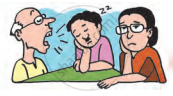 |
 |
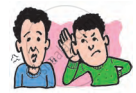 |
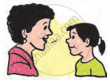 |
Which event in the story tells us that the lion was brave?
What does the poet want to know from the lark?
"That's one small step for a man, one giant leap for mankind." Neil Armstrong - Discuss
Who is wise according to you?
Read the following incident carefully to answer the question that follow.
The tie that does not bind
“Oh, so you’re going abroad? Can you bring me back…..?” I’ve been asked to bring back a vaccine for a course. Once I searched the suburbs of Paris for two days for a special brand of ceramic paint. Having spent a lot of money for Cartier lighter refills, I had them confiscated at the airport just before boarding because the gas might be dangerous in the air.
Now, two months before a trip, I stop talking to people so they won’t suspect I’m about to travel. But someone always catches me.” I’ve heard you’re going to New York, and I want you to get something for me. It’s just a little thing you can find anywhere. I don’t know exactly how much it costs, but it shouldn’t be much. We’ll settle up when you get back”.
What Gilson asked me to buy was, in fact, a little thing: a tie. But not just any tie. He wanted a tie with a small embroidered G. Any colour would do, as long as it had his initials. Look, this is a special flight, I explained. We are only staying Saturday through Tuesday. On the day we arrived I didn’t have time to think about the tie, but strolling around on Sunday I did see ties bearing various letters in more than one shop window. They were cheap, just a dollar, but all the shops were closed.
On Monday, lunch lasted the whole afternoon. Then it was Tuesday morning, time to leave. It was only when I saw our airport bus waiting outside the hotel that I remembered the tie.
I told the group to go on. I would get a taxi to the airport. And so I went in search of a nearby shop where I had seen ties.
But I couldn’t find it. I walked further down the street-one, two, three blocks - all in vain. Back at the hotel, a bit anxious now, I took my suitcase, got a taxi and asked the driver to rush to the street where I had seen them.
The driver stopped at each shop we passed so I could look from the window. The stores had all sorts of ties, but not the kind I was looking for.
When I finally thought I had located the right shop, I decided to go in and check. The driver refused to wait. Parking was prohibited, he said. I promised to double the fare, jumped out and ran into the shop. Was I going to miss the plane just for a damned tie?
The salesman was unbearably slow. When I realized that the smallest change I had was a ten dollar note , I grabbed ten ties of different colours so I wouldn’t have to wait for change. I rushed out with the ties in a paper bag.
On the street I looked around. The taxi had vanished, taking my suitcase. What is more, I was going to miss the plane.
I ran to the corner, and hope flared up again: the taxi was waiting in the next street. Quick to the airport! As I settled down inside the taxi. I sighed with relief. Gilson was going to have enough initialized ties to last him a lifetime.
When I reached the airport, I paid the taxi driver the double fare and grabbed my suitcase. Panting, I boarded the plane under the reproachful gaze of the other passengers, all primly seated with their seat belts fastened. Ready to take off. Departure had been delayed because of me.
“At least I hope you found your tie”, said one who knew the story.
“I did”, I answered triumphantly.
After making myself comfortable, I reached for the paper bag to show the ties.
I had left it behind; in the taxi.
Fernando Sabino.
Read the incident again and answer the following question.
What was the writer always asked to do whenever he planned to go abroad?
Mention at least two expressions which shows that Mrs. Krishnan was not willing to have Zigzag at home?
Fill in the blank.
______ is referred to as a festival of sacrifice.
Why was Sir Francis angry?
Grandfather felt planting trees would help the forest because______.
Who is Raj?
Narrate the story based on the story map
When did the richest farmer get upset? Why?
What should we do to save the Earth?
He offered _______ to his daughters.
When do we land on Mars?
What did the oil seller perform?
Circle the animals which are in the voyage.

Bala and Janani acted like the______.
What was the reason behind Nandhini’s dullness?
______will often say to be honest.
In real the plate was made of ______.
Read the passage carefully and answer the following question.
What did the farmer find in the field?
Choose the right word.
The tamarind tree grows over Tansen’s ______.
Here is an amazing news item on how the qualities of duty and devotion is not restricted to humans alone but shared by animals. Read the passage and answer the questions that follow.
Caesar, the Hero of Mumbai on 26/11
- Mumbai: Caesar, the last surviving hero of his kind, died of a heart attack on Thursday. Caesar, a Labrador Retriever, was covered with tri-color and given an emotional farewell from the city Police Force. The Mumbai Police Commissioner too marked the passing of the hero with a tweet.
- Caesar, who was 11 years old was the sole survivor among the dogs of Mumbai Police who took part in bomb detection operations during the terrorist attack on Mumbai that began on November 26, 2008. He died of a heart attack at a farm in Virar where he and his three canine buddies had been sent after retirement. During the terror attack in Mumbai, Caesar saved several lives when he sniffed out the hand grenades left by the terrorists at the busy CST railway station.
- Caesar was also a part of the search team at Nariman House, where terrorists were holed up for three days. Earlier he was also pressed into service for bomb search operation after the 2006 serial train blasts and July 2017 blast in Mumbai. The Mumbai police officials also tweeted their grief saying, “Services of retired members of Dog Squad during 26/11 will be unforgettable. We will remember our heroes forever.”
Answer the following questions.
- The Labrador Retriever was covered with tri-color. What does this signify?
- How did Caesar save several lives at the CST railway station?
- Which word in the third paragraph of the passage means the same as ‘forced’?
- “Services of retired members of Dog Squad during 26/11 will be unforgettable”. Mention three services rendered by Caesar.
- Caesar is a Labrador breed of dogs. Name a few other native breeds that are used by the Police Force.
- Try to rewrite the news item in your mother tongue without losing the spirit and flavour of the text. Give a suitable title to the translated version.
Enact any one anecdote in the classroom.
