Advertisements
Advertisements
Question
Discuss the following in pairs or in small groups.
Exceptionally talented people are born so; talent cannot be cultivated
Advertisements
Solution
Exceptionally talented people are born so, talent cannot be cultivated. Some genetic scientists opine that talent is determined by the genetic factor. It is inherited genetically. It cannot be cultivated . Had it been so, it would have been possible to produce exceptionally talented people by grooming individuals. But in reality that is not the case.
Another perspective:
There are other group of scientists who believe that talent is not exclusively determined by the genes or heredity. Environment plays a vital role in shaping talent. They call it meme and not gene.
APPEARS IN
RELATED QUESTIONS
B1. Complete the following statements:
(i) The poet is talking about............................. .
(ii) As a nation weare missing our .................................... .
(iii) Old people havekeys ........................... .
(iv) The elderly remember .......................... .
"Oh the value of the elderly! How could anyone not know? They hold so many keys, so many
things they can show.
We all will read the other side this I firmly believe.
And the elderly are closest oh what clues we could retrieve.
For their characters are closest to how we'll be on high.
They are the ones most developed, you can see it if you try.
They've let go of the frivolous and kept things that are dear.
The memories of so sweet, of loved ones that were near.
As a nation we are missing our greatest true resource,
To get to know our elders and let them guide our course."
B2 Express
State what the underlined words mean:
(i) Oh the value of the elderly! State the value ............. .
(ii) They are the ones most developed. 'They' stand for ............. .
B3: Match the words in Column A with their rhyming word in Column B:
| Column A | Column B |
| (i) Course | (a) Show |
| (ii) Believe | (b) resource |
| - | (c) retrieve |
It was her determination that helped Helen Keller get admission to Radcliffe College. Comment.
Answer the following question in 120-150 words:
How does Dr. Cuss's encounter with Griffin end in a disaster?
Read the passage and complete the activities given below :
B1 Pick out
The correct answers from the statements given below:
B2 Fill in the gaps with the information given in the passage :
Discuss the following statement in groups of two pairs, each pair in a group taking opposite points of view.
Reality is what is directly experienced through the senses.
While tribal communities may not seem to possess the scientific temper,there are many ideas from tribal conventions that could enrich modern societies.
How do stories/biographies of such famous people help youngsters?
Find proof from the poem for the following.
The colour imagery in the poem.
Find proof from the poem for the following.
The struggle of the cherry tree for survival.
Sue and Johnsy were very close friends.
Correct the following statement.
The last leaf was a real leaf that survived.
Complete the web with the help of adjectives used to describe eyes and nose in all respects. Two are done for you.
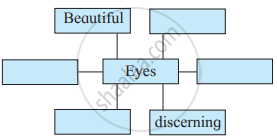

State whether the following statement is true or false. Correct the false statement.
The Ear was appointed as a judge.
Pick out the statements which aptly depict the theme of the poem.
- In the poem, the speaker memorises the past.
- In ‘The Planners’ the poet describes the unstoppable force of modernisation.
- The poet talks about the replacement of natural environment by the concrete jungle.
- The poet proposes to stop modernisation.
- The poet laments helplessly.
Write 3 to 4 lines about the following in your own words.
The Robotic Surgery
Find at least two things from the poem that show the following:
The atmosphere is pleasant.
Fill in the gap, choosing a word from the bracket to make an appropriate comparison.
(tall / quiet / humble / merry / busy / slippery / fast / sly / slow / big)
as ______ as a mouse.
List five of your favourite Hindi or Marathi poems or songs. Try to translate any one of them into English.
Read the following sentence carefully and choose the correct meaning.
Fine feathers don’t make fine birds.
What is described in the poem?
Discuss in groups and think about it.
Mention three occasions on which you have made someone else angry. What made that person angry? Can you avoid such things in the future?
What question did Shalihotra ask Sushruta?
Read about the novel ‘Robinson Crusoe’ by Daniel Defoe and ‘Gulliver’s Travels’ by Jonathan Swift.
What does the poet pray for? Why?
Complete the following using your own idea:
His head was too big to ______.
An activity:
Speak fast, think faster! Form groups of 4-6. Discuss each of the following topics. Then each person in the group should choose a topic and speak about it for one minute. Try to say as many sentences as you can in that time.
Imagine you are watching a scene. For example, someone learning to ride a bicycle; or a cricket match. Give a running commentary on what you see.
‘Monu is sitting on the bicycle. It has side wheels. Monu tries to push the pedal down - No - he stops. His uncle holds the seat in one hand and the handle in the other hand. He says, ‘Come on, Monu’... etc.
Complete the following sentence with reference to the passage:
He realised that making the body suffer was not ____________.
Prepare a short note on sea turtles with the help of the information given in the passage.
Guess the meaning of the following word:
exorbitantly
Write the smaller and related words that you see within this word.
Explain the use of the following property in the development of the play.
An envelope containing the letter
Say whether you agree or disagree.
The bachelor had narrated an improper story to the children.
Why is Great January annoyed with Holena and her mother? Does he help them?
Guess the meaning of the following word.
novel
Find two examples of the following from the lesson.
An Exclamation
What are search engines?
What did Aravind confess?
‘Finally the day had come’. Here the day refers to ______.
We should learn to ______questions.
- ask
- answer
- discard
What kind of learning brings joy to you?
Pick out the rhyming words from the first stanza of the poem.
Identify the character/speaker.
I must find out why he's in such a hurry!
Did he hire Kiouni? Why?
Rearrange the following jumbled sentences in the correct order.
- Payal’s house was a home for abandoned animals.
- It was a small ball of brown and grey.
- She found an owlet in one corner.
- Payal’s mother picked her up gently.
- Payal’s mother opened the carton.
- One day they got a carton.
Complete the sentence given below with word/phrase.
The buffalo ______ in the hole.
What is a sol? How many sols make a year?
Nilavan unknowingly started the space shuttle.
Nauranang is in Himachal Pradesh.
| Our national emblem is taken from Ashoka’s pillar at Sarnath. It is found on all government documents, coins, currency notes, postcards, and envelopes. It consists of four lions standing back to back but, we can see only three lions at a time. There is a Dharma chakra in the centre of the base plate, with the figure of a bull in the right and that of a horse in the left. The entire structure is sitting on a lotus. The words ‘Sathyameva Jayate’ is written under it in Devanagari script. These words mean, ‘Truth alone Triumphs’. |
- Where is our national emblem taken from?
- Where is our national emblem found?
- What does ‘Sathyameva Jayate’ mean?
- What are the animals found in the emblem?
Read the passage and colour one flag each time you read.
Our national emblem is taken from Ashoka’s pillar at Sarnath. It is found on all government documents, coins, currency notes, postcards, and envelopes. It consists of four lions standing back to back but, we can see only three lions at a time. There is a Dharma chakra in the centre of the base plate, with the figure of a bull in the right and that of a horse in the left. The entire structure is sitting on a lotus. The words ‘Sathyameva Jayate’ is written under it in Devanagari script. These words mean, ‘Truth alone Triumphs’.

Match their hobbies.
 |
swimming |
 |
cycling |
 |
gardening |
What was the age of Robinson Crusoe when he left for sea?
Choose the correct answer.
Find and write the clues.
Clue for lame ______.
Match the rhyming words.
| 1. | say | fall |
| 2. | go | day |
| 3. | all | grow |
Write the word with same meaning.

post- ______
If the fisher draws his net soon, he won’t get ______ in the net.
What was different about the rabbit that Alice saw?
Choose the right word.
Chintha Chettu is a tamarind ______.
What did he call his puppet?
How did the jackal become blue?
