Advertisements
Advertisements
Question
The quill is the central element of the poem – what does it symbolise?
Advertisements
Solution
The quill symbolises a new script. It is symbolic of the transition of a script, the characteristics that a script delivers to its successive script in legacy. Let us have a clearer idea of it by taking the evolution of Dogri's scripts into account. Around the time when the Dogri language developed, it used its native script Sharade, which evolved from the original Brahmi script. Sharade then came to be replaced by Devanagari, used presently. In the poem Mother Tongue, Padma Sachdev bemoans the depreciation of Sharade script. She explains a script's evolution by citing an example of a reed plant.
APPEARS IN
RELATED QUESTIONS
Read the extract given below and answer the questions that follow:
Wear skins peeped through by bones and spectacles of steel
With mended glass, life bottle bits on stones.
(b) Explain: 'slag heap'.
(c) What future awaits these children?
(d) Name the figure of speech used in the third line.
Answer any four of the following in 30 – 40 words each
(a) What precautions were taken for the smooth conduct of Evan's O-Level examination ?
(b) How did Jo want the Roger Skunk story to end ?
(c) What makes human beings love life inspite of all the troubles they face?
(A Thing of Beauty)
(d) What is suggested by the phrase, 'massive weight of Uncle's wedding band' ?
(e) How did Douglas remove his residual doubts about his fear of water ?
(f) Why did M. Hamel write 'Vive La France' on the blackboard ?
Attempt a character sketch of Squire Cass.
'The Address' is a story of human predicament that follows war. Comment
How is humour employed to comment on the pains that the author took to get his watch set right.
The lecture was delivered in 1864. What are the shifts in style and diction that make the language different from the way it is used today?
Discuss in pairs or in small groups
The description of novels as organisms.
Read the extract 'Being Neighborly' and complete the following statement:
Jo swept a path around the garden for ________________.
Say why the speaker of the poem wishes to be a -
gardener
Answer in your own words.
In what ways is Ashangbi different from other women of her community?
Think and answer in your own words in your notebook.
Why do you think God created worms? What is their ecological importance?
Find proof from the poem for the following.
The poet’s minute observations of the steady growth of the cherry tree.
Discuss in groups, reasons/ consequences/ effects:
The cherry blossomed.
‘Never mind faded forests, Austin’. The word ‘faded’ means to become dim or faint. The word describes the forests that have become faint or dim in appearance. Now go through the poem again and complete the table.
| Describing word | Object | Explanation |
| 1. faded | forests | The forests have become faint or dim in appearance. |
| 2. silent | ||
| 3. unfading | ||
| 4. bright |
For preparing questions based on the poem, an overall understanding of the poem is a must. Discuss with your partner and prepare a set of five questions.
For example:
- What is the name of the bridge?
- ________________________________
- ________________________________
- ________________________________
- ________________________________
- ________________________________
What is the Rhyme scheme of stanzas 1 to 3 and the last two stanzas?
How does it differ in the remaining stanzas 4 to 7?
Read 'The City Planners' by Margaret Atwood.
Fill in the gaps in the table of Degrees of Comparison.
| Positive | Comparative | Superlative | |
| (1) | ____________ | ____________ | oldest |
| (2) | ____________ | healthier | ____________ |
| (3) | near | ____________ | ____________ |
| (4) | ____________ | finer | ____________ |
| (5) | ____________ | ____________ | earliest |
| (6) | small | ____________ | ____________ |
| (7) | ____________ | faster | ____________ |
| (8) | high | ____________ | ____________ |
Read the description of the Kabaddi match and do the following:
Write, in your own words, what happened in the second half.
Find more information about the Indian Armed Forces - the Army, the Navy, and the Air Force with the help of your teacher.
What is described in the poem?
Form groups and discuss the following question:
The events described in the poem take place at a certain place, at a certain period of the year, under specific weather conditions. Describe the place, the time, and the weather conditions.
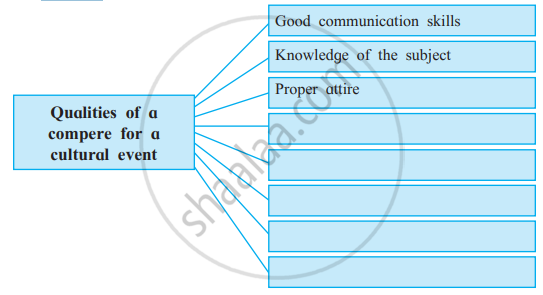
Imagine that you wish to organize a cultural event at your college. Prepare your own web-chart to indicate the qualities that you expect to have in a compere.
Shakespeare is acknowledged as the greatest writer because he understood human nature better than anyone else. Explain the statement in the context of the play.
Portia’s suitors chose the gold and silver caskets.
Visit a library:
Read other tales from Shakespeare, for example, Julius Caesar, As You Like It, Macbeth, and The Tempest.
Hold a mock trial for the following offence. There should be a complainant, a defendant, and lawyers to argue the case on behalf of them. The whole class can vote to pass the judgment. On what occasions will you plead for justice? What punishment will you suggest? When will you plead for mercy?
A poor man stole some ornaments from a rich girl.
Make a time table of your daily routine
- On a school day
- On a holiday, and
- During examinations.
Start at the time you normally get up and list your activities
hourly: 7 am to 8 am, and so on.
Does the poet expect anything in return? What is the poet’s reward?
Sayali was travelling in space for the first time.
Suggest at least one method of creating something useful or beautiful from waste.
Find the names of the exotic musical instruments and animals mentioned in the poem.
The items in the programme below have got mixed up. Rearrange them in the proper order. Just add the number in the left-hand column.
| Balanand Vidyalaya Art Festival Programme | |
| ( ) | → Koli Dance |
| ( ) | → igniting the Lamp |
| ( ) | → Chief Guest Speaks |
| ( ) | → Appraisal of the Art Festival |
| ( ) | → Dignitaries Arrive |
| ( ) | → Recital of ‘Taal kacheri’ |
| ( ) | → Welcome and Introduction of Guests |
| ( ) | → Prize Distribution |
| ( ) | → The Boy Comes Home - A skit by Std IX |
| ( ) | → Vote of Thanks |
Choose the appropriate phrase to insert in the gap, to make the sentence meaningful. Use the appropriate form of the verb.
Before we do the experiment in the Laboratory, let me ______ you all about it.
Find from the Internet and write down.
In which century did William Shakespeare write his famous plays?
Name the following.
Not comfortable with the wet ground.
What more difficulties would they have to face, if the roads are not cleared?
Do you agree with the poet’s thoughts? Why?
What is a password?
Find out the difference between the fingerspelling method, sign language and Braille.
Identify the character or speaker.
It seems to me like the recollection of a dream.
What was Ariel ordered to do with the people on the ship?
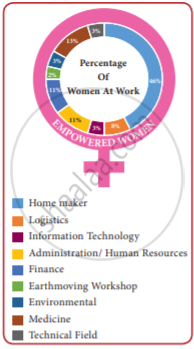
Read the data below and answer the following question.
Choose the correct answer.
Identify the three jobs where the same percentage of women work.
Find a sentence/word from the text which express the following.
The parent’s earlier view of the child
Read the lines and answer the questions.
Deep inside the mountain
the adventures hide themselves.
Where do adventures hide?
Read these lines and answer the questions given below.
Where the voice of the wind calls our wandering feet
Whose ‘Wandering feet’ is referred to here?
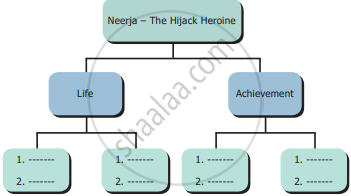
Write a summary based on the flow chart.
A sea turtle camouflages its nest by tossing sand on it to ______.
The author did not want to plant saplings in the forest because______.
How should one react to adversity?
Read scene I of the play carefully and answer the question below.
Whom does Mother Wolf talk about? How does she describe him?
The bird-catcher had a pigeon in his _______.
Choose the correct picture for the passage.
There is a table under a tree. A man with a big hat and a hare with long ears are sitting. A young girl is sitting between them. There are many cups on the table. The girl has a cup in her hand, and the man has a pot in his hand. It seems like they are having tea. Yes, they are having tea at the tea party in Wonderland. The girl is Alice, and she is in Wonderland.
Choose the correct answer.

Fill in the blank
He is rich ______ he looks simple.
_____ fights with everyone in school.
Why did the king want a leader who knows to grow a plant?
Why is your nose important for you?
How did he challenge everybody?
Read the passage and write the summary of it. Suggest a suitable title to your summary.
|
King Krishnadeva Raya would perform heavy exercises every morning. He regularly applied oil on his body and thereafter worked out till all the oil came out with the sweat. This was followed by a long ride on his horse. Once the king started leading a sedentary lifestyle, and he stopped exercising. He no longer went horse-riding either. The king overate and as a result grew fat and heavy. The king‟s temperament also underwent a sea change. Noticing this, the royal physicians cautioned the king against the ill effects of overeating and explained to him the risks posed by obesity. They advised the king to regulate his diet, exercise, and take care of his health. The repeated advice he got from the physicians to eat less made him so angry that one day he announced a reward for anyone who could find him an easy cure. But there was one condition: those who failed would have their heads off. None dared to advise the king in this regard. The situation became precarious and as usual Tenali Raman was approached by the courtiers for a remedy. Tenali heard the problem and assured the courtiers of a viable solution. The next day, an astrologer predicted that the king had only a month left to live. When the king came to know of this, he was furious. The astrologer was ordered by the king to be imprisoned for a month so that his prediction could be put to test and so the hapless forecaster was sent to prison. |
