Advertisements
Advertisements
Question
Read the following sentence aloud. Write who said it and to whom.
“Why, the dress you go to the theatre in !”
Advertisements
Solution
The above-given sentence is said by M. Loisel to Mathilde.
RELATED QUESTIONS
Describe Miss Stapleton's first encounter with Sir Henry in about 125 words
Anne's relationship with her mother was never simple. What created the tension and discord? Why
How is colour highlighted in the poem and why? List all the words in the poem that suggest colour.
How does Forster use the analogy of Scheherazade to establish his point ?
'There is no sophistry in my body' – this statement expresses the brutal frankness of the Hawk. Does the poet suggest something through this statement?
How does the banyan tree stand out as different from other trees? What details of the tree does the poet highlight in the poem?
Interpret these phrases in the context of the essay
- Mist of protection
- At a crossroads
- It came with strings attached
Say WHY. . . . . .
Mother agreed to send Ramanujan to England.
Give reasons :
Oberon and Titania fight for the custody of the Indian boy because - Titania wants ______________________.
Read the following words. Write the words that are combined to make these words.
- faraway
- nobleman
- whoever
- moneylender
- sometimes
Add ten more words to the list on your own. Each of the component words must be meaningful.
Answer in your own words.
What chores did the boys from 1000 CE and 1st Century CE, do on their farms/fields?
Read the poem again. Does it have a uniform rhyme scheme throughout?
Write down the rhyme scheme of every stanza separately.
- 1st stanza ______
- 2nd stanza ______
- 3rd stanza ______
- 4th stanza ______.
Write in your own words.
What does the poet miss?
Fill in the blank choosing the appropriate word/idiom from the lesson.
As soon as I ______ of my home, I greet my family.
Find out how the following game is played.
Table Tennis
Guess the meaning of the following word.
fragrant
Have you ever seen a bird making its first-ever attempt to fly?
Why did Mrs. Jhunjhunwalla buy the painting?
What do Tamil Nadu folk dances and folk arts represent?
Based on your reading, rearrange the following sentences in the correct sequence.
- Since all her methods failed, finally she gave him a pain-killer.
- He told his aunt that Peter had no aunt, so he gave him the medicine.
- The pain-killer triggered adverse reactions on Peter.
- It jumped out of the open window.
- Tom was dull and depressed.
- This incident upset Aunt Polly and she questioned him.
- But, Tom gave that painkiller to the cat Peter.
- So, Aunt Polly tried different types of remedies on him.
Do you think this was a good idea?
Read the incidents. Work in small groups to role play the situations in which they showed their presence of mind. Each group should perform the skit for the rest of the class. Share similar situations in the class.
Sea turtles are very small.
Who first brought these vegetables to India?
Women/Men can achieve anything, provided they put their heart and soul into it. Discuss in the class. Do you think being a man or a woman makes a difference?
Jaswant was captured alive.
A man in ______ clothes stopped near him.
Identify the character or the speaker.
“I was cruel and selfish.”
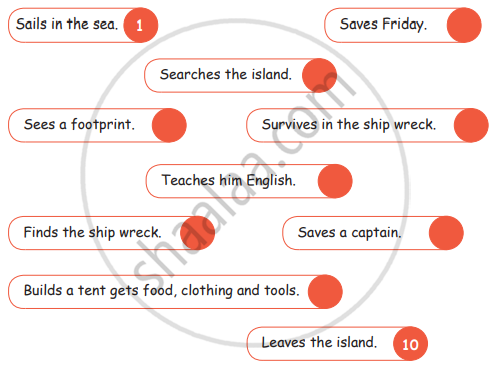
Arrange the actions of Robinson by numbering from 1 to 10.
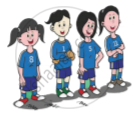
Write the events won by these players.
 |
______ |
 |
______ |
 |
______ |
Number the pictures in the correct order of the story.

Join the word with the correct prefix.
| paid | un |
| send | dis |
| able | re |
| continue | pre |
Did the seeds given to Ani sprout? why?
Whose word are these? Name the character.
“I am not rich enough to buy this plate. This is a gold plate.”
Choose the correct one.
Rooster

Pencil asked him to draw ______.
Read the passage carefully and complete the activities:
A1. Complete the following sentences. [2]
- Female sparrows lay ______.
- Sparrows build their nest out of ______.
- The eggs are ______.
- In cities, sparrows build their nest in ______.
|
A sparrow is a small bird which is found throughout the world. There are many different species of sparrows. Sparrows are only about four to six inches in length. Many people appreciate their beautiful songs. Sparrows prefer to build their nests in low places-usually on the ground clumps of grass low trees and low bushes. In cities, they build their nests in building nooks or holes. They rarely build their nests in high places. They build their nests out of twigs grasses and plant fibers. Their nests are usually small and well-built structures. Female sparrows lay four to six eggs at a time. The eggs are white with reddish-brown spots. They hatch within eleven to fourteen days. Both the male and female parents care for the young. Insects are fed to the young after hatching. The large feet of the sparrows are used for scratching seeds. Adult sparrows mainly eat seeds. Sparrows can be found almost everywhere where there are humans. Many people throughout the world enjoy these delightful birds. The sparrows are some of the few birds that engage in dust bathing. Sparrows will first scratch a hole in the ground with their feet then lie in it and fling dirt or sand over their bodies with flicks of their wings. They will also bathe in water or in dry or melting snow. Water bathing is similar to dust bathing with the sparrow standing in shallow water and flicking water over its back with its wings also ducking its head under the water. Both activities are social with up to a hundred birds participating at once and are followed by preening and sometimes group singing. |
A2. How do sparrows take a bath? [2]
A3. Find out adjectives for the following nouns from the passage. [2]
- ______ Song
- ______ Water
- ______ Bird
- ______ species
A4. Do as directed. [2]
- A sparrow is a small bird which is found throughout the world.
(Underline the subordinate clause) - Female sparrows lay four to six eggs at a time.
(Frame a ‘wh’ type question to get the underlined part as an answer.)
A5. ‘We have to save the birds.’ Do you agree with this statement? Why? [2]
Read the passage given below:
| 1. | Very often, we do not take the first step towards a good cause because we say to ourselves, "The task is so big. What can I do alone?" So nothing gets done. There is much talk about environmental protection, air pollution and saving our forests. Do we really care? If we do, here are a few things we can do to make our surroundings more pleasant. |
| 2. | It is good to adopt a two-uses-attitude! By putting an article to a second use, we are giving it a longer lease of life and using up less raw material from nature. One of the worst things we do is abuse of paper. The clean sides of envelopes can be used to write small notes, lists and reminders around the house. The more paper we use, the more trees will have to be cut down. For the same reason, we should avoid the use of paper napkins or paper plates. Cloth napkins are just as good, for they can be washed and used over and over again. |
| 3. | Another area which needs the most urgent attention is effective garbage disposal. People who are conscious about it follow rules and laws strictly. As a result, their neighbourhoods are clean and beautiful Similarly, each one of us can contribute to a cleaner environment. All kitchen waste should be collected separately. Those of you who have green fingers can turn this into valuable manure. Dig a pit and put the kitchen waste into it. When the pit is a little over half full, cover it up with mud. Let nature do the rest. Within three or six months, we will have a good garden manure. It can also be done as a community project by digging a large pit in the colony. Do take help of all the members, for nothing succeeds like co-operation |
| 4. | A lot of people don't care about the environment because they don't understand the adverse effect that society has on it. It is important to convince people to care about the environment. The first step would be to convince people to change by providing simple alternative solutions and ways of doing things. Theintemet is a powerful tool and a group on social media of like-minded people can be formed. People can share environmental stories and issues, as well as pool in solutions and alternatives to educate one another. With the current state that our planet is in, it is imperative that people actively care about the environment and most importantly to act now. |
Based on your understanding of the passage, answer any Eight questions from the nine given below:
- Why don't we take the first step towards a good cause?
- What is a two-uses-attitude?
- What can we do to avoid the abuse of paper? (any two points)
- What is the result of an effective way of a garbage disposal?
- What procedure can one adopt for kitchen waste?
- How can making of garden manure be done as community project?
- How long does it take to make good garden manure?
- Select a suitable word from the passage which means - being concerned or interested. (Paragraph 3)
- Pick out the word from the passage which means - completely necessary? (Paragraph 4)
Being a bachelor, the stranger had no patience with children.
Being a bachelor, the stranger had no patience with children.
