Advertisements
Advertisements
Question
Explain the phrase.
his bending sickle's compass
Advertisements
Solution
Compass is considered as a symbol of eternity. However, in the poem, it represents the change that a relationship goes through as it grows, old, and less intense. How a man's love for his young beloved grows less as he gave value to beauty over spiritual love. Though the love never dies, the physical beauty of a lover may fade and withers as it falls to time's compass' sickle.
APPEARS IN
RELATED QUESTIONS
A1. (i) Two activities that mother was free to do:
(a)...........................................
(b)............................................
(ii)Two activities that children avoided doing because of television:
(a) .....................................
(b) ...................................
Oh yes, we know it keeps them still,
They don't climb out the window sill,
They never fight or kick or punch,
They leave you free to cook the lunch
And wash thedishes in the sink
But did you ever stop to think,
To wonder just exactly what
This does to your beloved tot?
It rots the sense in the head!
It kills imagination dead!
It clogs and clutters up the mind!
It makes a child so dull and blind
He can no longer understand
A fantasy, a fairyland!
His brain becomes as soft as cheese!
His power of thinking rust and freeze!
He cannot think - He only sees!
'All right!' you'll cry. 'All right!' you'll say,
'But if we take the set away,
What shall-we do to entertain
Our darling children? Please explain!'
We'll answer this by asking you,
'What used the darling ones to do?'
'How used they keep themselves contented
Before this monster was invented?'
Have you forgotten? Don't you know?
A2. According to the poem, why is excessive watching of TV harmful?
A3. His brain became as soft as cheese. The figure of speech is ..........because............
Read the following passage and do the given activities:
B.1) Comparison
Write the comparison between the parts of the modular phone and the human body:
| Modular Phone | Parts of Human Body |
Every phone you buy, no matter how costly and latest it is, will go out of date in a year or so. That’s how quickly the smartphone world is moving right now. To keep yourself up to date with the current specification you will have to keep switching phones every once a while. What’s the solution to this problem?
MODULAR PHONES!
A modular device is a phone, tablet or another device where individual components such as the screen, camera, CPU, battery, memory can be removed by the user and replaced by others with a different specification. Imagine your body to be your phone and your clothes as the components, you can wear anything according to your needs and moods. Similarly, modular phones let you choose between components of different properties and specifications.
This would mean we’ll have the liberty to customize our phones, just like Lego building blocks! The main components of the phone will be Brain (processor), Spine (frame, screen) and Heart (battery). The other components may include a camera, storage memory, GPS, audio jack, speakers, USB module, etc. and the phone will have a motherboard, i.e. a base that will hold all components together
B.2) Give examples:
Write two examples that give the liberty to customize our phone.
• ____________________
• ____________________
B.3) Framing sentence:
Use the given phrases in sentences of your own:
(i) up to date
(ii) once a while
B.4) Write as instructed:
Rewrite the sentence as interrogative:
(i) We’ll have the liberty to customize our phones.
(ii) We will have the liberty to customize our phones. (Rewrite using the present participle form of the underlined word)
B.5) Personal Response
If given a chance to design a modular phone, what new features would you add?
Tick the item that is closest in meaning to the following phrase.
to give vent to
Why has he compared the three passions to great winds?
How is colour highlighted in the poem and why? List all the words in the poem that suggest colour.
The title, 'Refugee Blues' encapsulates the theme of the poem. Comment.
Read the extract and state whether the following statement is true or false. Correct the false statement.
The author is an example of ‘reverse migration’.
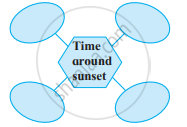
Pick out words from the poem to fill in the web diagram. They should be related to the theme in the web.
Answer in your own words.
What did Revathi discover about her balsam plants?
Think and answer in your own words.
Why is the street light compared to a one-red-eyed-giant?
When we look at the sky, we find several objects. They stand for something or the other. Complete the following table by finding the significance of the given objects. One example is given to you.
| Celestial Bodies | Association |
| The Sun | Power, Heat, Energy, Commitment, etc. |
| The Moon | |
| The Rainbow | |
| The Stars |
Behrman was a hard-hearted person.
The soldier-bees carry home ______.
Guess the meaning of the following words and phrases:
untold wealth, closest to the Emperor’s heart, grave offence, banish.
The whole world is happy because children are going to school. Why is it so? Discuss it in the classroom.
Form groups and discuss what must have happened to the handkerchief. Write the story in your own words.
Explain the term plot.
Answer the following question in one sentence.
Why does he ‘miss all the fun’?
Choose any one of the seven States. Find more information about it and prepare a leaflet or brochure to invite people to visit it.
Expand the following ideas in a paragraph or two:- Courage and resourcefulness are the keys to overcome problems.
Add ten more words to the list on your own. Each of the component words must be meaningful.
Draw word webs for the following.
Begin with the given word and go on writing as many other words associated with it, as you can.
Use these words to write other related words to form a word web.

Read aloud a paragraph of your choice from the passage.
Write about one occasion when you have behaved like -
Mr. Nobody
List the various things that the Lethargarians do or want to do. Can you sum up all of it in one word or phrase?
Find the meaning of the following word.
thee
Prepare similar word chains using the following ideas.
wind - breeze __________________.
Complete the following sentence with reference to the passage.
Nobody knows for certain who ___________________.
Suggest at least one method of creating something useful or beautiful from waste.
Write the rhyme scheme of the poem (Autumn).
Make as many 5 to 8 letter words as you can within 5 minutes, from the name.
| TESHUMAI TEWINDROW | |||
| Five-letter words | Six-letter words | Seven-letter words | Eight-letter words |
Rohan desperately wished for ______.
Guess the meaning of the following word.
postponed
Find out how the following game is played.
Table Tennis
Read the following line from the poem and answer the question given below.
They growl at that and they growl at this;
Whatever comes, there is something amiss;
- What does the word ‘growl’ mean here?
- Why do they find everything amiss?
Identify the speaker/character.
‘ Remember the tiny penknife he gave me last year’.
We should learn to ______questions.
- ask
- answer
- discard
Tackling the Issues
Ask the class to discuss solutions to an issue that plagues contemporary society at large or just your community—for example, homelessness, violence, environmental degradation, hunger.
Half the class should mention idealistic solutions to the chosen issue; the other half should mention only realistic approaches to solving the problem.
See if, in listening to both sides, someone can come up with a proposal that is both realistic and unconventional—an idea that hasn't been tried yet.
drenched – thoroughly wet
He is drenched to the skin. ______
What qualities of Mr. Phileas Fogg are highlighted in this extract? Support your answer with suitable examples.
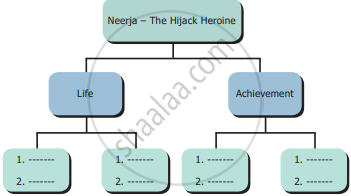
Write a summary based on the flow chart.
Who is Raj?
Mother called ______.
The horses were four and a half inches tall.
Amuthan locked the door behind him.
What robot will you make? Why?
Who is the guest?
Match the rhyming words.
| mars | crime |
| bed | cars |
| time | head |
What does the man have?
______was with Robinson.
Divide the following word.
man
Find and write the clues.
Clue for the load on the camel ______
Match the rhyming words.
| 1. share | dare |
| 2. bread | rest |
| 3. care | needs |
| 4. deeds | ahead |
| 5. zest | bear |
Teddy took his pillow as a sign of ______ them.
What are things that we can save? Why should we save them?
Rani thought of herself as a _______ engineer.
Mostly piggy banks look like______.
Mugund did not cut the raw wood.
Replace the bold word/words with a word from the quiver and re-write the sentence –
In no time she hit the object she aimed at.
What is the best time to water the plants?
