Advertisements
Advertisements
प्रश्न
How does the poet bring out the immortality of the bird?
Advertisements
उत्तर
While the poet is grieving on the unpleasant aspects of human life, he cherishes the nightingale's song and feels elated and finds peace in it. He praises the beauty of it. He calls the bird immortal for its humming is not to fade away as humans wither with age and death. He wishes to fly to the nightingale, wants to die and live with the bird. However, Keats soon realises that what he imagines is impossible. Keats is bewitched by nightingale's singing and he sings in praise of this bird whose ageless humming has been heard by the emperors and clowns and even Ruth and by all since times immemorial and will be there to be heard by posterity. Spellbound, he further embellishes and adds the beauty to the bird's song by his personification. Enchanted by the evergreen beauty of the sound of this bird, Keats delays the inevitability of death and lives the immortality of the bird, though not for long.
APPEARS IN
संबंधित प्रश्न
Attempt a character sketch of Mrs. Hall.
Read the following passage and complete the activities given below:
Talk to your partner about the following.
Would you agree that the author’s grandmother was a person strong in character? If yes, give instances that show this.
Briefly explain the following statement from the text.
Gangadharpant could not help comparing the country he knew with what he was witnessing around him.
Explain the associations that the colour 'white' has in the story.
Discuss in pairs or groups of four.
Replacing old machines with new is better than getting them repaired.
Explain the contradiction in the similies, ‘Like a child from the womb, like a ghost from the tomb’.
Why do you think the poet has used so many 'negatives' to make his statement?
What two things are compared in the poem?
How does Forster use the analogy of Scheherazade to establish his point ?
Study the Note to Aspects of the Novel given at the end. Discuss the features that mark the piece as a talk as distinguished from a critical essay.
Read the extract and state whether the following statement is true or false. Correct the false statement.
Growing in abundance is more important than the quality of the crop.
Name the world-famous personality who reached great heights despite of humble circumstances.

Using points from the lesson, give the details of the following in a short paragraph.
Different types of kites.
Correct the following statement.
Sue and Johnsy were good neighbours.
Write 3 to 4 lines about the following in your own words.
First Cardiac Surgery
Use the letters in the word MATHEMATICIAN to make 4 letters/5 letter and 6 or more letter words, within a time limit fixed by your teacher.
Answer the following question in short.
What do you learn about Pundits of Vijaynagar?
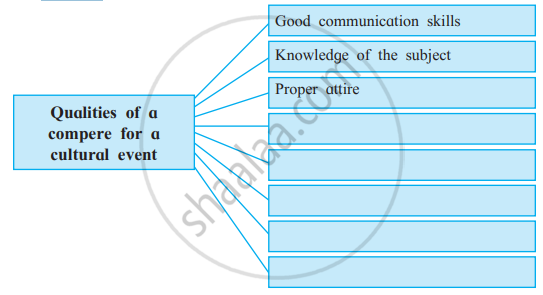
Imagine that you wish to organize a cultural event at your college. Prepare your own web-chart to indicate the qualities that you expect to have in a compere.
On any one page, note against the speech of every character what feelings it should show to bring out the meaning best. For example, joy, fear, anger, nervousness, friendliness, dislike, surprise, wonder, excitement, politeness, rudeness, cunning, curiosity.
Write a short note on the following:
Care of animals in the regime of Emperor Ashoka
Read the following.
- I mean what I say. I say what I mean.
- I see what I eat. I eat what I see.
Use your imagination to write a funny sentence on this pattern.
Answer the following question and write in short, why the parody sounds funny.
What does the bee stand for?
We find the following in the script of a skit or play. Rearrange these steps in the proper order and write them down in the form of a flow chart.

From the passage, find all the words and phrases used to describe the ‘monster’.
Complete the following phrases with the help of the poem.
- ______ music
- ______ rivers
- ______ breeze
- ______ lake
- ______ citron-trees
There are many popular lines like:-
- ‘Life is a game - play it well’.
- ‘Life is a journey - keep going ahead’.
Discuss and write down a few such metaphorical lines about ‘life’. You can make them up yourselves.
- ____________________________
- ____________________________
- ____________________________
- ____________________________
- ____________________________
Who said the following, to whom, and when?
“O Holy Master, bless us with thy song !”
What did Gopal Bhand say he was doing?
Describe the following with the help of the (The Twelve Months) story.
Springtime
List the insects, birds, trees and plants mentioned in the poem.
What examples of plentiful things does the poet give?
Look at the photographs on textbook pages 19-20 carefully and imagine the following:
- The colours, shape, size, actions, etc. of what you see in the picture.
- The sound/sounds you may hear at the scene of the photograph.
- How the different things, birds, animals, etc. in the picture feel to the touch.
- The smell / smells you may smell at the scene of the picture.
- The taste of what you see in the pictures.
In short, let your imagination include oil your five senses.
Now, write short descriptions of any 8-10 of your choice.
Remember to make use of your senses (one or more!) when you describe a photograph. You will find the following words and phrases useful. You may also use other words you know.
What is meant by being ‘online’?
Would you like to be a netizen?
How did Helen Keller help other blind people?
Read the following line from the poem and answer the question that follow.
In the dim past, nor holding back in fear From what the future veils; but with a whole And happy heart, that pays its toll To Youth and Age, and travels on with cheer.
- What does the poet mean by the phrase ‘in the dim past’?
- Is the poet afraid of future?
- How can one travel on with cheer?
Why did Dr. Ashok’s cousin call him?
What kind of learning brings joy to you?
Turtles are sea animals.
Grandmother had wanted the peepul tree cut down because______.
Why did the girls snigger?
Work in pair, find answer for the question and share in the class.
Why does the poet say the ‘ Spring is pretty’?
How did the third daughter use the grain?
Who is the wisest of all? Why?
Does it work its best?
Recite the poem 'My Robot' with correct intonation.
What wins the hearts?
What did they use as net?
Choose the correct answer.

Where is Keeraikuppam located?
The sparrow solved the problem with her _____.
Parents never let us get ______.
______always stays to the last in our needs.
Read the advertisement and answer the question given below.

What is free, for LED TV?
Try your own.
Where were they going?
Fill in the blank with rhyming word.
tree- ______
Where did they go to buy books?
Match the following items from column-A with those column-B:
| Column 'A' | Column 'Non-Textual' |
| (a) Geoffrey Chaucer | (i) Trinidad |
| (b) Daniel Defoe | (ii) Wuthering Heights |
| (c) V.S. Naipaul | (iii) Robinson Crusoe |
| (d) Emile Bronte | (iv) The Canterbury Tales |
