Advertisements
Advertisements
Question
How does the poem bring out the elusive nature of happiness in human existence?
Advertisements
Solution
The poem is an attempt to distinct happiness and true happiness, the real and imaginary, reality and dream, the pleasure and pain, the ideal, and the actual as Richard Fogle calls it. The everlasting and the momentary have been differentiated in the poem. The true pleasure as Keats defines lies not in the physical world which is full of miseries and pain and loss. We chase the beauty and happiness the way the poet chases the bird's song and still at a point the spell is bound to break like a bubble bursts and the human is thrown into the reality to realise the ultimate and inevitable, the death! Happiness is elusive and evanescent and can not be held forever. It is fickle and promiscuous. The poet when felt that he has found true happiness in the singing of the nightingale, which is beyond age and time; he wakes up to reality. He realises that it was just a vision of a dream, so is happiness, like a dream, not stationary! All that we can do is delay the inevitability of death through this beauty that gives transcendental happiness.
APPEARS IN
RELATED QUESTIONS
Write a character sketch of Mr. Barrymore in about 125 words
Answer any four of the following question in 30 – 40 words each:
(a) ''What a thunderclap these words were to me!'' (Franz). What were those words and what was their effect of Franz?
(b) Why did Douglas fail to come to the surface of the pool as he hoped to?
(c) What was Kamala Das's childhood fear?
(d) How is the Earth a source of life when all seems dead on it? Keeping Quiet)
(e) How does Mr. Lamb react when Derry enters his garden?
(f) Which problem did the Maharaja face when he had killed seventy tigers? How did he solve it?
Attempt a character sketch of Margot Frank as shown in ‘The Diary of a Young Girl’.
Mention three reasons why the author’s grandmother was disturbed when he started going to the city school.
Look at the following set of words and mention what is common to them both in form and meaning.
|
Snuffle |
snort |
sniffle |
snore |
How does G. N. Devy bring out the importance of the oral literary tradition?
Personification is a figure of speech that attributes human qualities to inanimate things and abstract ideas. How has it been used in the poem?
Discuss the following in pairs or in small groups.
“Before you begin experimenting you need to perfect the technique with which you experiment.”
What quality of 'beauty' and 'love' does the poem highlight?
Make groups and discuss the following:
What inspired them to spend the best part of their lives to research and share their findings?
Using a dictionary/internet note down the main difference between farm and granary.
Read the story aloud (or present it) in groups of three - the narrator, the peacock, and the crane.
What did one of the fluttering creatures do?
Discuss in groups and think about it.
Mention three occasions on which you have made someone else angry. What made that person angry? Can you avoid such things in the future?
Explain the following statement with reference to the context.
From now on The Herald shall be my artillery.
Read the story and write about the following in short.
Kojo
Expand the following ideas in a paragraph or two:-
Where there is a will, there is a way.
Write a conversation between a donkey and a dog.
Portia’s suitors chose the gold and silver caskets.
Write the following in short:
The events at the court.
Write about what you would like to do if ‘Time’ was your friend.
Try to write interesting time tables for imaginary people or creatures.
Sayali made a hasty purchase.
Complete the following diagram.

Answer in your own words.
What task did Grandpa wish to avoid?
Answer in your own words.
What did Neel realise from his encounter with his ancestors?
Form a group of four to six. As a group activity, write a conversation in which a person/a group of person thanks to someone.
Describe the following with the help of the (The Twelve Months) story.
Summer
Guess the meaning of the following word.
novel
Find out what 'Braille' is.
Find a word that has a similar meaning.
remove
What happened when Somu left Zigzag with the Krishnans?
Bring out a few differences between the two art forms: Therukoothu and Bommalattam.
What challenges does Alice face and how does she overcome them?
Look at the number pattern. Fill the blank in the middle of the series or end of the series.
FAG, GAF, HAI, IAH, ______
Match the following.
| 1. | A man of ease | Emanuel |
| 2. | John’s trainer | Lalli and Lolly |
| 3. | Mathew’s secretary | John Mathew |
| 4. | John’s chef | Louise |
| 5. | Mathew’s friends | Basky |
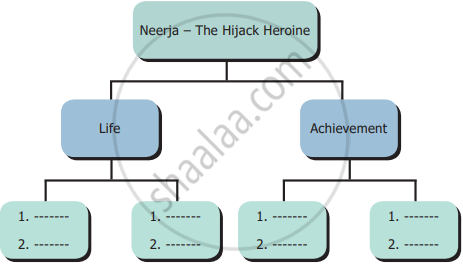
Why did the governments of India, America and Pakistan – honour Neerja?
Read the “Story of Self Sacrifice and Bravery” once again and complete the flow chart.
Female Olive Ridleys come ashore at night to lay eggs.
A turtle’s flippers help it to ______.
The boy was so inspired by Mithali that he was happy for his sister to play cricket.
The poor farmer’s crop was______.
Which planet has rings around it?
Why does the poet fly out of the universe?
Jaswant managed to kill _________ Chinese soldiers.
Read scene I of the play carefully and answer the question below.
Match the following.
| Sr.No. | CHARACTER | TRAIT |
| a. | Father Wolf | with a grey nose…feeds her four cubs |
| b. | Tabaqui | the big one from Waingunga River with a lame foot |
| c. | Mother Wolf | the chief of the Wolves |
| d. | Shere Khan | begs for meat and thanks for the meal/warns the wolves about the arrival of Shere Khan |
Vicky’s father decided to change his son’s character.
Pick out the rhyming words from the poem and write.
| Mars | |
| time | |
| be |
Fortune knocks with its best who _______ for their guest.
Why did he grow crops?
Write the events won by these players.
 |
______ |
 |
______ |
 |
______ |
What is the name of the girl?
Did Nandhini have fever?
What are things that we can save? Why should we save them?
The merchant paid______ to the boatman.
Why did he rub the circle again and again?
Replace the bold word/words with a word from the quiver and re-write the sentence –
The teacher said something about his good handwriting. He felt very happy.
“Something is wrong,” said Helen’s mother. What was wrong with Helen?
Read the following passage and answer the questions that follow:
The Stationmaster’s Supreme Sacrifice by Sanchari Pal (Adapted)
- Thirty-three years ago, on the night of December 2, 1984, Bhopal was hit by a catastrophe that had no parallel in the world’s industrial history. An accident at the Union Carbide pesticide plant in Bhopal had released almost 30 tons of a highly toxic gas called methyl isocyanate, turning the city into a vast gas chamber. The result was a nightmare; more than 600,000 people were exposed to the deadly gas cloud that left thousands dead and many more breathless, blind and in agonizing pain. Few people know that during the Bhopal gas tragedy a heroic stationmaster risked his own life to save others.
- On the evening of December 3, 1984, Ghulam Dastagir was settling down in his office to complete some pending paperwork. This work kept him in his office till 1am in the night, when he emerged to check the arrival of the Gorakhpur Mumbai Express. As he stepped on to the platform, the deputy stationmaster felt his eyes burn and a queer itching sensation in his throat. He did not know that poisonous fumes leaking from Union Carbide’s pesticide factory were stealthily enveloping the railway station.
- Beginning to choke, Dastagir did not know then that twenty-three of his railway colleagues, including his boss, station superintendent Harish Dhurve, had already died. It was later reported that Dhurve had heard about the deadly gas and had immediately tried stopping the movement of trains passing through Bhopal before collapsing in his office chamber. His suddenly worsening health and years of experience told Dastagir that something was very wrong. Though he did not fully comprehend what was happening, he decided to act immediately when he did not get any response from the station master. He alerted the senior staff at nearby stations, like Vidisha and Itarsi, to suspend all train traffic to Bhopal.
- However, the jam-packed GorakhpurKanpur Express was already standing at the platform and its departure time was 20 minutes away. Listening to his gut instinct, Dastagir summoned his staff and told them to immediately clear the train for departure. When they asked if they should wait until the order to do so came from the head office, Dastagir replied that he would take complete responsibility for the train’s early departure. He wanted to ensure that the train left immediately, without any delay. His colleagues later recalled that Dastagir could barely stand and breathe as he spoke to them. Breaking all rules and without taking permission from anyone, he and his brave staff personally flagged off the train.
- But Dastagir’s work was not done. The railway station was filling up with people, desperate to flee the fumes. Some were gasping, others were vomiting, and most were weeping. Dastagir chose to remain on duty, running from one platform to another, attending, helping and consoling victims. He also sent an SOS to all the nearby railway offices, asking for immediate medical help. As a result, four ambulances with paramedics and railway doctors arrived at the station. It was winter and the gas was staying low to the ground, a thick haze poisoning everything in its path. Besieged by hordes of suffering people, the station soon resembled the emergency room of a large hospital. Dastagir stayed at the station, steadfastly doing his duty, knowing that his family was out there in the ill-fated city. That day all he had for his protection was a wet handkerchief on his mouth.
- Ghulam Dastagir’s devotion to duty saved the lives of hundreds of people. However, the catastrophe didn’t leave him unscathed. One of his sons died on the night of the tragedy and another developed a lifelong skin infection. Dastagir himself spent his last 19 years shuttling in and out of hospitals; he developed a painful growth in the throat due to prolonged exposure to toxic fumes. When he passed away in 2003, his death certificate mentioned that he was suffering from diseases caused as a direct result of exposure to MIC (Methyl Isocyanate) gas. A memorial has been built at platform No.1 to pay tribute to those who sacrificed their lives in the line of duty on the fateful night of December 3, 1984. However, Ghulam Dastagir, who died later, is not one of them. A forgotten hero whose sense of duty and commitment saved countless lives, Dastagir’s story deserves to be recognized and remembered by our fellow countrymen.
- Why was the accident at Union Carbide unparalleled in the world’s industrial history?
- How was Dastagir affected by the poisonous gas?
- What was the action taken by the station superintendent?
- How did Dastagir and his staff break rules?
- What was the cause of Dastagir’s death?
- Find words from the passage which mean the opposite of the following.
- safeguard (para 1)
- common or familiar (para 2)
- prompt (para 4)
- cause (para 6)
Match the following items from column-A with those column-B:
| Column 'A' | Column 'Non-Textual' |
| (a) Geoffrey Chaucer | (i) Trinidad |
| (b) Daniel Defoe | (ii) Wuthering Heights |
| (c) V.S. Naipaul | (iii) Robinson Crusoe |
| (d) Emile Bronte | (iv) The Canterbury Tales |
