Advertisements
Advertisements
प्रश्न
Read the following extract and answer the questions given below:
If you do not get lowered in your own eyes
While you raise yourself in those of others,
If you do not give in to gossips and lies
Rather heed them not, saying, 'who bothers?'
You may be the person I am looking for.
If you crave not for praise when you win
And look not for sympathy while you lose,
If cheers let not your head toss or spin
And after a set-back, you offer no excuse,
You may be the person I and looking for.
(1) What should be your reaction towards gossips and lies?
(2) Who are your role models? Why?
(3) Give the rhyming pairs of words from the first stanza.
(4) Which line is repeated in this extract and what is its effect?
Advertisements
उत्तर
- We should not give in to gossips and lies. We should not even pay attention to them. Clearly speaking we should not bother about them.
- My role model is my parents. Who are very simple and humble in their character. They do not seek praise while in achievements and do not expect sympathy while losing. They are ready to face any challenge which comes across in their life.
- eyes - lies
Others - brothers - “You may be the person I am looking for” - This line gives the importance of that person to whom the poet is looking for.
APPEARS IN
संबंधित प्रश्न
A1. Order
Arrange the following sentences in the chronological order as they appear in the passage:
(i) On celebrations, parents can invest Rs. 200 and plant a sapling of a tree representing the child’s birth star.
(ii) He wants to create Brihat Panchvati.
(iii) He has been able to increase the areas of the Pavitra VanaVana.
(iv) Plans are afoot to create a Saptaswara forest.
Today, Reddy is one of the most well - known environment specialists in India. With his influence, he has been able to increase the areas of the Pavitra Vana and has plans to bring about awareness of Puranic trees and flowers for the knowledge of the Indian citizen.
He wants to create near the Pavitra Vana, a Brihat Panchavati so that parents can show their children the forest where Shakuntala lived or Sita spent her final days. There will also be a hillock where people can meditate. Plans are also afoot create a Saptaswara forest, pertaining to different ragas in music. Scientists have found that certain plants react in a particular way to different ragas. So in such a forest, when a musician performs certain ragas, the plants will reach in such a manner that it will benefit the audience, the musician and the whole environment. The other idea is an ecopark for children. On celebrations, like birthdays, parents can invest Rs. 200 and plant a sapling of a tree representing the child's birth star. The plant will also carry the child's name. The Pavitra Vana also houses a garden of Prophet Mohammed, which has some plants mentioned in the Holy Quran. There is the date plant - sacred to Islam - and the Mimosops elengi, the latter a highly fragrant variety. There is also the garden of Eden for housing plants sacred to Christianity, but the Pavitra Vana authorities have to procure most of them in the new sections.
A2. Find specialities
Write down the specialities of the following:
(i) Brihat Panchavati: ........................ ..... . .
(ii) Saptaswara Forest: ..................... ..... .............. . .
(iii) Eco-park: ..................................... . .
(iv) A garden of Prophet Mohammed:
A3. Antonyms Find antonyms for the following words from the passage:
(i) same
(ii) decrease
(iii) destroy
(iv) lost
A4. Language study
(i) He wants to create near the Pavitra Vana, a Brihat Panchavati. [Pick out an infinitive from the given line and use it in your own sentence]
(ii) Reddy is one of the most well-known environment specialists in India. [Begin with: Very few ………]
A5. Personal Response
Do you think one person alone can create an awareness towards environment conservation ? Support, your answer with appropriate reasons.
Answer any two of the following questions in about 30‒40 words:
(a) How does Kamala Das try to put away the thoughts of her ageing mother?
(b) Which is the exotic moment that the poet refers to in 'Keeping Quiet'?
(c) What are the difficulties that aunt Jennifer faced in her life?
Attempt the following in 150-200 words.
Why does Anne call herself 'a bundle of contradictions'?
You are Smitha/Sunil, Secretary AVM Housing Society. You are going to organize a yoga camp. Write a notice in not more than 50 words, urging the members of your society to come in large numbers to attend the camp. Invent all the necessary details.
Give an example from the passage that proves the crow to be an intelligent bird.
Attempt a character sketch of Squire Cass.
Read the following passage and do the activities:
A1 True or False:
Rewrite the following statements and state whether they are ‘true’ or ‘false’.
(i) Mashelkar’s mother did menial work to bring him up.
(ii) Mashelkar’s father died when he was twelve.
(iii) Mashelkar was born in a very rich family.
(iv) Tatas added much value to Mashelkar’s life.
I start with my greatest guru-my mother. I was born in a very poor family and my father died when I was six. We moved to Mumbai and my mother did menial work to bring me up. Two meals a day was a tough challenge. I studied under street lights and I walked barefoot until, I think, I was twelve. I remember when I passed the seventh standard and I wanted to go into the eighth standard, our poverty was such that even to secure 21 rupees for secondary school admission became a big challenge. We had to borrow from a lady, who was a housemaid in Chaupati in Mumbai. That was the tough life I had.
In fact, I remember, my passing the SSC Examination-i.e. 11th standard. Those days it used to be not 10th standard or 12th standard but 11th standard. I stood 11th among 1,35,000 but I was about to leave higher education and find a job. What helped me was the scholarship by Sir Dorab Tata Trust. It was just 60 rupees per month and would you believe that 60 rupees per month from Tatas added so much value to my life that I have been able to stand here today before you to speak to you.
I am on the Board of Tatas now and it is very interesting that the same Bombay House where I used to go to collect that 60 rupees per month now one goes and sits there like a Director on the Board of Tata Motors. The turn that these 40 years have taken is very interesting. It has all been possible because of the chance I got to do higher studies at the insistence of my mother. She gave me the values of my life. She was one of the noblest parents I have met in my life.
So, my greatest guru was my mother. My second guru was Principal Bhave, about whom I made a mention earlier. He taught us Physics. Because it was a poor school, I remember, it had to innovate to convey to the young students the message of Science.
A2 Complete:
Complete the following sentences and write:
(i) Mashelkar was inspired by his greatest guru _______
(ii) Mashelkar studied under _______
(iii) Principal Bhave taught _______
(iv) The scholarship by _______ Trust helped him in higher education.
A3 Find the meaning:
Choose the appropriate meaning of the underlined words from the given alternatives:
(i) We moved to Mumbai and my mother did menial work.
(a) skilled
(b) hard
(c) unskilled
(d) of low status
(ii) Because it was a poor school, it had to innovate to convey to the young students the message of science.
(a) do a cheap experiment
(b) introduce new things
(c) avoid
(d) try hard
(iii) I got to do higher studies at the insistence of my mother.
(a) firm saying
(b) being inspired
(c) being inspected
(d) being instigated
(iv) That was the tough life I had.
(a) difficult
(b) soft
(c) cheap
(d) simple
A4 Match:
Match the following sentences with their tags:
| 'A' | 'B' | ||
| (i) | I stood 11th among 1,35,000 |
(a) | aren’t I? |
| (ii) | I am on the Board of Tatas | (b) | didn’t we? |
| (iii) | It was a poor school | (c) | didn’t I? |
| (iv) | We moved to Mumbai | (d) | wasn’t it? |
A5 Personal Response:
“Mother is the greatest Guru.” Discuss.
A1 Web :
Complete the following web with the help of the passage :
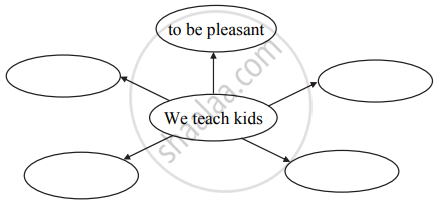
My dictionary tells me that personality is the “Personal or individual quality that makes one person be different and act differently from another.” Personality is, “the total physical, intellectual and emotional structure of an individual, including abilities, interests, and attitudes.”
There are many benefits to having a pleasant personality. There is only one opportunity to make a first impression, and all of us instinctively make decisions or judgments about an individual within the first few seconds of crossing paths. With that in mind, I believe when we teach our kids to smile, to be pleasant and cheerful, to be courteous and respectful of others, to pleasantly respond to requests or questions, we are helping them develop a personality that will open many doors for them. Once the doors are opened, the character will keep them open; but personality, not character, is on display in the first few seconds. Therefore, it’s important to develop a pleasant personality and use it for life.
A2 Personality :
Personality of an individual is recognized by :
(i) _______ (ii) _______
(iii) _______ (iv) _______
A3 Vocabulary :
Find out words for the following from the passage and write:
(i) polite =
(ii) relating to feelings =
(iii) to do anything naturally without thinking =
(iv) a chance to do something =
A4 Complete the following table :
| Noun | Adjective | Adverb |
| – | different | differently |
| Instinct | – | instinctively |
Select any word from the table and use it meaningfully in a sentence of your own.
A5 Personal Response :
Why do you thing, personality development is necessary?
Answer the following in 200-250 words :
Describe the relationship between Anne and Margot?
What is the meaning of the line “Both wry with the laboured ease of loss”.
|
The energy stored in coal and petroleum originally came to the earth from the sun. The bulk of the present-day supplies was laid down some 200 to 600 million years ago, when tropical conditions were widespread. Lush, swampy forests produced huge trees; warm coastal seas swarmed with microscopic forms of life. When these organisms died, much of their tissue was recycled as it is today — through scavenging and decay. But a significant amount of dead plant and animal material was covered with mud, which prevented complete decomposition. With the passage of time, layer upon layer of the fine sediment was deposited over the once-living material; the sheer weight turned the sediments to rock. Sandwiched between the layers, both coal and petroleum were produced and preserved under pressure. Coal was formed mostly of giant fern-like plants that have only small counterparts today. Coal may still be forming here and there on earth, but conditions are not right for the production of significant quantities. |
Underline the important words and phrases.
Discuss the following in pairs or in groups of four:
'It is time to realise that unless we modify the established notion of literature as something written, we will silently witness the decline of various Indian oral traditions'
Love is presented as the subject or the doer of actions in the poem. Why do you think the poet has used this form rather than involving human agents?
What decision taken by Dick changed his fortune?
Think and answer in your own words.
What exactly does the speaker in the poem crave for?
The best punishment is ‘forgiveness’. Discuss the sentence in light of the text you have read. You can make use of the following points.
(a) Forgiveness provides an opportunity to change the behaviour.
(b) Forgiveness leads to repentance.
(c) A person may commit a mistake/crime impulsively or under the force of strong emotions.
(d) ________________________
(e) ________________________
complete the following sentence.
Ajoy reported about ________________.
Think and answer in your own words in your notebook.
Why does the poet appeal to us, to respect the life of a worm?
Find evidence from the lesson and write in your own words.
In Israel, the media have a positive outlook and self-respect.
Find proof from the poem for the following.
The colour imagery in the poem.
Answer the given question in your own words.
What message do you get from this story?
Life is an amalgam of happy and sad moments. Think of such moments in your life, pair with your classmate, and share both the aspects of life.
| Happy Moments | Sad Moments |
| 1. Winning the first prize in a competition | Losing your mobile, bicycle, or wallet |
| 2. | |
| 3. |
Using points from the lesson, give the details of the following in a short paragraph.
Different types of kites.
For preparing questions based on the poem, an overall understanding of the poem is a must. Discuss with your partner and prepare a set of five questions.
For example:
- What is the name of the bridge?
- ________________________________
- ________________________________
- ________________________________
- ________________________________
- ________________________________
Read the descriptions of the following from the story and describe any one of them using your own words.
- The ivy vine
- Behrman
- The last leaf that Johnsy saw
Say where the image from nature given in the poem exists.
AIR / LAND / WATER
beneath the boughs
Choose the proper alternatives from the statements given below which would explain why town planning is essential - _______________.
- To develop the city according to the guidelines.
- To get the ‘Best City Award’.
- To attract tourists.
- To use and develop the land available in the city for the interest of the citizens.
Expand the idea inherent in the following proverb :
One should eat to live, not live to eat - Franklin.
We all know that blogs can be written on many topics. Your teacher will divide the class into groups and assign a task to every group to make a list of various topics on which blogs are normally written. One is given to you.
- Social Awareness
- _________________
- _________________
- ________________
Answer the following question in short.
What punishment did the emperor threaten the Pundits with?
Read the passage and answer the following question:
What is 'Param Vir Chakra'?
What did one of the fluttering creatures do?
Discuss in groups and think about it.
Mention three occasions on which you have made someone else angry. What made that person angry? Can you avoid such things in the future?
How many of them are personal articles? How many of them are used for the beautification of your home? How many of them are meant for utility (to fulfill a useful function in the household)?
Find out the different processes by which fabrics are made. Find illustrations and write a few lines on each process.
Write about the various wheel-like objects you see at home, in school, and on the road.
Visit a library: Find poems about animals. Copy them and recite them to your friends.
Shylock was not at all generous.
Find four words ending with ‘-ous’ from the story.
Can you add three more words ending with ‘-ous’ to this list?
Find, in your science textbook, the topics of the stalls handled by students of VI A.
(Write the page number.)
What time is being described in the poem?
List the various things that the Lethargarians do or want to do. Can you sum up all of it in one word or phrase?
Read the passage. Underline the new words. Guess their meaning from the context. Verify it from a good dictionary.
Read the following sentence aloud. Write who said it and to whom.
“You have nothing else?”
Read the following sentence aloud. Write who said it and to whom.
“What! ... how ! ... That’s impossible! ”
Think and answer:
Are the boys and girls happy that it is raining?
This story takes an unexpected turn when the lion decides to spare the camel’s life. Choose any fable, a story that you like, and rewrite it giving it an unexpected turn.
Correct the following sentence using facts from the passage.
Achilles was killed by an arrow that pierced his heart.
Write the following:
The sights mentioned in the third stanza.
Complete the following sentence with reference to the passage.
It is believed that _________ Homer, who __________ and who ________ to all who __________________.
Explain the use of the following property in the development of the play.
An envelope containing the letter
A parody is a playful, comic imitation of a writer’s style. A parody is like a verbal cartoon. Compare the original poem and its parody given on page 35 using the following points:
|
How doth the little busy bee |
How doth the little crocodile (parody) |
| Choice of a subject (an animal) | __________________ |
| __________________ | __________________ |
| Number of lines and stanzas | __________________ |
| __________________ | __________________ |
| Same or similar constructions | __________________ |
| __________________ | __________________ |
| Tone of the poem | __________________ |
| __________________ | __________________ |
Write the symbol that is used in the poem to represent the following idea.
Some other time.
Rewrite in your own words.
One event from the story.
Spot and write any three alliterative phrases or sentences from the poem.
(Alliterative phrases/sentences are those in which the same sound is repeated.)
Rohan desperately wished for ______.
Put the following expressions in a table of Do’s and Don'ts as expressed by the poet.
- Please listen
- give me advice
- tell me why
- solve my problem
- just hear me
- accept as a simple fact
- contribute to my fear
- wait a minute
| Do’s | Don'ts | |
| 1. | ||
| 2. | ||
| 3. |
Guess the meaning of the following word.
fruitless
Find out how the following game is played.
Lawn Tennis
How was Gulliver taken to the city?
Would you like to be a netizen?
Guess the meaning of on the wing.
Describe the struggles underwent by the young seagull to overcome its fear of flying.
Identify the character or speaker.
He was the chief of all spirits.
What were the various sounds the brothers heard when they went downstairs?
Were the policemen willing to leave the house?
Why was the narrator sorry to have paid attention to the footsteps?
The weather is always too hot or cold; Summer and winter alike they scold. Nothing goes right with the folks you meet Down on that gloomy Complaining Street.
Pick out the rhyming words and identify the rhyme scheme of the above lines.
When and where was the first ATM installed?
What game did Anne choose to play?
‘Finally the day had come’. Here the day refers to ______.
What did Hamid buy at the fair? And for whom?
Tom lay thinking. Presently it occurred to him that he wished he was sick; then he could stay home from school. He examined himself. He found no symptoms or sickness, and he investigated again. This time he felt he had a stomach ache, but it soon grew feeble, and presently died wholly away. He reflected further.
What did he detect?
Discuss with your partner and complete the table.
| S.No. | Question | Who asked this? | Who answered? | What was the answer? |
|
1. |
Shall we run back together? | |||
| 2. | Can you see something behind the wall? | |||
| 3. | Who said good bye? | |||
| 4 | Was it just the wind? |
Read the comic strip and answer the following question.
How do you behave in a virtual platform?
Did he hire Kiouni? Why?
Work in pairs and answer the following.
Write the rhyme scheme of the poem.
Everyone in the ship started to pray because ______.
Identify the speaker/character.
Wake up, child.
Read the story and fill in the grid by ticking each character’s qualities.
Discuss in pairs to rate the characteristic and give marks from 1 to 10 depending on the grade of each quality.
Justify your views in one or two sentences.
| Characteristics | Jane Eyre | Mrs. Reed | Bessie | Helen Burns | Miss. Temple |
| arrogant | |||||
| bitter | |||||
| caring | |||||
| courageous | |||||
| cruel | |||||
| emotional | |||||
| friendly | |||||
| kind | |||||
| sensitive | |||||
| rich | |||||
| poor | |||||
| patient | |||||
| self-disciplined | |||||
| unjust |
Ridleys come to lay their eggs in the month of January.
Work in groups of five. Tell the story in ten sentences.
You can begin the story like this:
The author’s Grandfather served in the Indian Forest Service.
After his retirement he built ______ Now continue the story. Each one should say one sentence.
Read the story on your own. Discuss in a group and complete the story map below.
| A story map is the main events of the story given in a flow chart. |
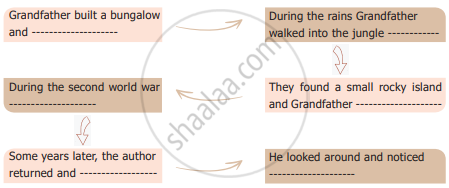
When Amma said,'Don’t upset our foreign visitor' she meant______.
Narrate the story based on the story map
The wild boar settled down scraping the hole into a ______ to have a good sleep.
The poor farmer’s crop was______.
In the Earth, we get water from ______.
The girl was badly hurt.
Why did the girl reply haughtily?
What is Amar Jawan Jyoti?
What was the epidemic that broke out in the story?
Find the rhyming word from the poem.
Country - ______.
The Chinese troops attacked the lonely Indian post located in ______.
According to the Indian army, Jaswant is still serving.
Read scene I of the play carefully and answer the question below.
Match the following.
| Sr.No. | CHARACTER | TRAIT |
| a. | Father Wolf | with a grey nose…feeds her four cubs |
| b. | Tabaqui | the big one from Waingunga River with a lame foot |
| c. | Mother Wolf | the chief of the Wolves |
| d. | Shere Khan | begs for meat and thanks for the meal/warns the wolves about the arrival of Shere Khan |
The robot did not obey his master.
What does it sing?
What did Anitha eat in the expo?
Choose the odd one out.
Connect and write the homophones in the box.
|
Sea |
 |
|
One |
 |
|
Flower |
 |


Identify the character/speaker.
He set the fish free.
What was the lesson learnt by Uthaman?
______ over heard her father’s talking on the phone about the robbery.
Answer the following yes or no question.
Did Bujju realise his mistake?
Meena’s father was a fisher man.
Where did Kani see the old cracked cup?
The villagers took oath not to harm the _______.
Fill in the blank
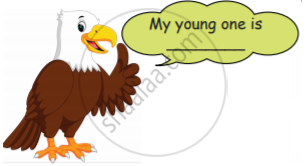
When do you feel proud?
Try your own.

The king shouted at Ani.
Read the passage carefully and answer the following question.
What is the main idea of the story?
Name the animal and sound it makes.
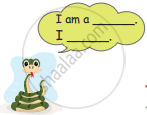
Name the animal and sound it makes.
Write the word with same meaning.

Torch
Name a few things that sink.
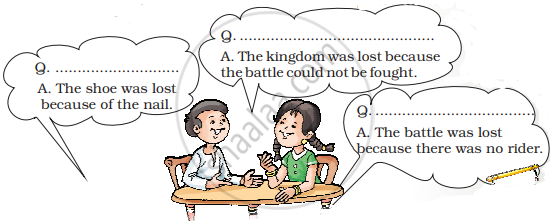
Read the poem.
For Want of a Nail
For want of a nail, the shoe was lost,
For want of a shoe the horse was lost,
For want of a horse, the rider was lost,
For want of a rider, the battle was lost,
For want of a battle, the kingdom was lost,
And all for the want of a horseshoe nail!
[traditional rhyme]
Now form questions for the answers given in the speech bubbles.
How does Tagore acknowledge Gandhi’s noble work?
Read the given sentence and underline the 'no' word.
Nobody is at home.
