Advertisements
Advertisements
प्रश्न
Write the appreciation of the poem.
- About the poem/poet/title
- Theme
- Poetic devices, language, style
- Special features/novelties/focusing elements
- Values, message
- Your opinion about the poem.
Advertisements
उत्तर १
Appreciation of the poem 'The Planners'
The poem, 'The Planner', is a criticism of modernisation at the cost of the country's history and heritage. The poet, Boey Kim Cheng, is an Australian poet of Chinese descent, born in Singapore. He expresses his disapproval of the unyielding building projects carried out by the planners. The poet's country, Singapore, is being turned into a concrete jungle and losing its past in the process. The poem revolves around the theme of the preservation of history and nature against the onslaught of urbanisation. Though improvement is essential for a country, it should not come at the expense of losing its roots. And this is precisely what the poet is trying to convey through the poem. The poet has used a number of poetic devices like Alliteration, Antithesis, Inversion, Irony, Onomatopoeia, Oxymoron, Paradox, Personification, Repetition, and Tautology.
The language used by the poet is positive, but the tone is that of sarcasm. By portraying history and heritage as flawed, blemished, and useless, the poet is, in reality, mocking the planners; because it is the planners who are thoughtlessly destroying the past in their craze for a perfect future. The poet has written the poem in short lines, which show his curtness in criticising the planners and also the planners' desire to build ceaselessly. The line 'They plan. They build' is an example of this as it shows the inconsiderate action of the planners implementing their plans without factoring in the people's opinion.
The poet has used literary devices imagery and extended metaphor to clearly convey his emotions. The mathematical reference in the first stanza creates the visual image of all the structures being crammed into grids of various sizes, making them appear confined. The extended metaphor of dentistry in the second stanza conveys that the planners' treatment of the ancient structures in the city is the same as a dentist's treatment of a rotten tooth. The planners are adept at erasing blemishes and filling gaps to create a country with perfectly aligned buildings and numbing the people's senses so that they don't feel the pain of this transformation. In the last stanza, the poet says in a melancholic yet sarcastic tone that the new city does not inspire his creativity and that is why he would not stain this perfectly-structured world with his poetry.
The poet conveys the message of not losing the past in this day and age of modernisation, because without the past, a country would be nothing but a cluster of lifeless structures.
In my opinion, this poem is a fine read as it focuses on the severe consequences of rapid urbanisation on the history of a country, rather than the more commonly known effects on the environment.
उत्तर २
Appreciation of the poem "Nose versus Eyes‟
William Cowper satirises the judiciary in his poem "Nose versus Eyes." The theme focuses on court proceedings when decisions are made without giving them much thought. The poem has a 'abab' rhyme system, which gives it a melodic flow. The poem's use of imagery, similes, personification, and inversion are its most noteworthy elements. Although inversion has been employed to preserve the rhyme scheme and enhance poetic value, imagery aids in giving readers a clear mental image of the court scene.
The personification of the tongue, nose, and eyes is the poem's main feature. Each of them has a character that is entirely appropriate and contributes to the poem's hilarious quality. The poem makes fun of the legal system, but its main point is to warn the reader about the dangers of selective hearing in general and to use sound judgement. The poem also exposes the legal system's shortcomings in administering justice.
The phrases "then shifting his side, as a lawyer knows how" and "what were his arguments few people know" make this very clear. The poem's irony is that the person who didn't need it—the nose—was given the benefit of the doubt. The eyeballs were subjected to injustice in a court of justice. On the surface, the poem seems humorous, yet a deeper reading reveals its depth.
APPEARS IN
संबंधित प्रश्न
Imagine that you are Santosh Yadav, or Maria Sharapova. You have been invited to speak at an All India Girls’ Athletic Meet, as chief guest. Prepare a short speech to motivate the girls to think and dream big and make an effort to fulfil their dreams, not allowing difficulties or defeat to discourage them. The following words and phrases may help you.
• self confident/confidence/sure of yourself
• self assured/assurance/belief in yourself
• morale/boost morale/raise morale
• giving somebody a boost/fillip/lift
• demoralising/unsure of yourself/insecure/lack confidence
What is the tone of the poem?
Is there any significance of the logs of wood in the hands of the six people?
What are these bangles for? Why has the poet repeated the word happy in the last line here?
What do you think of the old man’s point of view?
How was the great victory a personal tragedy for Kaspar?
The caged bird sings with
A fearful trill of things unknown
But longed for still and his
Tune is heard on the distant hill
For the caged bird sings of freedom.
Read the above lines and answer the question that follow.
What parallel can be drawn to the poet’s feelings and that of the caged bird?
The air broke into a mist with bells,
The old walls rocked with the crowd and cries.
Had I said, "Good folk, mere noise repels....
But give me your sun from yonder skies!"
They had answered "And afterward, what else?"
Read the above lines and answer the question that follow.
Explain with reference to the context.
Identify the figures of speech in the following lines from the poem.
(a) Awoke one night from a deep dream of peace.
(b) Making it rich, and like a lily in bloom.
In how many ways was this Olympic special? Explain?
She laid the table after she had finished the cooking. (Begin: When…)
Fill in each of the numbered blanks with the correct form of the word given in brackets. Do not copy the passage, but write in correct serial order the word or phrase appropriate to the blank space.
Example:
(0) He had been (0) ……… (sit) on the bank of a small irrigation canal.
Answer: sitting
He was (1) ………. (gaze) at a couple of herons (2) ……… (fish) in the muddy water, when he (3) ……… (feel) something bumps his elbow. (4) ……… (look) around, he (5) ………. (find) at his side a little goat, jet black and soft as velvet with lovely grey eyes. Neither her owner nor her mother (6) ……… (be) around. She continued to (7) ……… (nudge) Mukesh, so he (8) ……… (look) in his pocket for nourishment.
We have had to respect for nature. Now we are suffering from the effects of global warming.
Give reasons for the following.
Carter had to chisel away the solidified resins to raise the king’s remains.
Given below is an interesting combination of words. Explain why they have been used together.
ritual resins
Some of the leaves and flowers mentioned in the passage for adorning the dead are willow, olive, celery, lotus, cornflower. Which of these are common in our country?
What is the poet’s feeling towards childhood?
Explain the following phrase
Turned to dust
Use it in a sentence of your own.
Discuss in pairs or in small groups
The eccentricities of the old are often endearing.
Examine the pieces of conversation in the story. How do they reflect the world view of each of the speakers?
Write four to six lines of Free Verse on the topic ‘The road that leads to my college’. Express that it is the road to knowledge and bright future. You may begin like this: Every day I tread with the bag of books …
What is a space shuttle? Name the shuttle which took Kalpana in space.
The poet says, “Beauty is heard in …”
Can you hear beauty? Add a sound that you think is beautiful to the sounds the poet thinks are beautiful.
The poet, Keats, said:
Heard melodies are Sweet,
But those unheard are sweeter.
What do you think this means? Have you ever heard a song in your head, long after the song was sung or played?
Find words in the story, which show things striking violently against each other.
The cobra struck the crow, his snout th___ing against its body.
State whether the following statement is true or false. Correct the false statement.
There is nothing wrong with being grateful to great men.
State whether the following statement is true or false. Correct the false statement.
One man one vote and one vote one value.
The cherry tree is a narrative poem. Features that make it a narrative poem are given below. Justify them with proper examples.
Different places are mentioned.
Write an appreciation of the poem considering the following points:
- About the poem/poet/title.
- Theme
- Poetic devices, language, style
- Special features/ novelties/focusing elements
- Values, message
- Your opinion about the poem.
‘Earth has not anything to show more fair.’
This line expresses the poet’s feelings. The sight he saw from the bridge is beautiful. There are a few more lines similar to the above. With the help of your partner find them and discuss what they express.
Place the given areas of questioning from the list in the appropriate columns.
- future plans
- inspiration
- overcoming hurdles/ struggle
- coach/ mentor/ guide/ teacher
- message for the youngsters
- family support
- alternate career choice
- first or maiden award/ achievement /success /setbacks
- a turning point in life/ success formula/technique.
| Section of the interview | Aspects to be covered | |
| 1. | Introduction | Welcoming/Greeting, Introduction of the guest/Occasion. |
| 2. | Opening questions | |
| 3. | Main body | |
| 4. | Concluding questions | |
| 5. | Summing up | Concluding the statement, Expressing gratitude. |
You can add your points.
The setting of the act is the office of the newspaper 'The Herald'. Explain how it is the proper background for the theme of the play.
Given in a mixed order below are some good human attributes of the family. Pick out from the box and write it against the line that reflects it.
Thinking ahead of winter, the father decided to create a place safe from the elements.
Prepare and present a short speech on the following.
How I accomplished a difficult task.
Local Historians
- Ask students to collect stories about their town from older people.
- Ask them to find out how the streets were named.
- Are there any interesting people or legends to which the street names refer?
- Are there any local places in town about which people tell stories?
- Any haunted houses?
- Let students find out when the town was founded and by whom.
- Visit a local historical society to see old photographs or artifacts.
Let students create an original historical fiction:
Describe the town from the point of view of a fictitious citizen who might have lived in the town long ago. Include local issues of the time in the story. Write the story of the town from the fictionalized point of view of a resident who actually lived.
Read the informal letter given below.
|
Sender’s address: 15, Beach Road Salutation: Dear Rosy, Body of the letter: How are you? I am fine. I couldn’t write earlier, because I was very busy. I like my new home. It is a lovely house. I have a big bedroom looking over the garden. I helped Mummy paint the bedroom walls yesterday. We chose a pretty yellow. A boy called Sundar lives next door. He likes animals not just like we do but even more. He says he is going to be a Vet when he grows up. I am still thinking about being a writer. Do you want me to send the story I am writing. It is all about Ooty – the Queen of Hill Stations. Write soon. I am looking forward to hear all your news. Subscription: Yours lovingly Signature: Mangai |
Now write a reply to Mangai.
| Sender’s Address | |
| Date | |
| Salutation | |
| Body of the letter | |
| Subscription | |
| Signature |
Use the following clues to complete the following exercise.
| play | stop | buy | learn | see | meet | learn |
| be | eat | go | travel | start | read | visit |
Write three things you have not done in the last three years.
- I have not played ______
- ____________
- ____________
You woke up one morning and found yourself in the land of dwarfs!
Write a paragraph describing your experiences there and how you got back home finally. You may begin like this.
Everything around me looked different. ______
Look for words in the poem which sound like the words given below.
- are ______
- there ______
- flour ______
- where ______
- son ______
- threw ______
In the sentence below the capital letter, comma, full stop and question mark are missing. Put these in the correct place.
on monday i will go to school
Fill in the blank with choosing the preposition from the option.
This tree was the home a flock ______ wild geese.
See the picture Travel Time below. Answer the questions that follow.
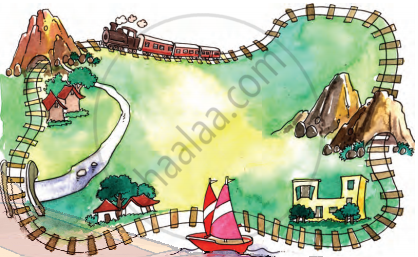
- Where did you go for an excursion/holiday?
- With whom did you go?
- What did you take with you?
- What was the first thing you saw when you reached your destination?
- What did you like best about the place?
- How long did you stay there?
- What did you miss about home?
Read the following sentences.
- Bhaiya has been studying in the same class for two years. (for a period of time)
- Munna was flying kites since morning. (from a time in the past till the present)
Choose a story that you like.
In groups of four, write down dialogues for the story and make it into a short play. You may then present it in the class.
Find one story of bravery about a child. You can search for the story by talking to older people or watching a TV programme or from a film.
- Write down the story. Also, mention its source.
- Narrate the story to the class.
- Which story did you like the best? Write down your reasons.
The ______of flowers was lying on the table.
The old man shouted ______[loud]
Why did K.C’s words shock Sletherby?
Write conversation on the following situation.
Between two friends about planting trees
How do you behave under the spells of different moods?
Aunt Jane seemed to think that there was a mistake in the wedding present she had given Jack. Why?
Answer the following question as briefly as possible and with close reference to the relevant text.
“Then paint the cut with iodine.” With reference to this line, what is your understanding of Klausner? Do you sympathise with him? Give your reasons.
Write an e-mail to the Principal of a neighbouring school inviting their pupils to attend the classes if they so wish. Give all details of the classes to be held.
To whom does Portia compare Bassanio as he steps forward to take the casket test?
Life is a series of choices that we make every day. Narrate an incident when you had to make a difficult choice. Elaborate on the positive impact it had on you.
Your younger sister wants to eat something tasty. You are telling her the recipe of one such food item. Prepare a dialogue about it.
What provisions should be made in public places so that everyone gets the same access to public facilities?
What do you like better - to listen to a joke, or to tell a joke?
What makes you happy?
Imagine someone has invited your family to a programme, and you were the only person at home when the invitation was given orally.
Write a note (4-5 lines) to pass on the message to the other people in your family. Or, Write an imaginary conversation in which you pass on the message to your parents.
Write a composition (in approximately 400 – 450 words) on the following subject.
You had to go on a train journey with your family. On reaching the railway station, you discovered that your train was delayed by two hours. Describe how you spent those two hours, detailing what you saw, the sounds you heard, and the interactions you had with the people around you. Express your feelings when you saw the train finally approaching the station.
