Advertisements
Advertisements
प्रश्न
Read the information in the table below and answer the following questions.
| Sl. No | Event | Year | Affected Area |
| 1. | Earthquake | 2001 | Bhuj, Gujarat |
| 2. | Tsunami | 2004 | Coastline TN, Kerala, A.P., A&N Islands, Pondicherry |
| 3. | Floods | July 2005 | Maharashtra |
| 4. | Earthquake | 2008 | Kashmir |
| 5. | Floods | 2008 | North Bihar |
| 6. | Cyclone | 2008 | Tamil Nadu |
| 7. | Floods | 2009 | Andhra Pradesh & Karnataka |
| 8. | Cyclone | 2011 | Tamil Nadu/Cuddalore |
| 9. | Flash floods | June 2013 | Uttarkhand |
| 10. | Cyclone | Oct. 2013 | Coastline of Orissa & Jharkhand |
| 11. | Floods | Dec. 2015 | Tamil Nadu/Chennai |
| 12. | Cyclone | Dec. 2016 | Tamil Nadu/Chennai |
- What kinds of natural disasters have occurred before 2005?
- Name the disasters that are common in India.
- Mention the states often affected by disasters.
- List out the disasters that are common in North India
- Write three sentences on your inference about the data given.
Advertisements
उत्तर
- Earthquake and Tsunami have occurred before 2005.
- Floods and cyclones are common in India.
- Tamil Nadu and Andhra are often affected by disasters.
- Earthquakes, floods, and flash floods are common in North India.
- Coastal towns in Tamil Nadu, Andhra, and Orissa are often plagued with cyclones and floods. Kashmir and Gujarat were affected by earthquakes about 15 years ago. Cyclones and floods happen often in South India in the coastal belt.
APPEARS IN
संबंधित प्रश्न
Here is a topic for you to
1. think about;
2. give your opinion on.
Find out what other people think about it. Ask your friends/seniors/parents to give you their opinion.
‘Career Building Is the Only Goal of Education.’
Or
‘Getting a Good Job Is More Important than Being a Good Human Being.’
You can use the following phrases
(i) while giving your opinion:
• I think that...
• In my opinion...
• It seems to me that…
• I am of the view that...
• As far as I know...
• If you ask me...
(ii) saying what other people think:
• According to some...
• Quite a few think...
• Some others favour...
• Thirty per cent of the people disagree...
• Fifty per cent of them strongly feel...
(iii) asking for others’ opinions:
• What do you think about...
• What do you think of...
• What is your opinion about...
• Do you agree...
• Does this make you believe...
Fill in each blank with the suitable word.
He broke _____________ in the middle of his speech at the function.
Do you consider the title apt?
What social and ecological benefits of planting a tree does the poet refer to?
What do you think of the old man’s point of view?
Explain and discuss the themes of the poem.
What is the rhyme scheme of the poem?
In how many ways was this Olympic special? Explain?
(A) He knew the culprit but refused to admit it.
(B) Although………………………..
Infer the meaning of the following words from the context.
| Padding | transient |
Now, look up the dictionary to see if your inference is right.
Notice these expressions in the text. Infer their meaning from the context.
-
anecdote
-
delicate realism
-
figurative painting
-
illusionistic likeness
-
conceptual space
What does the phrase “strange to tell” mean?
Notice this expression in the text. Infer its meaning from the context.
a holistic and ecological view
Identify the words in the advertisement that gave away the fact that it was placed by John Garrideb.
Complete the table. One is done for you.
| The World around you | What we should aim to be | |
| 1. | Callous | Caring for people, environment, life |
| 2. | Violent | |
| 3. | Greedy | |
| 4. | Corrupt |
Complete the following sentences.
The factors that have made 'The Jungle Book' a great movie are - _________________.
- It's a fantasy world of wonder.
- _____________________________
- _____________________________
- _____________________________
Pick outlines from the poem that help create images of the following in our mind and write them in the table.
| No. | Old Woman | The Street | Schoolboys |
| 1. | |||
| 2. | |||
| 3. |
Find and write the descriptions of different people given in this story.
Answer the following question :
What are the two ways of avoiding fear?
Write the reason in your own words.
After the song, Ostad had vanished.
Imagine you are the lion and someone is interviewing you.
Write the answer to the following question.
Who were your companions on the way to Oz?
Create a Personal Particular for your class with support from your teacher and collect personal and educational information.
What are the themes of the singers’ songs?
Punctuate the following sentence.
wasn't tim born on the 26th of january 1989.
Some word have similar sound, but different meaning. Choose the correct word from the option and fill in the blank.
The King sits on the ______.
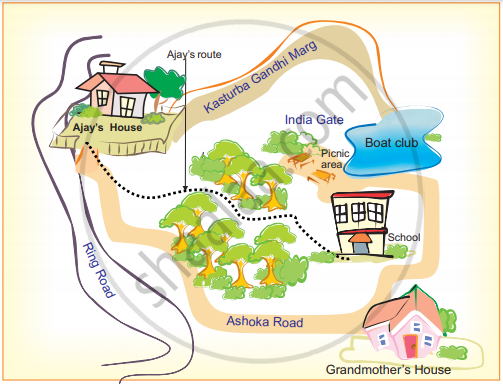
Use the above map to answer the questions.
- What does the dotted line on the map show?
- What road would Ajay take to get to the boat club?
- What building is next to the picnic area?
- What road passes by Ajay’s house?
- What other way could Ajay use to get from his house to his grandmother’s house?
Now write:
Use verbs like go, turn, cross
Use prepositions like: across, between, in front of, beside, near, behind, and write how you get home from school.
To your shock, you find out that your close friend is indulging in some wrong activity. Will you avoid him/her or try to correct him/her? Give reasons for your answer.
According to Mary Kom, what was the reason for her losing in the finals?
Answer the following question as briefly as possible and with close reference to the relevant text.
How does Prospero prove, “the rarer action is in/virtue than in vengeance” in the final act of The Tempest?
Write a composition (in approximately 400 – 450 words) on any one of the following subjects.
You become what you read. Present your reflections on this statement.
