Advertisements
Advertisements
Question
Write the appreciation of the poem.
- About the poem/poet/title
- Theme
- Poetic devices, language, style
- Special features/novelties/focusing elements
- Values, message
- Your opinion about the poem.
Advertisements
Solution 1
Appreciation of the poem 'The Planners'
The poem, 'The Planner', is a criticism of modernisation at the cost of the country's history and heritage. The poet, Boey Kim Cheng, is an Australian poet of Chinese descent, born in Singapore. He expresses his disapproval of the unyielding building projects carried out by the planners. The poet's country, Singapore, is being turned into a concrete jungle and losing its past in the process. The poem revolves around the theme of the preservation of history and nature against the onslaught of urbanisation. Though improvement is essential for a country, it should not come at the expense of losing its roots. And this is precisely what the poet is trying to convey through the poem. The poet has used a number of poetic devices like Alliteration, Antithesis, Inversion, Irony, Onomatopoeia, Oxymoron, Paradox, Personification, Repetition, and Tautology.
The language used by the poet is positive, but the tone is that of sarcasm. By portraying history and heritage as flawed, blemished, and useless, the poet is, in reality, mocking the planners; because it is the planners who are thoughtlessly destroying the past in their craze for a perfect future. The poet has written the poem in short lines, which show his curtness in criticising the planners and also the planners' desire to build ceaselessly. The line 'They plan. They build' is an example of this as it shows the inconsiderate action of the planners implementing their plans without factoring in the people's opinion.
The poet has used literary devices imagery and extended metaphor to clearly convey his emotions. The mathematical reference in the first stanza creates the visual image of all the structures being crammed into grids of various sizes, making them appear confined. The extended metaphor of dentistry in the second stanza conveys that the planners' treatment of the ancient structures in the city is the same as a dentist's treatment of a rotten tooth. The planners are adept at erasing blemishes and filling gaps to create a country with perfectly aligned buildings and numbing the people's senses so that they don't feel the pain of this transformation. In the last stanza, the poet says in a melancholic yet sarcastic tone that the new city does not inspire his creativity and that is why he would not stain this perfectly-structured world with his poetry.
The poet conveys the message of not losing the past in this day and age of modernisation, because without the past, a country would be nothing but a cluster of lifeless structures.
In my opinion, this poem is a fine read as it focuses on the severe consequences of rapid urbanisation on the history of a country, rather than the more commonly known effects on the environment.
Solution 2
Appreciation of the poem "Nose versus Eyes‟
William Cowper satirises the judiciary in his poem "Nose versus Eyes." The theme focuses on court proceedings when decisions are made without giving them much thought. The poem has a 'abab' rhyme system, which gives it a melodic flow. The poem's use of imagery, similes, personification, and inversion are its most noteworthy elements. Although inversion has been employed to preserve the rhyme scheme and enhance poetic value, imagery aids in giving readers a clear mental image of the court scene.
The personification of the tongue, nose, and eyes is the poem's main feature. Each of them has a character that is entirely appropriate and contributes to the poem's hilarious quality. The poem makes fun of the legal system, but its main point is to warn the reader about the dangers of selective hearing in general and to use sound judgement. The poem also exposes the legal system's shortcomings in administering justice.
The phrases "then shifting his side, as a lawyer knows how" and "what were his arguments few people know" make this very clear. The poem's irony is that the person who didn't need it—the nose—was given the benefit of the doubt. The eyeballs were subjected to injustice in a court of justice. On the surface, the poem seems humorous, yet a deeper reading reveals its depth.
APPEARS IN
RELATED QUESTIONS
Which of these words would you use to describe Santosh Yadav? Find reasons in the text to support your choices, and write a couple of paragraphs describing Santosh’s character
| contented | determined | resourceful | polite | adventurous | considerate |
| weak-willed | fearful |
independent |
pessimistic |
patient | persevering |
Your friend has not fared well in the recent examinations. Write a letter to him/her expressing your concern. Give him/her some advice on how to score better marks and offer to help him/her to improve his/her performance.
Write an e-mail to the Principal of a neighbouring school requesting him/her to send a team of three members to participate in the Quiz Competition.
What are the poetic devices (figurative language) in the poem? How do they contribute to the meaning/how do they effect the poem?
Why did the men keep back their sticks?
Which literary device is used in the last two lines:
Tinkling, luminous, tender, and clear, Like her bridal laughter and bridal tear.
Explain and analyse the use of hyperbole in the poem.
Explain what is imagery in a poem. Flow has Angelou used it in the poem?
Thus I entered, and thus I go!
In triumphs, people have dropped down dead,
"Paid by the world, what dost thou owe
Me?"....God might question; now instead,
'Tis God shall repay: I am safer so.
Read the above lines and answer the question that follow.
What does the rain imagery signify?
Thus I entered, and thus I go!
In triumphs, people have dropped down dead,
"Paid by the world, what dost thou owe
Me? "....God might question; now instead,
'Tis God shall repay: I am safer so.
Read the above lines and amswer the question that follow.
Give an example of Antithesis from the poem ‘The Patriot: An Old Story.’
Fill in the blank with an appropriate word:
The young man put the flute _______ his lips and began to play.
Fill in the blank with an appropriate word:
The cyclist rode quickly ______ the path.
Join the following sentence to make one complete sentence without using and, but or so.
The child helped her mother to make breakfast. She washed the tomatoes.
Since her childhood, Meera has been good in Mathematics.
(End: ............................ childhood)
He had plenty of wealth but he was not happy.
(Begin: In spite............................................ )
What difference did you notice between the reaction of the adults and the children when faced with danger?
Given below is an interesting combination of words. Explain why they have been used together.
eternal brilliance
Some of the leaves and flowers mentioned in the passage for adorning the dead are willow, olive, celery, lotus, cornflower. Which of these are common in our country?
Which local bird is like the goldfinch.
Why is the image of the engine evoked by the poet?
Answer the following question:
“It was to be a battle of champions.” (8)
(i) What qualities did the two champions have? Pick out words and phrases from the paragraph above this line in the text and write them down.
|
Mongoose |
Cobra |
| (a) ________ | (a) ________ |
| (b) ________ | (b) ________ |
| (c) ________ | (c) ________ |
(ii) What did the cobra and the mongoose do, to show their readiness for the fight?
Look at your hands carefully. Now, write down for each finger one action for which that finger is particularly important. For example, the second (or index) finger helps to hold the knife down firmly when cutting.
After reading the text one can easily understand that there is a lot of risks involved in mountaineering. Write in short about any adventure sport that you like and the risk involved in it.
Planting and growing more crops a year seems to be progressed by normal standards, but the chapter makes a case against it. Give reasons.
Search in your college library or on the internet for at least five stories where a king or any great person has forgiven a losing king, culprit, or offender. There are many such stories that you might have read in your history books. One such story is of Alexander and Porus. Find at least five stories and write their summarised version in your notebook.
Read and understand the following poem ‘Paper Boats’ and write its paraphrase in your own simple language. (You may take the help of a dictionary or the internet.) The first line is done for you.
(Day after day, one after another, I sail paper boats on the stream of flowing water.)
Your examinations are only two months ahead. Plan your schedule of studies and write in your notebook.
Given in a mixed order below are some good human attributes of the family. Pick out from the box and write it against the line that reflects it.
The father told Fritz, the gourds would make excellent bowls and spoons and they cut them into various utensils ______________________.
Maintain a diary at least for a week. Write about your interactions with other people in your surroundings in 3-4 lines. Also write whether you find the interactions happy unhappy, satisfactory-unsatisfactory, enjoyable-stressful, etc.
Write the reason in your own words.
Akbar strongly desired to hear Ostad sing.
Form groups of 3. Read aloud the conversations in the story, each group presenting one piece of conversation.
Following are the ways to preserve ‘World Heritage Sites.’ Transfer these points into a small paragraph. Suggest a suitable title.
- Practical conservation of posterity
- Human/animal trespassing
- Unmonitored/uncontrolled/unrestricted access
- Threat of local administrative negligence
How can you prove this maxim to be incorrect - ‘Too many cooks spoil the broth’. Write a counterview on the given topic. (Clue - Teamwork)
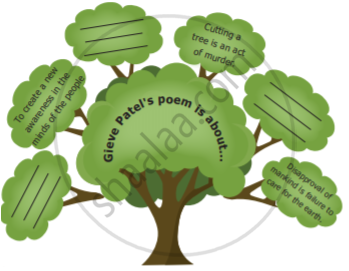
Based on the reading of the poem, complete the web chart given below.
Look at the image of the familiar advertisement given below. Identify the product and try to frame your own slogan for them.

Write an article for the following.
You are Jansi/Avinash of Class X studying in GHSS, Chengalpet. You believe that physical activities improve our health and reduce the risk of sickness. It has got immediate and long-term benefits. Write an article in not more than 150- 200 words for your school magazine stressing the importance of physical activities in a student day to day life.
Local Historians
- Ask students to collect stories about their town from older people.
- Ask them to find out how the streets were named.
- Are there any interesting people or legends to which the street names refer?
- Are there any local places in town about which people tell stories?
- Any haunted houses?
- Let students find out when the town was founded and by whom.
- Visit a local historical society to see old photographs or artifacts.
Let students create an original historical fiction:
Describe the town from the point of view of a fictitious citizen who might have lived in the town long ago. Include local issues of the time in the story. Write the story of the town from the fictionalized point of view of a resident who actually lived.
You have prepared some eco-friendly craft materials like paper mache dolls, greeting cards, book marks, festoons, garlands, quilling jewellery etc for an Art Mela to be conducted in your school premises. Describe in a few sentences how you made the craft work. Include the following details in your writing.
- Name of the craftwork
- Materials used
- Nature (handy / eco-friendly / longlasting / affordable price )
- Use (place / person / time)
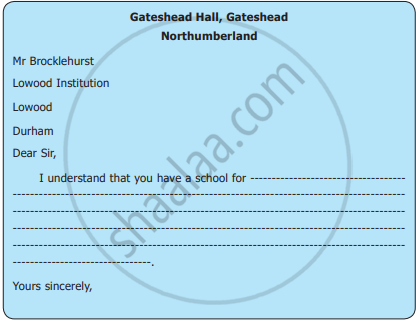
Read scene I. Discuss with your partner what Mrs Reed might write about Jane in her letter to the owner of a school. Now complete her letter to Mr. Brocklehurst.
Trees can help you recognise seasons. How do the trees look different in each season? Write a short paragraph with the clues given below.
- Summer - Trees stretch their leafy branches towards the sun.
- Spring - Branches are full of new green leaves.
- Rain - Trees absorb water and look green.
- Autumn - Trees shed their leaves.
Fill in the blank by choosing the preposition from the option.
The frogs jumped ______ the well.
Did you observe that in the poem, the last words in every second and fourth line rhyme with each other?
Can you write a four-line poem?
Connect the pairs of sentences below using and or but.
- Sheila got some chocolates for her birthday.
- She got some new clothes too.
Discuss and write –
- Why do cats and dogs fight?
- Why do we walk across the road, not run?
- Why do people like ice-cream?
Where do the following live ?
- Birds live in
- Rabbits live in
- Beavers live in
Look at this sentence –
A library is a place where books are kept.
Now fill in the blanks after reading these sentences.
- An ______ is a place where aeroplanes take off and land.
- A ______ is a place where food is cooked.
- A ______ is a place where sick people are taken care of.
- A______is a place where you can buy thing.
- A______ is a place where children study.
What is your favourite book? Write down the name of the book. Then write down the story.
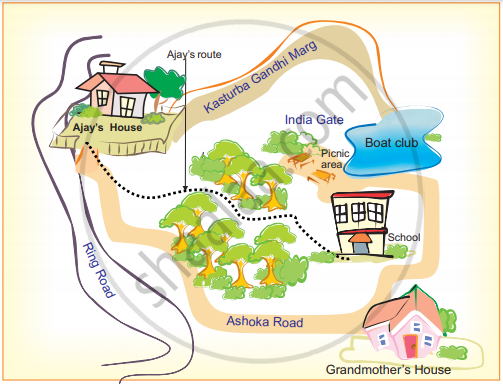
Use the above map to answer the questions.
- What does the dotted line on the map show?
- What road would Ajay take to get to the boat club?
- What building is next to the picnic area?
- What road passes by Ajay’s house?
- What other way could Ajay use to get from his house to his grandmother’s house?
Now write:
Use verbs like go, turn, cross
Use prepositions like: across, between, in front of, beside, near, behind, and write how you get home from school.
What do you expect your close friends to do for you? Beautify the petals with your thoughts.

To your shock, you find out that your close friend is indulging in some wrong activity. Will you avoid him/her or try to correct him/her? Give reasons for your answer.
What was Sletherby’s response to Bertie’s request?
Explain the following phrase selected from the story in your own word and work with a partner to make sentence using these phrase:
making up for lost time
How did Woman 5 move ahead in the waiting list of patients?
Read the information in the table below and answer the following questions.
| Sl. No | Event | Year | Affected Area |
| 1. | Earthquake | 2001 | Bhuj, Gujarat |
| 2. | Tsunami | 2004 | Coastline TN, Kerala, A.P., A&N Islands, Pondicherry |
| 3. | Floods | July 2005 | Maharashtra |
| 4. | Earthquake | 2008 | Kashmir |
| 5. | Floods | 2008 | North Bihar |
| 6. | Cyclone | 2008 | Tamil Nadu |
| 7. | Floods | 2009 | Andhra Pradesh & Karnataka |
| 8. | Cyclone | 2011 | Tamil Nadu/Cuddalore |
| 9. | Flash floods | June 2013 | Uttarkhand |
| 10. | Cyclone | Oct. 2013 | Coastline of Orissa & Jharkhand |
| 11. | Floods | Dec. 2015 | Tamil Nadu/Chennai |
| 12. | Cyclone | Dec. 2016 | Tamil Nadu/Chennai |
- What kinds of natural disasters have occurred before 2005?
- Name the disasters that are common in India.
- Mention the states often affected by disasters.
- List out the disasters that are common in North India
- Write three sentences on your inference about the data given.
You come across an advertisement in the newspaper. A Publishing House in Chennai has brought out a paperback edition of the complete works of Khushwant Singh. You want to buy it. You are asked to send a Demand Draft for Rs.1000/- Fill in the following challan for the DD in favour of ‘X Publishing House, New Delhi’, payable at Chennai. The surcharge for Rs.1000/- is Rs.25/-.

Preparation of apple juice
You plan to delight your parents and sister, serving them chilled apple juice. Here is the process: (Complete the sentences with the right form of the verbs)
Four or five apples ______ (take) and ______(wash) well. They ______(wipe) dry and cut into pieces of medium size. The seeds ______(remove). Then the apples ______(put) into the mixer. Some milk ____(add) .The apples ______(crush) and a fine liquid ______(obtain). This liquid ______(filter) and the juice ______(store) in the refrigerator. It is ______(take) out whenever needed, and after adding sugar, it ______(serve) in cups.
"That which we obtain too easily, we esteem too lightly. It is dearness only which gives everything its value."- Thomas Paine
Do we value only what we struggle for? Plan your response, and then write an essay to explain your views on this issue. Be sure to support your position with specific points and examples. (You may use examples from your reading, observations, and inputs from subjects such as History, Science and literature)
You are the editor of your school magazine. You want to bring about awareness among the students on the topic -Noise Pollution: A threat to all life forms. Write an article in about 300 words based on the following points:
Causes of noise pollution - effects on humans - effects on other living creatures - measures to reduce noise pollution - role of authorities - conclusion.
What strategies do you use when you study on your own?
