Advertisements
Advertisements
प्रश्न
‘My Favourite Place’
Read again the paragraphs of the story in which the author describes the banyan tree, and what he used to do there. Is there a place in your house, or in your grandparents’ or uncles’ or aunts’ houses, that you specially like? Write a short paragraph about it, saying
- where it is
- what you do there
- why you like it
You may instead write about a place you dislike, or are afraid of.
Advertisements
उत्तर
My Favourite Place
I have an uncle in Delhi. I go there during the summer vacation. My uncle’s house has a small but beautiful library. It has many books. Among them are the books specially meant for children. There are interesting story books. Whenever I go to my uncle’s, my afternoons are invariably spent in this library. I have already read quite a few books such as Gulliver’s Tales and Farm House. I like this place most because I love reading books.
संबंधित प्रश्न
You want to start a new club at your school.
Write a letter to your principal requesting permission to start the club, explain your role in it and give reasons to prove that the club will be beneficial for the school.
Whose family has been referred to earlier in the context?
Whose dirty looks are referred to?
Why does the poet use the word ‘wandered’?
It was roses, roses, all the way,
With myrtle mixed in my path like mad;
The house-roofs seemed to heave and sway,
The church-spires flamed, such flags they had,
A year ago on this very day.
Read the above lines and answer the question that follow.
By which flower was the patriot welcomed?
Re-write the following sentence according to the instructions are given. Make other changes that may be necessary, but do not change the meaning of the sentence.
Naresh goes to a school that has over a thousand students.
(Begin: There……….)
Discuss in groups of four.
“Are we to leave our successors a scorched planet of advancing deserts, impoverished landscapes and an ailing environment?”
Look at the highlighted expressions in the following sentences from the text and explain their figurative meaning.
- 'I went through it, sir, with a fine-toothed comb and never a Garrideb could I catch.'
-
'They are my favourite covert for putting up a bird, and I would never have overlooked a cock pheasant as that.'
-
'There is no bolt-hole for you in this country.'
-
'When his castle in the air fell down, it burred him beneath the ruins.'
How did the narrator learn to distinguish between 'a flask' and 'a thermos'?
Complete the web highlighting the feelings/emotions of Tenzing after reaching the summit.
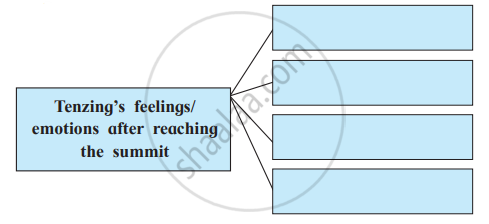
State whether the following statement is true or false. Correct the false statement.
There is nothing wrong with being grateful to great men.
Now read the beginning and end of a sci-fi story given below and complete the story using your imagination.
|
‘The Magic Glasses’ After ten years of diligent experimenting on ‘light’, Jayant, a brilliant scientist, created a pair of eye-glasses which would enable him to see through all opaque objects, doors, walls, metal structures, etc. On Monday, he put on his ‘magic’ glasses and stepped into the busy street outside ____________________________ ______________________________________________________ ______________________________________________________ ______________________________________________________ ______________________________________________________ And so, Jayant received the ‘State Award for Brave Citizens’ _____________________________________________ |
Make a poster of any natural disaster, giving details about the devastation caused.
Write a meaningful paragraph using the hints given below.
Mahesh – celebrates – 14th birthday – an old-age home – family, friends – informs home in advance – delegates tasks – friends buy things necessary – arrives home early – decorates place – balloons, colour papers – inmates gathered – cuts cake – sing-song, claps – distributes cakes – expresses his feelings – gets blessings – offers things – bedsheets, footwear, etc. needed – fun, entertainment – happy and content.
Develop the following hints.
A wood cutter - cutting wood - dropped his axe in the pond - started weeping - an angel appeared - asked what the matter was - brought a golden axe - from the pond - wood cutter did not accept - brought a silver axe - not accepted - brought an iron axe - accepted - pleased with the honesty - offered all the axes to him.
The word in the sentence is jumbled. Write them in order.
was afraid I now.
Explain the following phrase selected from the story in your own word and work with a partner to make sentence using these phrase:
a tinge of coldness
Why do patients leave the clinic without meeting the dentist?
The poet immortalizes the tree. Elucidate.
Write the full form for the following.
who's - ______
