Advertisements
Advertisements
प्रश्न
State whether the following statement is true or false. Correct the false statement.
There is nothing wrong with being grateful to great men.
पर्याय
True
False
Advertisements
उत्तर
There is nothing wrong with being grateful to great men - True.
APPEARS IN
संबंधित प्रश्न
Transform the following sentence as per the given instruction.
The old woman said to Arun, “Can you help me to cross the street?”
(Begin: The old woman asked Arun……………….)
Explain and discuss the themes of the poem.
Which line(s)/stanza(s) do you enjoy most? Why?
What do you think is the message of the poem?
But a caged BIRD stands on the grave of dreams
His shadow shouts on a nightmare scream
His wings are clipped and his feet are tied
So he opens his throat to sing.
Read the above lines and answer the question that follow.
What is the main conflict in this poem?
The caged bird sings with
A fearful trill of things unknown
But longed for still and his
Tune is heard on the distant hill
For the caged bird sings of freedom.
Read the above lines and answer the question that follow.
Explain, ‘stands on the grave of dreams / his shadow shouts on a nightmare scream’.
What surprises Abou the next night? What message has the poet conveyed to all of us?
Write a composition (350 - 400 words) on the following:
Narrate an incident from your own experience when you helped to prepare a meal. Explain what you did and what you gained from the experience.
Fill in the blank with an appropriate word:
The dog was hiding __________ the bed, barking at the stranger.
Write a composition (350 - 400 words) on the following:
“The use of Mobile Phones must be allowed in schools.” Express your views either for or against the statement.
Fill in the blank with an appropriate word:
His teacher is very pleased ……… him.
I prefer going out with friends to staying alone at home.
(Begin : I would rather ………….)
Give an account of how Napoleon and his companions were unjust and cruel in their behavior towards the other animals.
Since her childhood, Meera has been good in Mathematics.
(End: ............................ childhood)
In what ways do you think we could help prevent the extinction of languages and dialects?
Write a letter to your friend narrating your experiences in a rescue operation.
Make a list of items that are referred to differently in British and American English, for example, 'lift' (BE) 'elevator' (AmE).
Your teacher will speak the word given below. Write against two new words that rhyme with it.
fast ______ ______
Multiple Choice Question:
What does the phrase in the extract ‘turned black’ mean here?
Use the phrase in a sentence of your own, after finding out its meaning.
spread across
The words in the box are all words that describe movement. Use them to fill in the blank in the sentence below.
The snake hissed, his forked tongue ____________ in and out.
Find out from your grandparents or parents the names of vegetables and fruits they had eaten in their childhood and mention how the vegetables and fruits are different from the one's today.
| Name of the vegetable or fruit | Shape | Colour | Taste |
| 1. | |||
| 2. | |||
| 3. |
Write a summary of the poem using the following points:
- Title
- Introductory paragraph (about the poem, type, nature, tone)
- Main body (central idea, the gist of the poem)
- Conclusion (opinion, views, appeal)
Prepare a poster on the need for the conservation of the Great Indian Bustard.
Write down the consequences of the following occurrences with the help of the play.
Aslaksen declares that he would not print Dr. Stockmann's article.
Give, in your own words, TWO reasons for each of the following :
The schoolboys were in a happy mood.
Write the reason in your own words.
Ostad’s song was more elating than Tansen’s songs.
Have you ever eaten any fruit/vegetable picking it straight from the tree or field? Write about that experience in 3-5 lines.
Prepare an announcement for an occasion like the one mentioned.
Form groups and discuss each element of planning an interview and prepare notes on each element.
- Format - Structure: ......................
- Size/Length - How much: ......................
- Do’s and Dont’s - Rules and Regulations: ......................
- Type of Questions - Yes/No questions or Wh Type: ......................
Write about a day when you felt very happy. Use the following questions to help you. Think/Recollect a day ............
Note down the points.
- Do you remember the exact day and date?
- Was it a special occasion or celebration?
- What happened on that day?
- How did you react to the things that happened on that day?
- How did other people react when they saw you were so happy?
- What did you do next ?
- What happened in the end?
- Describe any other emotions you felt that day
Now, with the help of the guidelines write a short paragraph of at least 100 words about that happy day. Give a suitable title for your narrative/write up.
Write a report of the following event in about 100-120 words.
You are the Coordinator of the Science Forum of your school. An event had been organized on account of National Science Day for the members of the forum. Now, write a report on the observation of “National Science Day” at your school.
What is the name of her diary?
Fill in the blank with choosing the preposition from the option.
“It would be a pity ______ destroy it now.”
Punctuate the following sentence.
when I went fishing I caught an old shoe a plastic bag and a bad cold.
Who said these words and to whom?
| Who said | To whom | |
| “Wake up, dear! Wake up fast!” | ||
| “Ma, who woke me up today?” | ||
| “Why do you sleep at nine every night?” |
Find one word from the story that means
- to walk fast h ___________ .
Give another word for the ones given below with similar meanings and make sentences. Now write the opposites of these describing words and make sentences with them –
| Opposite | Sentence | |
| lovely | ||
| talking | ||
| listening | ||
| see | ||
| centre |
Complete the following stories by using an appropriate word from the box given below –
| my, his, he, your |
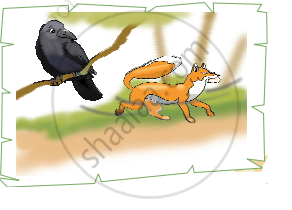
Sitting on a tree a crow was enjoying a piece of bread. A hungry fox wanted to have that bread. said very sweetly, “Dear brother, I've heard that ______ voice is very sweet. Please sing a song for me.” The foolish crow opened ______ beak and the piece of bread fell down. The fox picked it up in ______ mouth and ran away.
In the sentence below the capital letter, comma, full stop and question mark are missing. Put these in the correct place.
what is the colour of the sky
Here is a report on Uncle Lal’s farm.
Father took me to visit Uncle Lal’s dairy farm. I saw all of Uncle Lal's cows. He has fifty cows. They eat grass in the big green farms. In the evening the farmers bring them to the barn to be milked. Uncle Lal sells his milk in the city.
When writing a report, remember to do these things
|
In groups of four, write a report on different brands of ice creams available in your area.
You may use the following clues.
- Start with a short introduction that contains the topic.
- Then list the ice cream brands available in your area.
- Next, say which are the common flavors of ice cream in each of the brands.
- Under each brand, find out which flavors are being sold the most. Also, find out their prices.
- Finally, write which do you think is the most popular ice cream.
The boys played ______[quiet]
What made her feel confident about the competitive players? Explain.
Debate is an essential skill and your classroom is the best place to practice this skill. Your teacher will now divide the class into two groups and organize a debate on the topic “Fast food tastes better than nutritious food.” The following points may help you to participate and speak in a debate. One group will speak FOR the motion and the other group will speak AGAINST the motion. Now prepare a speech for the debate.
Why do patients leave the clinic without meeting the dentist?
Why was the photographer proud to receive Leacock on Saturday?
The photographer made the author wait for ______.
Respond to the following advertisements.
Classified Advertisement
| WANTED 100 part-time Graphic Artists Experienced in Photoshop and InDesignSalary negotiable. Apply to: MM Graphics, Triplicane, Chennai - 5 or Mail your Resume to [email protected] |
Block Advertisement
|
Female IELTS Teachers Required Postgraduates in English with a minimum of 3 years experience Must be bold and confident Good salary, transport and food allowance provided Apply to: ARV Institute of Languages 149B, Bose Road, Coimbatore Ph: 98400 xxxxx Email: [email protected] |
Do you think it is important not to be swayed by every passing mood?
Write a composition (300 - 350 words) on the following:
Study the picture given below. Write a short story or description or an account of what the picture suggests to you. Your composition may be about the subject of the picture or you may take suggestions from it.

You are a regular visitor to your school library. Describe your library. Give details of the familiar sights. What do you see and feel as different students come irt and check out the books? Why is this place so important?
Why does Portia ask Shylock if he had arranged for a surgeon to be present at Antonio's trial?
Write a paragraph on ‘Online Shopping’ using the points in the below table.
| Advantages | Disadvantages | ||
| 1. | Time-saving | 1. | Delay in delivery |
| 2. | Variety of products | 2. | Products are not always genuine. |
| 3. | Easy to Pay | 3. | Prone to scams |
| 4. | Easy to order | 4. | At times, it is challenging to return. |
| 5. | Good discounts | 5. | Cannot see or touch the product before purchase. |
Write in a few lines, about an experience of your own where you scored in your exams much more than you hoped for. What did that experience teach you?
These two passages are examples of a short introduction to works of art - a short review. They cover the following points:
- The name of the creator
- The theme or subject matter
- Type of art
- Individual style
- Presentation techniques
- Its effect on viewers
- Message or interpretation
Choose a book/film and review it in short using the points you have listed.
What do you like better - to listen to a joke, or to tell a joke?
Imagine someone has invited your family to a programme and you were the only person at home when the invitation was given orally.
Write a note (4-5 lines) to pass on the message to the other people in your family. Or, Write an imaginary conversation in which you pass on the message to your parents.
