Advertisements
Advertisements
प्रश्न
Write a summary of the poem using the following points:
- Title
- Introductory paragraph (about the poem, type, nature, tone)
- Main body (central idea, the gist of the poem)
- Conclusion (opinion, views, appeal)
Advertisements
उत्तर
The Sower
The poem centres on the act of sowing by the farmer, who tirelessly sows the seeds, despite having seen many bad harvests. Still an optimist, he hopes for a good harvest each time he sows the seeds. The poem is an ode to the sower, whose noble actions make him the receptor of the poet's admiration. It is a gripping narrative by the poet of his observations about the sower. The tone of the poem is optimistic and complimentary. As the poem progresses, the poet's description of the sower takes on a tone of reverence. The central idea of the poem is that with dedication, commitment, perseverance, and hard work, one can achieve anything that one sets one's mind too. The poet's observations about the sower tell us that the sower's undeterred faith in the likelihood of a good harvest in the future makes him work hard today. Though the sower is old and in tattered clothes, he is calm and patient, because he knows that even if he doesn't get to reap the benefits of his labour, others will certainly benefit from it. The sower braves the darkness and continues to sow the seeds by marching to and fro in the field, scattering the grain far and wide and ensuring that the grains cover the entire field. This is when the poet realises that the sower's actions are noble because he does not sow merely for himself. For the greatness of his actions, the sower appears to be a towering figure, whose nobility elevates his position in the poet's eyes such that his height seems to be touching the starry skies.
The poem is full of positive elements that aim to encourage the reader. The constant reiteration of the values like persistence and resolve give the poem a motivational tone and the extensive use of word imagery make the poem appealing to the readers.
APPEARS IN
संबंधित प्रश्न
What social and ecological benefits of planting a tree does the poet refer to?
What was the great victory? Who had won the victory?
Explain the use of the rhetorical device like the apostrophe by the poet.
How does the poem make use of contrast? Consider the contrast between the poet and the daffodils, and between his feeling before, while and after seeing the daffodils.
The eight other runners pulled up on their heels
The ones who had trained for so long to complete
one by one they all turned around and went back to help him
And brought the young boy to his feet.
Then all the nine runners joined hands and continued
The hundred-yard dash now reduced to a walk
And a banner above that said (Special Olympics)
Could not have been more on the mark.
That's how the race ended, with nine gold medals
They came to the finish line holding hands still
And a standing ovation and nine beaming faces
Said more than these words ever will.
Read the lines given above and answer the following question:
Explain in your own words the meaning of the line ‘the hundred-yard dash now reduced to a walk’.
What is the primary purpose of “Hearts and Hands” by O. Henry?
What makes Margot different from the other children? Why does this cause the other children dislike Margot?
I have never worn a more ill-fitting suit. (End: …………..ever worn.)
The anthology `ISC Collection of Short Stories' includes several stories in which a woman is a central character. Which female character has awakened your admiration, sympathy or interest and why?
Join the following sentence to make one complete sentence without using and, but or so.
They bought a new car. They can travel long distances.
Re-write the following sentence according to the instructions are given. Make other changes that may be necessary, but do not change the meaning of the sentence.
Father said to Sunil, “I can help you with your homework.”
(Begin: Father told Sunil……….)
A number of loose electric wires are hanging from a lamp post near the main gate of your school. Write a letter to the Municipal Commissioner explaining the problem, the danger it poses and suggests a quick solution.
Give reasons for the following.
Howard Carter’s investigation was resented.
Explain the statement, “King Tut is one of the first mummies to be scanned — in death, as in life...”
Discuss the following in groups of two pairs, each pair in a group taking opposite points of view.
Knowledge about the past is useful to complete our knowledge of the world we live in.
What do you notice about the beginning and the ending of the poem?
(i) What do you understand by the terms `outsider art’ and `art brut’ or `raw art’?
(ii) Who was the “untutored genius who created a paradise” and what is the nature of his contribution to art?
Notice the following sentence patterns.
I am the Poem of Earth, said the voice of the rain.
Rewrite the above sentences in prose.
Notice the following sentence patterns.
For song…duly with love returns
Rewrite the above sentences in prose.
Look for some more poems in the rain and see how this one is different from them.
Locate the following words in the text and study their connotation.
1. gripped the imagination of
2. dawned upon
3. ushered in
4. passed into current coin
5. passport of the future
Interview the students of your class regarding the career they would like to pursue and the reason for selecting that particular career. Collect the data from your class and analyze the information you have collected.
Use the phrase in a sentence of your own, after finding out its meaning.
streaked over
Match the words and phrases with their meanings in the box below.
|
|
|
paragraph numbers |
|
1. |
homesick |
(3) |
|
2. |
practically |
(4) |
|
3. |
it pains me |
(7) |
|
4. |
appreciate |
(9) |
|
5. |
thoughtless |
(10) |
|
6. |
exercise |
(11) |
|
7. |
relief |
(13) |
|
8. |
ghastly |
(14) |
|
Almost |
it hurts me |
terrible |
|
test the strength of |
understanding the difficulties |
|
|
wanting to be home |
a welcome change |
not very caring |
A poem for you to read
All but Blind*
All but blind
In his chambered hole
Gropes for worms
The four-clawed Mole.
All but blind
In the evening sky
The hooded Bat
Twirls softly by.
All but blind
In the burning day
The Barn Owl blunders
On her way.
And blind as are
These three to me,
So, blind to Someone
I must be.
Your teacher will speak the words listed below. Write against each a word of opposite meaning.
Examples:
liquid-solid
hard-soft
1. old —————
2. wet —————
3. open —————
4. blunt —————
5. forget —————
State whether the following statement is true or false. Correct the false statement.
Liberty cannot be divorced from equality.
Different arms and ammunitions are mentioned in the excerpt. Find their names.
Make a paraphrase of the poem ‘Leisure’ in your own simple words. Write it down in your notebook.
Form groups and try to write a script for a short film or documentary on any topic of your choice. The script must develop properly. You can take the help of the following points.
- choose a topic
- central theme
- the beginning, the middle, and the end
- the message
Discuss the following and write about the following in your own words in 5-6 lines.
Which events in the story (Part I and Part II) changed Mathilde’s life?
Think and write in your own words.
How can the tender maiden Autumn become a full-grown woman? What change in nature does this imply?
Write a letter to your friend or cousin telling him/her about a difficult choice you have recently made, for example, pursuing one sport or hobby rather than the other or choosing between your studies and hobbies.
Tell your friend/cousin how his/her example helped you to make a decision.
Imagine Taffy comes to you for help to write a letter of apology, in the modern script we use. She wants to express her regret to the stranger-man for her mother’s action. Write that letter of apology (informal) on her behalf.
Imagine you are the lion and someone is interviewing you.
Write the answer to the following question.
Who were your companions on the way to Oz?
Write an email to your teacher about the interesting English model that you have prepared for the literary fest.
Create a poster for the following.
You are Sita/ Sudhan. Design a poster in not more than 50 words to focus on not wasting water. Be creative.
Read the jumbled lines from the poem and rearrange them in correct order.
| 1. cinnamon, betel leaves |
| 2. and ginger and garlic” |
| 3. Go to Muthu’s |
| 4. My mother would say: |
| 5. and get some |
| 6. “Little boy Raj… |
| 7. And so I go to the shops |
| 8. singing all the way |
| 9. tomatoes and pickles” |
| 10. “Sesame seeds, onions |
| 11. I rattle off a list: |
| 12. what I’d want |
| 13. and when Muthu asks me |
| 14. my mother twists my ear |
| 15. and back home |
| 16. ouch! |
Write some sentences about the picture.

It, is, has, walks, elephant, legs, tusk, trunk, big, long, slowly, strong.
Write the dialogue and complete the story.

Here are some answers about the given picture.
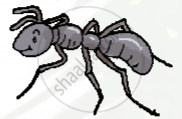
- The colour of the ant is black.
- It lives on land.
- It has two long antennae.
- It crawls on the ground.
- It eats sugar.
Now frame questions for the above answers.
Fill in the blank by choosing the preposition from the option.
The frogs jumped ______ the well.
The child got an ______ for winning the race.
Some words have similar sound, but different meaning. Choose the correct word from the option and fill in the blank.
The squirrel has a long ______.
Some words have similar sound, but different meaning. Choose the correct word from the options and fill in the blank.
I have to leave at ______.
Look at this sentence –
A library is a place where books are kept.
Now fill in the blanks after reading these sentences.
- An ______ is a place where aeroplanes take off and land.
- A ______ is a place where food is cooked.
- A ______ is a place where sick people are taken care of.
- A______is a place where you can buy thing.
- A______ is a place where children study.
In a short paragraph write how you can be a good friend.
How is school education in the village different from that in the city?
One has to be cautious and not be carried away by stories. How did Sletherby exhibit caution?
Complete the summary of the play, choosing the appropriate words from the list given below the passage.
A number of patients wait at the (1) ______of a dentist’s clinic. Everybody is tensed at the thought of a painful (2) ______being extracted. One of the women is bent on showing everyone her (3) ______. After the arrival of the dentist, Joe, the first (4) ______is called in. Sometime later, the nurse comes out and goes in with a (5) ______. Everyone is (6) ______at this, imagining Joe being subjected to a lot of hammering in the process of his tooth being pulled out. Once again the nurse comes out to fetch a large pair of (7) ______and later on she takes in a (8) ______. A little boy confesses that he pretended to have (9) ______, because he did not wish to go to school. The loud (10) ______and screeching from within the room makes everyone leave the (11) ______, one by one. Finally there are only two women in the waiting room, one of them being Joe’s wife. She weeps (12) ______about her husband. But Joe comes out and explains that he had shifted his (13) ______to the evening and had been given some pills for the pain. After they leave, the dentist comes out and locates the key of his tool (14) ______. He had been trying to open it using the hammer, the pliers and the hacksaw only in vain. The woman with the photographs is surprised to see that the (15) ______had moved quickly and she was the next patient to go in.
| hammer | patient |
| hacksaw | cabinet |
| frightened | queue |
| worried | waiting room |
| pliers | tooth |
| photographs | clinic |
| toothache | sawing |
| appointment |
Write conversation on the following situation.
Between two friends about the importance of reading newspapers
Why did the photographer feel happy after taking the photograph?
Read the following passage and write a summary of it. Suggest a suitable title to the summary.
|
According to some experts, a staggering 93 percent of our daily communication is non-verbal. Facial expressions are easy to decipher. One can readily detect happiness, sadness, anger. Physicians can tell a patient is doing well (or not) by looking at his/her face. Eye contact is another type of non-verbal communication, which can tell a lot about the other person. The eyes convey a range of emotions-happiness, sadness, boredom, surprise, confidence ..... even emotional interest. Staring at someone's forehead may intimidate the recipient, staring at the mouth is sometimes interpretated as a sign of emotional interest. In fact staring into someone's eyes is a sign of lying, and so is looking away. In certain cultures, lack of eye contact is taken as a sign of respect. If body language is to be defined, it is a combination of facial expression, gestures, eye contact, body movements and posture and voice. Frequent blinking is a sign of the person feeling distressed or uncomfortable. If the pupils are dilated, it often indicates interest, even emotional interest. The lips also reflect our body language, and lip biting indicates worry and/or anxiety; tightening of the lips may be an indication of disapproval. Slightly turned-up lips indicate happiness and slightly turned-down lips indicate sadness. |
______ was Portia’s; faithful servant.
Think of different types of people who have to face great difficulties. Write what you can do to help at least one of them.
These two passages are examples of a short introduction to works of art - a short review. They cover the following points:
- The name of the creator
- The theme or subject matter
- Type of art
- Individual style
- Presentation techniques
- Its effect on viewers
- Message or interpretation
Choose a book/film and review it in short using the points you have listed.
Prepare an attractive tourist leaflet for your native place, in English as well as in your mother tongue.
Who is your favourite comedian?
Write a review of a film that you watched recently, using the points given below. The reveiw is to be published in your school newsletter and should not exceed 300 words.
Name of the film and director - lead actors and their performances - plot - setting - description of a scene that you particularly liked - rating and recommendation.
