Advertisements
Advertisements
प्रश्न
One has to be cautious and not be carried away by stories. How did Sletherby exhibit caution?
Advertisements
उत्तर
Sotheby is a very cautious person. From the beginning, he had decided not to be carried away by the ‘stories’ of the young man. He laid the trap for the young man by feigning absolute ignorance about his mom’s looks. He asked him if his mom resembled him. Bertie replied that his mom had dark brown hair like himself. Besides, in his mental eye, Sletherby compared the crest he found in the invitation received from Mrs. Saltpen-Jago “a greyhound” with the young man’s description of the royal crest “demi-lion holding a cross-crosslet in its paw”. The two details contradicted Mr. Sletherby’s knowledge of Mrs. Saltpen-Jago’s royal family. There is something basically inhuman not to be interested in the affairs of a fellow human being “in distress”.
“The truth is a beautiful and terrible thing and hence should be treated with caution.”
APPEARS IN
संबंधित प्रश्न
Fill in the blank with the suitable word.
She turned _____________ the offer to work at the factory.
What killed the six men?
What kinds of stories captivated the young minds in the past?
Who are ‘they’ referred to in the third line of the last stanza? When had the poet come across them?
How does Seattle justify his religion as opposed to what the white men had said about it?
Discuss how the author uses comic irony to describe the incident surrounding the statue?
Describe the picture of India given by the author.
Write a composition (350 - 400 words) on the following:
Write an original short story entitled 'The, Gift'.
The chairman says that he will look________their complaints.
He takes________ his grandfather
Distinguish between the following pairs of sentences.
The team played two matches successively.
Examine the subtle humour in the narration of the story that lightens the gravity of the subject matter.
Find out the information about the qualification and eligibility required in the profession related to wild life such as:
Forest officer / Ranger
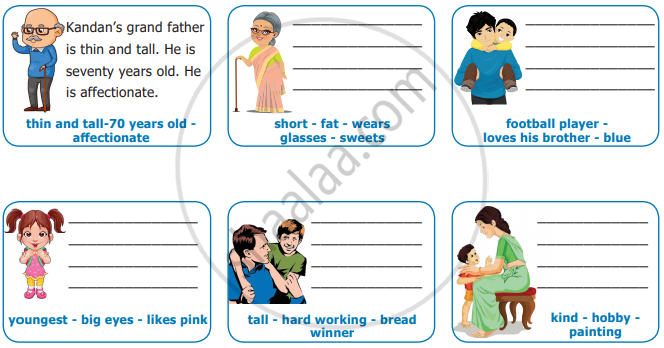
Given in a mixed order below are some good human attributes of the family. Pick out from the box and write it against the line that reflects it.
He believed, his daughter was still alive, after three years.
Write what you think about the following thoughts and actions of Mathilde :
Mathilde told her friend about the lost necklace.
Write a short passage/essay on ‘Women Power’ in the Neolithic, Medieval, and Present Times.
‘..... and that’s how I realized that courage and hope can help me overcome any major mishap/problem in life.’ Write an episode/experience from your own life that leads to the above conclusion.
Prepare and present a short speech on the following.
An inspiring incident in the life of a great leader.
How can you prove this maxim to be incorrect - ‘Too many cooks spoil the broth’. Write a counterview on the given topic. (Clue -Teamwork)
You are a volunteer in your locality to serve people who are affected by floods. How will you caution them to move to a safer place taking only their bare necessities? Describe.
Here are some answers about the given picture.

- The colour of the ant is black.
- It lives on land.
- It has two long antennae.
- It crawls on the ground.
- It eats sugar.
Now frame questions for the above answers.
Use the option to fill in the blank.
Her frock______too long.
Why is there a double negative in the title: The Never – Never Nest? Elucidate with reasons from the play.
Write a composition (300 - 350 words) on the following:
Describe an area in your city or hometown which is famous for its street food. Give details of the familiar sights and sounds you would experience on this street.
Write a composition (300 - 350 words) on the following:
It is very important for young people to spend time quietly or alone for a short while every day. If you were given an hour to spend on your own, how will you spend it? What will you learn from the process?
Why does Portia ask Shylock if he had arranged for a surgeon to be present at Antonio's trial?
You must have seen and liked a play (in any language) on the stage. Write down the following details about it.
- Name of the play
- Important Characters
- Its main theme
- Whether it was a Comedy/Tragedy /Social Theme or any other
- Why you liked it
- The message of the play
- Any other information about the play
Write points and counter points on the following topic:
You must memorise the rules of grammar
Send a formal letter of invitation · in 50 words to Dr. Mehra, noted novelist and educationist, to speak on, The Importance of Books'. You are Lena/Sanjay, Secretary Literary Club, S. S. Public School. Meritionday, date, time and venue.
Read the passage given below and answer the questions (i), (ii) and (iii) that follow.
| (1) | “Can I see the Manager?” I said, and added solemnly, “Alone.” I don't know why I said “Alone.” “Certainly,” said the accountant and fetched him. | |
| (2) | The Manager was a grave, calm man. I held my fifty-six dollars clutched in a crumpled ball in my pocket. “Are you the Manager?” I asked. God knows I did not doubt it. “Yes,” he said. “Can I see you …. alone?” I asked. |
5 |
| (3) | The Manager looked at me in some alarm. He felt that I had an awful secret to reveal. “Come in here,” he said, and led the way to a private room. He turned the key in the lock. “We are safe from interruption here,” he said; “Sit down.” We both sat down and looked at each other. I found no voice to speak. “You are one of Pinkerton’s men, I presume,” he said. |
10 |
| (4) |
He had gathered from my mysterious manner that I was a detective. I knew what he was thinking, and it made me worse. |
15
20
|
| (5) | The Manager got up and opened the door. He called to the accountant. “Mr. Montgomery,” he said unkindly loud, “this gentleman is opening an account, he will deposit fifty-six dollars. Good morning.” I rose. A big iron door stood open at the side of the room. “Good morning,” I said, and stepped into the safe. “Come out,” said the Manager coldly and showed me the other way. |
30 |
| (6) | I went up to the accountant’s wicket and poked the ball of money at him with a quick convulsive movement as if I were doing a conjuring trick. My face was ghastly pale. “Here,” I said, “deposit it.” The tone of the words seemed to mean, “Let us do this painful thing while the fit is on us.” He took the money and gave it to another clerk. |
35 |
| (7) | He made me write the sum on a slip and sign my name in a book. I no longer knew what I was doing. The bank swam before my eyes. “Is it deposited?” I asked in a hollow, vibrating voice. “It is,” said the accountant. “Then I want to draw a cheque.” My idea was to draw out six dollars of it for present use. Someone gave me a chequebook through a wicket and someone else began telling me how to write it out. The people in the bank had the impression that I was an invalid millionaire. I wrote something on the cheque and thrust it in at the clerk. He looked at it. |
40
45 |
| (8) | “What! Are you drawing it all out again?” he asked in surprise. Then I realised that I had written fifty-six instead of six. I was too far gone to reason now. I had a feeling that it was impossible to explain the thing. I had burned my boats. All the clerks had stopped writing to look at me. Reckless with misery, I made a plunge. “Yes, the whole thing.” “You withdraw all your money from the bank?” “Every cent of it.” “Are you not going to deposit anymore?” said the clerk, astonished. “Never.” |
50
55 |
| (9) | An idiot hope struck me that they might think something had insulted me while I was writing the cheque and that I had changed my mind. I made a wretched attempt to look like a man with a fearfully quick temper. | |
| (10) | The clerk prepared to pay the money. “How will you have it?” he said. This question came as a bolt from the blue. “What?” “How will you have it?” “Oh!”— I caught his meaning and answered without even trying to think— “in fifties.” He gave me a fifty-dollar bill. “And the six?” he asked dryly. “In sixes,” I said. He gave it to me and I rushed out. As the big door swung behind me. I caught the echo of a roar of laughter that went up to the ceiling of the bank. Since then, I bank no more. I keep my money in cash in my trousers pocket and my savings in silver dollars in a sock. |
60
65
70 |
| Adapted from: My Financial Career By Stephen Leacock |
||
-
- Find a single word from the passage that will exactly replace the underlined word or words in the following sentences. [3]
- The kind stranger went and got back the ball from where it had rolled into the bush.
- I took offence at the expression on his face that was clearly meant to insinuate I was a liar.
- The firm experienced a financial loss when the contract went to a contender who had just entered the business.
- For each of the words given below, choose the correct sentence that uses the same word unchanged in spelling, but with a different meaning from that which it carries in the passage. [3]
- alarm (line 8)
- The silence from the other end set off alarm bells in her head.
- The pallor of his skin alarmed those standing around.
- I set my alarm for six o’clock but slept through it.
- The sound of the approaching jets caused some alarm in the war room.
- wicket (line 44)
- The wicketkeeper was the true saviour of the day for that one match.
- The team wanted to bat while the wicket was still dry.
- The man at the window handed us our tickets through the wicket.
- The quick loss of wickets demoralised the team.
- reason (line 48)
- After the tragedy, his ability to reason is severely diminished.
- They reasoned they could get better seats if they arrived early.
- Recipients of funds were selected without rhyme or reason.
- We have every reason to celebrate.
- alarm (line 8)
- Find a single word from the passage that will exactly replace the underlined word or words in the following sentences. [3]
- Answer the following questions as briefly as possible in your own words.
- With reference to the passage, explain the meaning of the expression of the ‘I had burned my boats?’ [2]
- Cite any two instances of the behaviour of the bank employees that indicate the insignificance of a deposit of fifty-six dollars. [2]
- Why do you think the people in the bank thought of the narrator as an “invalid millionaire?” [2]
- Summarise why the narrator decided ‘to bank no more’ (paragraphs 6 to 10). You are required to write the summary in the form of a connected passage in about 100 words. Failure to keep within the word limit will be penalised. [8]