Advertisements
Advertisements
प्रश्न
Write a composition (in approximately 400-450 words) on the following subject:
Cooking should be made a compulsory subject in the higher classes. Argue either FOR or AGAINST the given statement.
Advertisements
उत्तर
For the Motion:
Cooking is a need as well as an art. You might like the cooking or gripe and cook. In both respects it fulfils a need. But early scientific awareness of cooking can have a big impact on one's attitude to this vital ability. The best forum for such learning is found in schools. Age-old is the case against making cookery a required course of study in the curriculum of the schools. Critics point out the difficulty of scheduling time from courses judged more important for professional development, the seeming simplicity of cooking that purportedly does not call for formal education, and the necessity of hiring more faculty members. Howevet', I strongly feel that, among other disciplines, the science and art of cuisine are as vital and rich of opportunities.
Cooking is a branch of science. All things can be learnt categorically from school lessons: what ingredients to use in the proper method, what procedures preserve the maximum nutrients, the correct amount of heat to the right food stuff, and which type of food is better eaten- raw or unprocessed? For the newbie, learning under a professional who has perfected the science of culinary art will be invaluable. Add to this the enjoyment group learning offers.
Cooking also provides aesthetic pleasure. Table setup, knife arrangement, and deft garnishing can improve the meal experience and inspire more conscious and pleasurable eating practices. These elements of cooking, stressing the gastronomic and artistic experience, ought to be taught in schools naturally. Moreover, cooking presents work possibilities. Unlike conventional disciplines like physics, chemistry, or mathematics, which are seen as better, home science has become a popular and esteemed field allowing several job paths. Highly sought-after cooks abound in the gastronomic scene whose knowledge not only commands great pay but also improves their social position. This emphasises the need of taste in the enjoyment of life.
One should realise that not all cooking techniques are acquired at home. Many, especially in societies where cooking is not expected of boys, may never walk into the kitchen without official education. Thus, a mandatory cooking curriculum in schools is rather beneficial since it offers fundamental information and skills that everyone may use.
Ultimately, requiring cooking as a mandatory course for higher classes would help to not only improve the quality of life for pupils by imparting necessary life skills but also create new job routes and promote a more inclusive and skillful society. I lay my case and salute the motion.
Against the Motion:
Making any topic required sometimes reduces the enjoyment of learning. Cooking is not something to approach like rocket science. It is a precise mathematical activity without requiring complex methods or significant computation to be accurate. It calls for imagination, feelings, and some common sense. And what better approach than to learn from our seniors in the comfort of our homes instead of following the grind of a boring and mandated activity in a school? Offering it as an optional topic is better suitable for individuals really interested in the finer points of cooking. In upper courses, science and humanities are options; so, insisting on mandatory cookery education seems to be an unduly burden for students. Let pupils pursue cooking as a hobby and you will greatly improve their educational process. A better approach of learning than following theory is tasting, adding, tempering, and garnishing in line with one's taste.
Regarding the career opportunities in cookery, students have the choice to follow hotel management and related studies even after they graduate from their university. There is little significance of a school-level cooking course for admittance in these sectors. Many acclaimed chefs worldwide never taught cooking as a required course of instruction in their schools. Their entrance into the gastronomic scene was either accidental or deliberate, without negative effects for their careers or capacity for creativity. Natural reaction to imposition is resistance. Cooking is intrinsically distinct, even if mandatory education in math, languages, physics, and humanities justifies their broad educational value, which may be difficult for some to appreciate independently. Driven by creativity and mood, it involves our senses-taste, smell, touch-in the making of a food.
Cooking is an art to be appreciated, not a set formula to be adopted everywhere. For those who are passionate about it, it should remain an optional topic rather than a forced one. Let's keep cooking optional in the curriculum so that we may preserve the delight and personal connection it offers.
APPEARS IN
संबंधित प्रश्न
Write an application in response to the following advertisement using information given in the CV provided :
| SITUATION VACANT |
| Wanted Smart, English speaking salesman for an electronic showroom. Good salary offered. An experienced candidate will be preferred. Write giving details to : The Proprietor, Ganesh Electronics, M.G. Road, Solapur. |
| C. V. (Resume) | |
| (1) Name: | Suhas Randive |
| (2) Age: | 29 years |
| (3) Address: | 105, Roshan Apartment, L.T. Road, Pune - 11 |
| (4) Educational: | B. A. (First class), Pune University qualification |
| (5) Experience: | 3 years' experience of working as a salesman in a textile shop. |
| (6) Interests: | Travelling, photography, reading. |
Join the following sentences to make one complete sentence without using and but or so :
(i) He was very ill. He did not take any medicine.
(ii) You come back from your holiday. We will discuss the problem.
(iii) He remained absent on Friday. It was foolish of him.
(iv) Rahul ran all the way to the bus stop. He missed the bus.
Fill in the blank with the suitable word.
She turned _____________ the offer to work at the factory.
Pick out words and phrases which are examples of visual and auditory imagery in the poem.
What is the activity referred to later in the poem, that sharpens their brains?
What is the climax of Ray Bradbury’s “All Summer in a Day?”
Write a composition (350 - 400 words) on the following:
Write an original short story entitled 'The, Gift'.
(A) I am afraid you cannot get admission to the college without clearing the admission test.
(B) I am afraid you cannot be……………….
Locate instances of irony in the story.
Multiple Choice Question:
Explain The afternoon turned black.
We add ‘un-’ to make opposites. For example, true — untrue. Add ‘un’– to the word below to make its opposite. Then look up the meaning of the word you have formed in the dictionary.
successful: ____________
The word ‘round’ usually means a kind of shape. What is its meaning in the story?
The words in the box are all words that describe movement. Use them to fill in the blank in the sentence below.
When he began to trust me, the squirrel began ____________ into my pockets for morsels of cake.
The words in the box are all words that describe movement. Use them to fill in the blanks in the sentence below.
The snake _______________ his head ______________ to strike at the crow.
Narrate in 100 words an incident, that illustrates the way a friend of yours ‘made you feel happy and accepted’, at some point in your life.
Interpret the following lines in simple English.
Puck: I’ll follow you.
Bottom: The Finch, the sparrow.
Answer the following question :
How does fear lead us to error?
Write in your own words:-
What are the latest modern methods of depositing money in your own or somebody else’s account?
Draft Letter for the following.
You are Ajeet, living in a remote village in Tirunelveli. You participated in a health camp organized by your school. You were surprised to observe that most of the residents were unaware of health and hygiene. As a concerned citizen, write a letter to the editor stating the need to organize such camps focusing on the importance of health and hygiene.
Write a paragraph from the contents of the table given below. Frame sentences with these words – but, as well as, whereas.
eg. A turtle as well as a tortoise belongs to the reptile family.
| Tortoise | Turtle |
| reptile family | reptile family |
| land animal | sea animal |
| has a long life | lives for many years |
| uses tiny feet to walk | uses flippers to swim |
| eats grass, weeds and flowers | eats insects and bugs |
Fill in the form given below.

Have a conversation with your partner based on the picture below. You can start as -
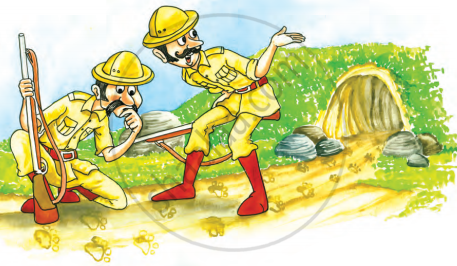
| Hunter 1 | “Look at the footprints in the mud!” |
| Hunter 2 | |
| Hunter 1 | |
| Hunter 2 |
Use the words ‘and’ or ‘but’ and make as many sentences as you can about Rajiv’s family.
Example:
Grandpa and Grandma get up early in the morning
Grandpa is walking but Rajiv is jogging.
In the sentence below the capital letter, comma, full stop and question mark are missing. Put these in the correct place.
on monday i will go to school
Here is a report on Uncle Lal’s farm.
Father took me to visit Uncle Lal’s dairy farm. I saw all of Uncle Lal's cows. He has fifty cows. They eat grass in the big green farms. In the evening the farmers bring them to the barn to be milked. Uncle Lal sells his milk in the city.
When writing a report, remember to do these things
|
In groups of four, write a report on different brands of ice creams available in your area.
You may use the following clues.
- Start with a short introduction that contains the topic.
- Then list the ice cream brands available in your area.
- Next, say which are the common flavors of ice cream in each of the brands.
- Under each brand, find out which flavors are being sold the most. Also, find out their prices.
- Finally, write which do you think is the most popular ice cream.
Why are photographs taken?
| e.g. to freeze our favourite moments | |
Now write a short story to explain these proverb.
Despair gives courage to a Coward
The given bar graph shows the preferences of children in a school in playing different games over the span of six years. Write an analytical paragraph about the given information in about 109 words:

What was the very first thing that the children noticed when it stopped raining on Venus in Ray Bradbury's story. 'All Summer in a Day'?
One cannot always get what one wants and sometimes it is for the best. Present your reflections on this statement.
