Advertisements
Advertisements
प्रश्न
Write conversation on the following situation.
Between two friends about the importance of reading newspapers
Advertisements
उत्तर
| A | Do we need newspapers? We have different sources of news. Even an android phone gives one access to different kinds of news. |
| B | Well, the question is how important is the reading of newspapers? |
| A | My contention was that one can read the e.version. |
| B | Read any version, brother. Newspapers must be read. |
| A | Why do you advise it so strongly? |
| B | I advocate reading of newspaper strongly because most of the students focus only on their Board exams or class tests. If they cultivate the habit of reading newspapers, their knowledge of the world will expand. In the future, they will be in a comfortable position to prepare for any competitive examination including the IAS examination. |
| A | We will tell all our friends about this. |
| B | That’s nice. |
APPEARS IN
संबंधित प्रश्न
You had gone on a trekking expendition with a group of friends. As night closed in, you realised that you were separated from the group. Describe your initial feelings and the place where you got lost. How did you spend the night alone before you were reunited with your group?
In the following items, sentence A is complete, while sentence B is not. Complete sentence B, making it as similar as possible to sentence A. Write sentence B.
(A) He loved his little daughter, but he was in mortal fear of her fierce temper.
(B) Although ..............................................................................
Fill in the blank with the suitable word.
To every one’s surprise, he turned _____________ at the party.
What are the fears of the caged bird? Answer with examples from Maya Angelou’s poem.
Fill in the blank with an appropriate word:
The soldier fought bravely__________ his country.
The ailing company was taken________by the government.
How does G. K. Chesterton in his essay On Running after one's Hat, romanticize difficult situations by dwelling on the notion that "An inconvenience is only an adventure wrongly considered'"?
Notice the following sentence patterns.
I am the Poem of Earth, said the voice of the rain.
Rewrite the above sentences in prose.
Make a list of words which are spelled differently in American and British English.
We add ‘un-’ to make opposites. For example, true — untrue. Add ‘un’– to the word below to make its opposite. Then look up the meaning of the word you have formed in the dictionary.
important: ____________
The words in the box are all words that describe movement. Use them to fill in the blank in the sentence below.
I saw a cobra ___________ out of a clump of cactus.
Notice the use of ‘there’ in the following sentences.
-
There was a big crowd at the fair.
-
There were many things I’d have liked to buy.
Now rewrite the following sentences using ‘there’ in the beginning. Look at the following examples.
-
I can do nothing to help you.
-
There is nothing I can do to help you.
-
A man at the door is asking to see you.
-
There is a man at the door asking to see you.
1. This park has beautiful roses.
2. Your story has no fun in it.
3. We have no secrets between us.
4. My village has two primary schools.
5. This problem can be solved in two ways.
The feeling of a person when he commits a mistake are __________________.
- He tries to justify it.
- __________________
- __________________
- __________________
- _________________
You have just returned after your first experience of the kite - festival in Gujarat / Ahmedabad. You were thrilled with the festivities.
You have a friend who lives abroad. Write a letter to your friend describing how you enjoyed the kite-festival.
While building a bridge, a group of people comes together. They are architects, designers, engineers, officers, masons, politicians, building material suppliers, carpenters, etc. Write about the qualifications of these people. Choose any career from the list above and complete the table.
| Your choice of career/ careers | Skill/Qualifications |
Comment on the following characters depicted in the poem, in a sentence or a phrase.
| On the Nose | On the Eyes |
There are ample career opportunities in film making and producing films.
The following professions which require different professional skills, and write them accordingly.
| Professions | Professional skills |
| 1. Actor-Male or Female | Acting, voice modulation, Body language, facial expressions, etc. |
| 2. Director | |
| 3. Producer | |
| 4. Music-director | |
| 5. Script-writer | |
| 6. Lyrist | |
| 7. Cameramen | |
| 8. Cinematographer | |
| 9. Set-designer | |
| 10. Costume-designer |
Narrate the story of Sushruta in your own words.
Imagine someone has invited your family to a programme and you were the only person at home when the invitation was given orally.
Write a note (4-5 lines) to pass on the message to the other people in your family. Or, Write an imaginary conversation in which you pass on the message to your parents.
Hold a debate on - 'Pets or Pests?'
Write in your own words:-
Why does the bank need so many details of its customer?
Write the reason in your own words.
Akbar had to dress like a slave.
Write a complaint to the officer of the PWD department to take immediate actions of maintaining cleanliness in the Children’s Park in your locality.
Write a short paragraph on 'summer' using the hints given.
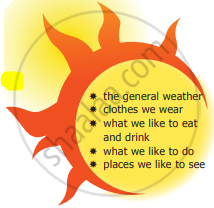
you can begin like this
I live in Chennai. The weather is...
Make the children write their own story. The following questions will help them to write. Ask them to gather information from their parents before writing and to give a title.
- When were you born?
- Where were you born?
- What is your father’s name and what is he?
- What is your mother’s name and what is she?
- What is your birth order?
- Do you have any nickname, if yes, reason for that?
- An interesting incident that happened in your life.
Write about yourself using the following expressions (do you play in the park, go to bed late, fuss over food, study hard, etc.?)
| always | frequently | usually |
| often | sometimes | rarely |
For example - I always do my work neatly.
- ____________
- ____________
- ____________
- ____________
- ____________
Answer the question by looking at the picture.
Example: What is happening in picture 5?

Now describe two of the following processes.
(i) How to send a letter/e-mail.
(ii) How to make a salad.
(iii) How to prepare a garden bed to grow flowers.
(iv) How to paint a mural or a wall picture.
The grandmother was strong-minded. Justify
Prepare a dialogue from the jumbled sentences:
- It will reach Nagpur at 7: 15 a.m.
- What is the departure time of the Vidarbha Express?
- When will it reach Nagpur?
- The departure time is 8:30 p.m.
